
Jerome Powell’s days as Federal Reserve boss were akin to a roller coaster ride for Southern California’s housing market.
Read more Taylor Swift concert plot suspect apologizes in Austrian court ahead of verdict
You can’t pin all of housing’s gyrations on the now-departed Fed chairman. Yet his eight years as the head of the nation’s central bank were a tale of two worlds for real estate, which basically doubled a typical Southern California homebuyer’s mortgage payment.
Powell’s reign began with low mortgage rates that helped boost home prices and sales. Then the pandemic changed everything.
Initially, there were historically cheaper loans needed to backstop a coronavirus-twisted economy. Next came a high-rate era used to cool an overheated business climate. Pricey financing stunted home sales and appreciation.
Let my trusty spreadsheet walk you through how local real estate was whipsawed over Powell’s eight years — splitting his chairmanship into the first four years against the last four.
2018-22 vs. 2022-26
First, note the mortgage rate gyrations under Powell, as measured by Freddie Mac’s 30-year loan benchmark.
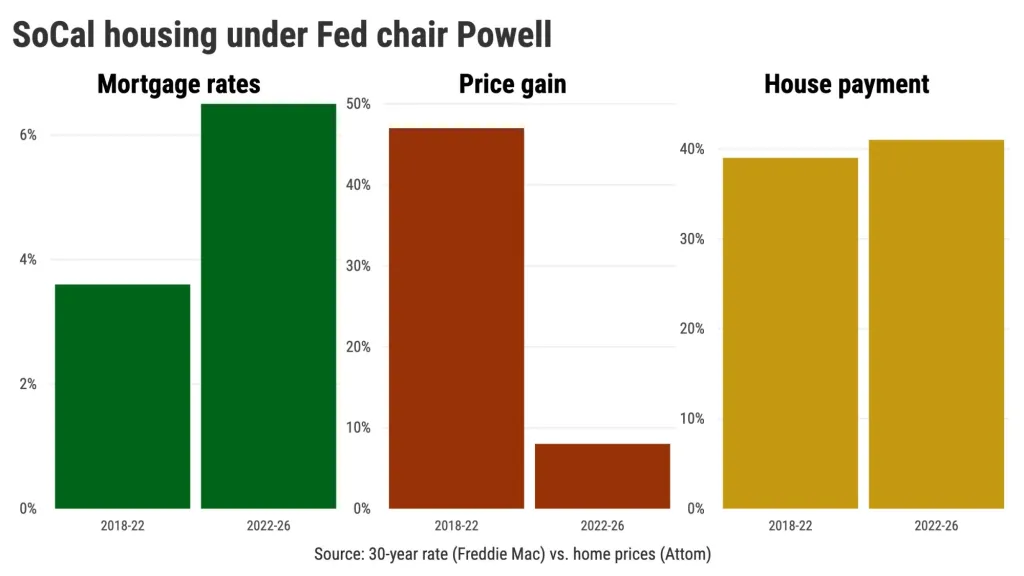
Nearly 5 percentage points separated the month with the lowest rate (2.7% in December 2020) from the month with the highest rate (7.6% in October 2023). Ponder that this mortgage yardstick averaged 3.6% during his first four years compared with 6.5% in his final four years.
Consider how those rate swings aligned with Southern California homebuying patterns, according to the real estate tracker Attom.
Southern Californians bought 694,571 residences during the past four high-rate years. That was a sharp 28% drop from the buying pace of the previous four low-rate years.
At the same time, price gains dramatically cooled.
Now, the mortgage rate reversal didn’t create the pricing discounts house hunters wanted. That may be because the number of homes for sale, according to Realtor.com data, was 10% lower over the past four years than in 2018-22.
Those pricier mortgage rates, at least, cut the rapid appreciation seen during the pandemic era’s cheap-money days.
Think about the $810,000 median selling price in March 2026 for Southern California. It represented a slim 8% gain during the past four high-rate years.
That’s quite a chill compared with the 47% gain in the previous four low-rate years.
Bottom line
Next, ponder how surging rates clobbered affordability as home prices failed to tumble, and sales collapsed.
Read more Key inflation gauge worsens as Americans shell out more for gasoline
Think about the estimated $3,931 monthly house payment for March 2026 that came with buying the median-priced home — with a 20% down payment at current rates.
To a Southern California house hunter, perhaps Powell’s legacy is this: A buyer’s house payment jumped 96% over his eight years.
Meanwhile, Southern California’s average weekly wages, according to one federal index, rose just 39% in that same period.
Elsewhere
This latest housing tumult isn’t just some Southern California weirdness.
Statewide, sales fell 27% over the last four years vs. 2018-22. Meanwhile, home-price appreciation slowed to only 5% over the last four years from 47% in 2018-22. Why? House payments rose 91% over eight years.
Nationally, sales fell 19% over the last four years vs. 2018-22, while price gains slowed to 15% from 48% in 2018-22, as payments rose 109%.
Counting counties
Here are the six local counties’ housing markets under Powell, ranked by their sales drop when comparing the last four years with 2018-22:
– San Diego: 32% sales dip with a 10% price gain last four years against 49% in 2018-22. The house payment rose 101% over eight years.
– Ventura: 32% sales dip, 9% price gain last four years vs. 41% in 2018-22, payment rose 89%.
– Riverside: 31% sales dip, 4% price gain last four years vs. 61% in 2018-22, payment rose 107%.
– San Bernardino: 31% sales dip, 6% price gain last four years vs. 58% in 2018-22, payment rose 106%.
– Orange: County’s 29% sales dip, price gain 21% last four years vs. 41% in 2018-22, payment rose 109%.
– Los Angeles: 23% sales dip, price gain 7% last four years vs. 43% in 2018-22, payment rose 87%.
Jonathan Lansner is the business columnist for the Southern California News Group. He can be reached at [email protected]
Read more US jobless claims rise to 215,000 but remain low despite Iran war uncertainty
- Try Jonathan Lansner’s Substack collection of economic trends. CLICK HERE!