
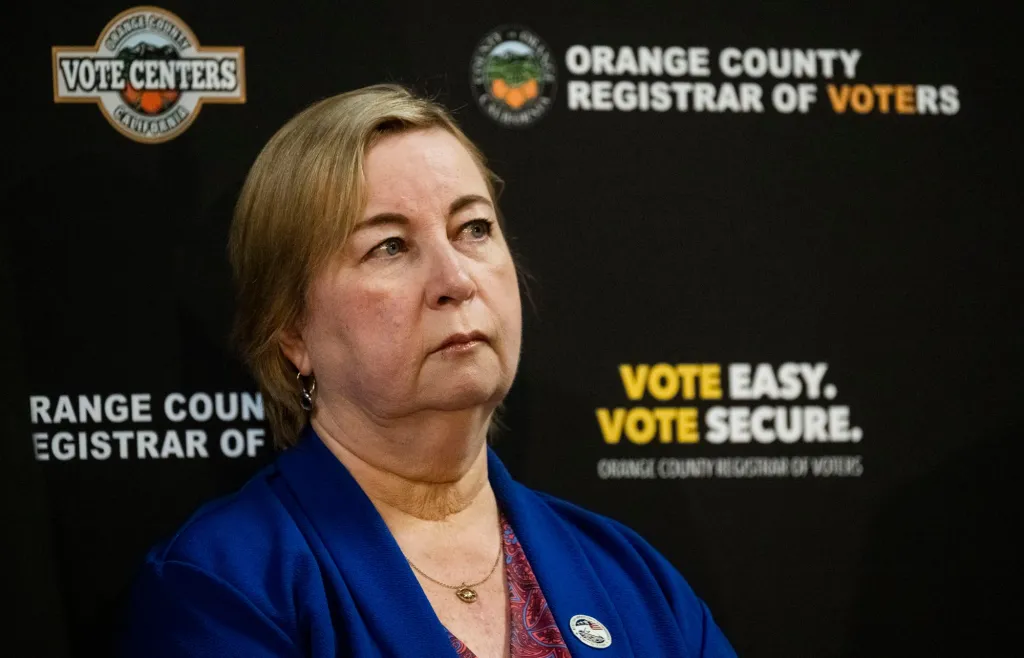
Looking back, Christy McCormick was destined to work in elections.
She grew up watching her parents become heavily involved in political campaigns — they were, she recalled, one of the first families to hold a fundraiser for former Secretary of State John Kerry when he ran for U.S. Senate in the 1980s. And, later, she began her career by heeding a call from the Town Clerk of East Haven, Connecticut, who was looking for people to help register local voters.
Read more Gaza mourns 10 killed in Eid strikes as Netanyahu vows wider control of the strip
Related: Life of a ballot: How Orange County’s votes are counted, verified and stored
Now, McCormick, serves as vice chair of the U.S. Elections Assistance Commission, a bipartisan federal agency that aids local officials in improving elections and ensures that voting equipment across the country is safe and secure.
That’s what brought McCormick to Orange County on a recent afternoon, for a tour of how the registrar’s office collects, processes and counts ballots. When the tour was over the Republican official had nothing but praise for the local election administration.
“This jurisdiction is consistently at the forefront for ideas, innovation and excellence, and constantly works to find ways to improve election procedures and processes,” McCormick said. “It serves as a model for election officers across the country.”
At the EAC, four commissioners — nominated by the president based on recommendations from congressional leadership — provide training to election workers around the country. They also compile a massive state-by-state analysis of every election that includes voter registration statistics, the number of polling places, how many ballots were rejected, the ways ballots were cast, and more.
The EAC also creates certification standards for election technology — think poll books (the electronic list of registered voters) and election night reporting systems — as well as testing and certifying voting equipment across the country.
McCormick joined the EAC in 2014, nominated by President Barack Obama and backed by Republican Sen. Mitch McConnell. At the time she had spent much of the previous decade working in the U.S. Department of Justice on voting issues in the department’s Civil Rights Division. McCormick was also selected to work at the U.S. Embassy in Baghdad, in 2009, where she oversaw Iraq’s national elections — and the extensive recount effort.
With all that in mind, we chatted with McCormick, now a Pasadena resident, about her job and about California elections. Her responses are lightly edited for brevity and clarity.
Q: There are often questions about how California conducts its elections — every registered voter is mailed a ballot, an ID isn’t necessarily required to cast a ballot, and the top two vote-getters advance in the primary, regardless of party affiliation, for example. The EAC does a lot, but does it have a hand in how California conducts its elections?
A: We don’t. Obviously, that’s in the Constitution, that the states and the localities run the elections, and so every state has its own rules and procedures.
I think it’s interesting that most people will trust their own way that elections are run, but not the way other states run their elections. There are a lot of questions in the country about California, and even within California by jurisdiction, there are questions about how L.A. does their elections, or how San Diego does theirs.
Q: What’s a common misconception you often hear about elections as you travel the country?
Read more In new memoir, Jill Biden wonders whether acknowledging Joe’s poor debate would have been better
A: People don’t understand the complexity of what it takes to run an election. You walk into a warehouse, and it’s overwhelming to see how much equipment you have to keep updated, how many people it takes, all the different ballot styles.
You’re voting in a different supervisor race than somebody else, or in some places in the country, you’re voting for the fire department, a utility district, schools, judges. There are so many different ballot styles that all have to be tracked. And just the whole process of securing all that. You get a county the size of L.A. or Orange County, you’re talking millions and millions of pieces of paper and then auditing those pieces of paper to make sure that your results are correct, and there’s no room for error. You have to get it right.
Q: What else is important for people to know about elections?
A: I wish they understood how much funding it takes. It takes a lot of money to run an election, and we do not have a good, single source of funding for elections in the country.
Q: In your opinion, are voting machines secure?
We have never had an incident to show that the machines have actually been a cause of any fraud.
They are very secure, and we run a secure system. That doesn’t mean there aren’t opportunities for people — and people won’t try to find places that they can do things — and anything we can do to boost voter confidence is a good thing.
Q: Tell us more about your job. What exactly does the Election Assistance Commission do?
A: We cover the entire country and the territories. We speak with the election officials, we provide training, and we also try to visit as many jurisdictions as we can to work with them on improving elections and spreading good ideas.
We are also responsible for testing and certifying all the voting equipment across the country. We accredit laboratories, and we set the guidelines with some federally-appointed committees. We have a baseline of requirements that all the machines in the country have to meet. There are thousands of points that they get tested on in these laboratories before they’ll get certified by our agency. That is a voluntary program; not every state signs onto it, but about 40 or so states will use our process or some part of our process to decide which voting equipment they’re going to use.
(Editor’s note: California state law requires its secretary of state to approve all voting systems and does not opt in to the EAC’s program. However, the state’s own process for approving its voting systems , a spokesperson for the agency noted.)
We have some teams that can go out to the jurisdictions and help them verify that no one has tried to hack the machines or compromise the machines in any way. We provide them with physical security and cybersecurity.
We also have a group dedicated to the election supporting technology, things like the electronic poll books, electronic ballot delivery and election night reporting systems. We’re setting up national certification standards for those. They had never had certification standards in the past.
Q: How does one become an EAC commissioner?
A: We have four commissioners. There are two Democrats and two Republicans.
Once the leaders of Congress identify the persons whom they wish to serve on the commission, that goes to the president. They go through a huge background check, do all kinds of interviews with people who’ve known you over your life — the whole presidential appointment process. The president nominates, and then we go through a confirmation hearing before the U.S. Senate, and then the Senate has to confirm us. It’s a long process.
Read more Gio Reyna and Joe Scally bring a close bond forged in Germany to US World Cup roster