
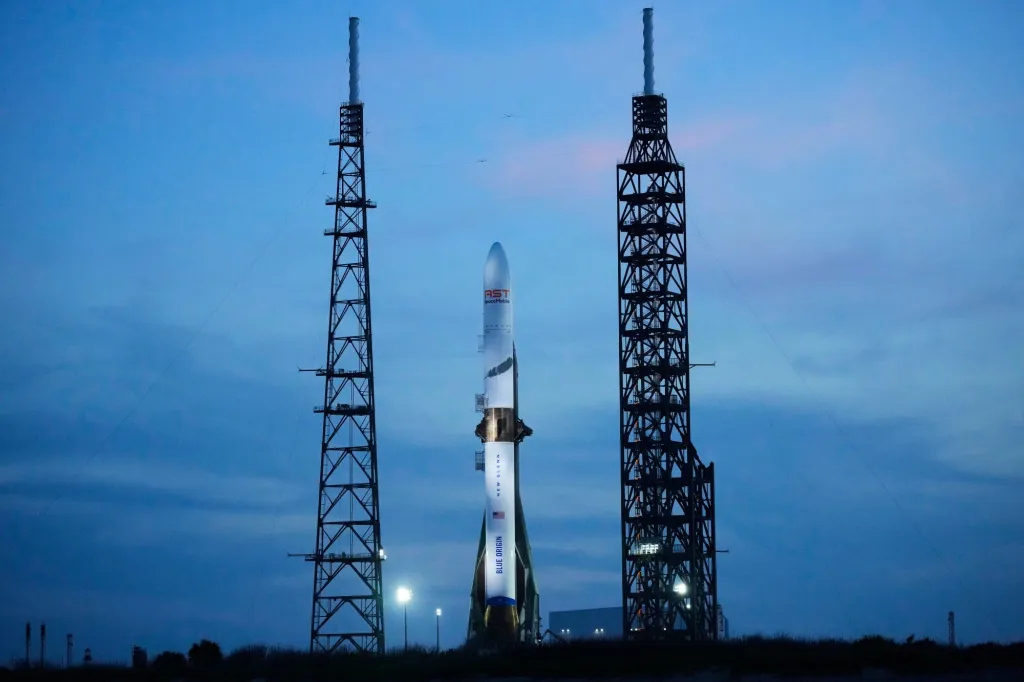
The new first stage for an upcoming Blue Origin New Glenn mission exploded on the launch pad in Cape Canaveral on Thursday night.
Read more Pam Bondi to face closed-door questioning from House lawmakers over Epstein files
Here’s our video of the explosion at Launch Complex 36. It happened about 9 pm ET (0100 UTC) as Blue Origin was beginning a static fire test of its New Glenn rocket.
Watch live views: https://t.co/tm2wZQmAVD pic.twitter.com/PmbgQC6Qmq
— Spaceflight Now (@SpaceflightNow) May 29, 2026
“We experienced an anomaly during today’s hotfire test. All personnel have been accounted for. We will provide updates as we learn more,” Blue Origin posted on X.
Video captured by Spaceflightnow.com and posted to X showed the rocket stage standing vertical on the pad at Cape Canaveral Space Force Station’s Launch Complex 36 become engulfed in flames. The fireball expands out and covers the entire launch pad as the fuselage of the rocket can be seen crumbling into the flames.
Blue Origin founder Jeff Bezos added,” It’s too early to know the root cause but we’re already working to find it. Very rough day, but we’ll rebuild whatever needs rebuilding and get back to flying. It’s worth it.”
SpaceX founder Elon Musk, a Blue Origin competitor, weighed in as well.
“Sorry to see this, I hope you recover quickly,” he posted on X.
The explosion occurred around 9 p.m. ET.
“Emergency responders are on the scene. All personnel have been accounted for and there were no injuries/fatalities,” according to a press release from the Space Force’s Space Launch Delta 45, which oversees the launch pad and all launches as part of the Eastern Range, the area that extends east from Florida’s launch sites over the Atlantic.
“Range officials, in coordination with Blue Origin and appropriate partners, are currently evaluating available data to determine the exact cause of the anomaly,” the release stated. “Additional information will be released as it becomes available.”
Space Coast launch schedule
Other launch providers should not be affected. There are two launches planned for Friday farther north at the Space Force station. A SpaceX Falcon 9 and United Launch Alliance Atlas V are primed for missions from Canaveral’s Space Launch Complexes 40 and 41. SpaceX’s Starlink 10-53 mission is slated to launch during a window from 7:52-11:52 a.m. and ULA’s Amazon Leo 7 mission slated to launch during window from 7:33-8:02 p.m.
“The Eastern Range remains fully mission capable and continues to support operations at all other launch complexes.” the Space Force release stated.
The hotfire, also known as a static fire, is supposed to test out the rocket stage, usually with a full load of fuel and locked down to the launch tower so it remains in place as teams make sure everything runs smooth for launch day. This lower part of the rocket has a combination of liquid oxygen and liquefied natural gas.
The lost hardware was the third-ever New Glenn first stage manufactured at Blue Origin’s rocket factory in nearby Merritt Island. It had been tapped for what would have been Blue Origin’s next flight, NG-4, that was slated to fly as early as next week.
That was going to be the first of 24 missions to fly up satellites as part of the Amazon Leo broadband constellation.
Read more Tomatoes become latest symbol of America’s affordability squeeze
With the explosion, New Glenn won’t be flying anytime soon, though, as repairs will be needed at the launch pad. At least one of the lightning towers adjacent the pad was visibly missing after the explosion. This is the only launch complex available for Bezos’ big rocket.
SpaceX suffered a loss of a rocket in 2016 at Canaveral’s SLC-40 when a Falcon 9 exploded on the pad ahead of the AMOS-6 mission. Damage from that incident caused a four-month delay before SpaceX was able to launch from the pad again.
The base of New Glenn’s stage is outfitted with seven of the company’s BE-4 engines, which would also have been destroyed. BE-4 engines are also used on ULA’s Vulcan rockets.
The company does still have one flight-proven first stage available, though, which flew both New Glenn’s second and third missions and made recovery landings downrange in the Atlantic after launch.
The company’s first New Glenn first stage was lost during its first-ever launch in January 2025 as it was not able to make the recovery landing.
The heavy-lift rocket was just cleared to fly by the Federal Aviation Administration last week after a different issue on its third flight, NG-3, in which the upper stage was not able to put its payload into the correct orbit after one of its two engines malfunctioned.
Blue Origin CEO Jeff Limp had indicated earlier this year his goal was to fly at least eight New Glenn missions this year.
NASA had been counting on New Glenn to help with its moonbound efforts. Targeting a launch this fall is supposed to be the debut launch of Blue Origin’s uncrewed Blue Moon MK1 lander to the moon’s South Pole.
That mission will help Blue Origin develop its crewed Blue Moon MK2 lander that’s tied to NASA’s Artemis missions and would also launch on New Glenn.
NASA Administrator Jared Isaacman posted on X that NASA was aware of the incident.
“Spaceflight is unforgiving, and developing new heavy-lift launch capability is extraordinarily difficult,” he wrote. “We will work with our partners to support a thorough investigation of this anomaly, assess near-term mission impacts, and get back to launching rockets. We will provide information on any impacts to the Artemis and Moon Base programs as it becomes available.”
Read more Cole Kim leads Sunny Hills boys golf to CIF-SGCA regional title, state berth