
The take-home essay is dead. So are lockers. And, probably, physical textbooks, too.
Read more Judge temporarily blocks payouts from Trump’s $1.8B ‘anti-weaponization’ settlement fund
But for Maria Poveromo, a soon-to-be Woodbridge High School graduate, some academic cliches still ring true.
With graduation right around the corner, Poveromo, 18, is saying “bye” to childhood friends and daring to start anew across the country at Fordham University in New York, where she’ll study political science and international relations. She’s equipped with a hefty financial aid package and a broad-brush vision of what her post-high school life will look like.
She has a sense of the world she is bracing to inherit, one made uncertain by AI’s trajectory, political polarization, rising costs and slimming job markets. She’s been told what to expect, but Poveromo says she doesn’t really know what the future holds for her generation.
The answer, she suggests, lies in what Gen Z has forsaken.
“I don’t know one kid at my entire school that uses their locker to put textbooks in. Everything’s online,” Poveromo said. “It’s really embarrassing, but I think it says a lot about my generation.”
If lockers are long gone, then naturally, Poveromo adds, so are print books. Apple pens and iPads are the modern-day pen and paper among her Woodbridge peers – “everybody’s using them to take notes.”
Chapman University professor and Fletcher Jones Foundation Endowed Chair in Free Speech Vikki Katz calls the world high schoolers are graduating into a “period of transition and rapid innovation and development.”
The stakes aren’t trivial. A generation’s confidence is on the line.
In this moment, she said, “It feels like AI has shaken the foundations of all the things they were told” and distorted the idea of “you’ll go to a good college and everything will be mapped out for you.”
At this age, a student’s confidence is in “their trust in their unique view of the world. And for young people, it feels like that’s missing right now,” she said.
“We need to make sure that we’re creating infrastructures and incentives for young people that enable them to slow down, where the world is working to speed things up,” she said.
For Katz, “slowing down” includes honing in on developing students’ soft skills and teaching them to engage in civil discourse — abilities she saw dampened by students spending some of their formative years in quarantine and communicating over their devices. It is also about designing classrooms where “face-to-face conversations” reign and the reliance on AI is controlled.
In this digital age, and perhaps foreshadowing for the graduating Class of 2026, Katz’s colleagues at Chapman are shifting toward “hands-on” learning, reverting to blue books for tests, pens and paper for notes — frameworks that deter cheating and “reward the process of understanding rather than an outcome.”
“We need to spend more time in class engaged in meaningful activities that students can do interactively,” she said. “So from my vantage point, the take-home essay is dead.”
Honest work
Fountain Valley High School senior Andy Ngo uses AI every day.
“I think every student in high school has used AI,” he said. “And if they (say they) haven’t, they’re lying.”
“There’s not a single day where I don’t use the internet, so there’s not a single day where I don’t get in contact with AI,” he said, adding that with even simple Google searches, he’s met with AI responses.
Ngo’s behavior is not unusual. In a Gallup survey published in April of 1,572 members of Gen Z, about half of the 14- to-29-year-olds said they use AI either daily or weekly, and just 19% said they never use it.
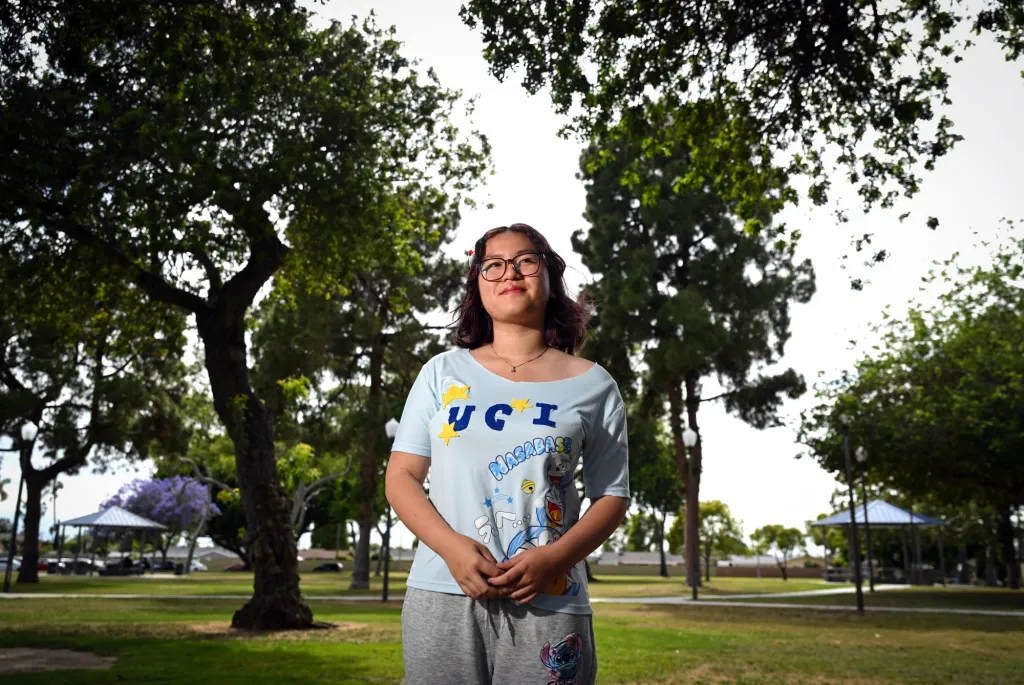
Ngo, 17, is headed to UC Irvine this fall to study bioengineering. For the son of two immigrants, college was always on the mind: “For immigrant families, it’s the No. 1 model. You’ve got to go to school, work hard and just live a stable life,” he said.
But AI, he said, is changing the equation.
“I don’t want to say a degree is useless, but with AI, a lot of degrees are losing their value to me,” Ngo said, referring to posts he’s seen on TikTok and Instagram flagging “non-safe” paths, such as communications, degrees that are business-related or “anything too easy.”
“People will not hire somebody to make phone calls and outreach or create a website or send emails,” Ngo said. On the other hand, “building a product or even blue-collar work, like construction, cannot be replaced by AI.”
His own intended major, Ngo said, is not invulnerable. He is undecided on a career — though interested in developing prosthetics — but already he’s expecting the hunt for internships and early-career jobs to become increasingly competitive.
Ngo is “super anxious” about AI’s progression and its implications on a college education, but said he also can’t risk ignoring AI and “falling behind.”
“In education, or maybe in general, people will score higher than you or get more success because they use AI and you do it by yourself,” he said. And “with AI developing, it feels very demoralizing to do honest work because everybody around here is shortcutting their way.”
His anxiety isn’t isolated.
While Gen Z’s use of AI has remained steady compared to 2025, according to the Gallup survey, disillusionment with AI has significantly risen. Gen Zers’ “hopefulness” about AI fell from 27% to 18% in the last year, while “anger” increased from 22% to 31%.
Katz, of Chapman University, says AI nurtures a “confidence problem” for Gen Z.
“The way assignments are structured, I suspect the worry isn’t about falling behind because AI is so clever,” she said. “It’s that they think AI might have better answers than them.”
As educators, “we need to make sure that the assignments we give do not inadvertently incentivize people to be using AI instead of engaging in the worthy struggles to really figure it out themselves,” Katz said. “But as long as we’ve got AI at our desks, the harder it will be for them to do that. Every time they do a Google search, they’re gonna see an AI summary at the top, and that’s before they open ChatGPT to help them with a specific assignment.”
Poveromo can’t say for certain what “ethical AI-using” will look like in her future classrooms. But she expects it might resemble her current habits, though she believes she’s an outlier: “I use it to digest things, to do busy work.”
Read more South Coast Repertory raises funds with ‘Sex and the City’ benefit performances
“It’s a tool, essentially,” Poveromo said. “It’s not the answer.”
Soft skills
Jennifer Ortiz partitions her workday at Anaheim High School between teaching English and serving as the campus community schools teacher lead.
The position, unique to the Anaheim Union High School District, focuses on “getting input from families, students, teachers and community members on the educational experience in order to make decisions around what is going to produce the best graduate.”
One of the most pressing concerns Ortiz said she identified in the Class of 2026 is “the need for soft skills.” The school district calls these attributes “durable skills,” boiling them down to the “five C’s:” collaboration, communication, compassion, creativity and critical thinking.
Poveromo recognizes this issue amongst her peers at Woodbridge High. “There’s definitely a soft-skill gap,” she said, “eye contact, conflict resolution, public speaking, teamwork, even.”
“And I think that’s due to the pandemic and social media, the lack of face-to-face interaction,” she said.
COVID-19 restrictions and precautions, for Poveromo and her peers, started in sixth grade, lasting through eighth grade.
Limiting screen time at school has helped cultivate those soft skills, Ortiz said.
“Last year we talked about how phones and social media affect the brain and kids,” she said. The average daily screen time for Anaheim High School students in 2025 was about 10 hours, Ortiz said.
So “this year, the high school implemented an ‘absolutely no cell phones in the classroom’ policy,” she said.
Claudia Villalobos, an educational services coordinator with Cal State Fullerton’s GEAR UP program, works with a cohort of about 50 students, including from Anaheim High. Gaining Early Awareness and Readiness for Undergraduate Programs focuses on “having students either be college-ready or career-ready.”
Practicing soft skills is pivotal to that preparation, Villalobos said. As part of the program, she practices everyday conversations with her students.
Some scenarios include “how to advocate for yourself, how to communicate with someone about trouble you’re having with your assignments and the learning of that class,” she said, adding she hopes those conversations “translate going into a career, and how you talk to your employer about, for example, taking days off.”
In this digital age, where social media headlines and opinions often bleed into each other, the soft skills and students’ capacity for civil discourse go hand in hand, Katz said. “We need to incentivize that kind of engagement.”
But that kind of interaction “was definitely hurt and continues to be hurt by social media and the pandemic,” Poveromo said, mentioning a civics class that touched on the topic.
“We read a study that said the Class of 2025 had the most violent fights on campus ever, and I think that says a lot,” she said, “because this is the age where you learn how to disagree respectfully, debate ideas without attacking people, and listening.”
What’s the cost?
Ny Nguyen, 18, was torn between spending the next four years at UC Irvine or UC San Diego to study political science and economics, with the hopes of eventually attending law school.
Her decision to attend UCI came down to the cost savings of living at home, she said. “If someone’s taking the grad school route, they might as well just do community college or a cheaper school in undergrad.”
Ngo was at the same crossroads. He, too, chose to stay close to home.
Villalobos said among her GEAR UP students, there are several who are foregoing higher education altogether because of the economics.
“They want to go directly into the workforce,” she said, “and the conversation does revolve around the fact that they want to start early with their careers, because they feel like they can learn more being on the job, and they can learn with the new programming, the new technology.”
The priority is getting students college-ready, but Villalobos recognizes that “not all of our students are going to do that route.” So, to equip students for either path, she encourages the soft skills: “being adaptable, being resilient, communication, active listening.”
Recently, Orange County business and education leaders gathered to talk about whether a college degree could still give graduates an edge. A degree makes a candidate stand out, but diplomas alone don’t make the cut, they said.
“We have shifted from an attitude of looking at degrees as a credential and more to looking at degrees plus capabilities,” Orange County Business Council President and CEO Jeff Ball said. “When we think about how the market is changing, we need our employees to be dynamic. And the more educated they are, the more they have that foundation, the more they’re going to be able to adjust with us.”
Poveromo isn’t intimidated. Bright and by all means an academic go-getter, she’s got a list of extracurriculars under her belt and has every intention of keeping the momentum up in college.
“I would totally join an academic frat, or they have a lot of culture clubs at my school. Maybe an Italian club. Maybe I’ll join the tennis team,” Poveromo said. “And of course I’m excited for the classes I’m going to take.”
But for now, there are the last days to experience as a high schooler.
There was just senior ditch day, and still yearbooks to sign and getting that diploma.
Read more Wall Street inches higher while oil prices fall on optimism over talks of Iran ceasefire extension