
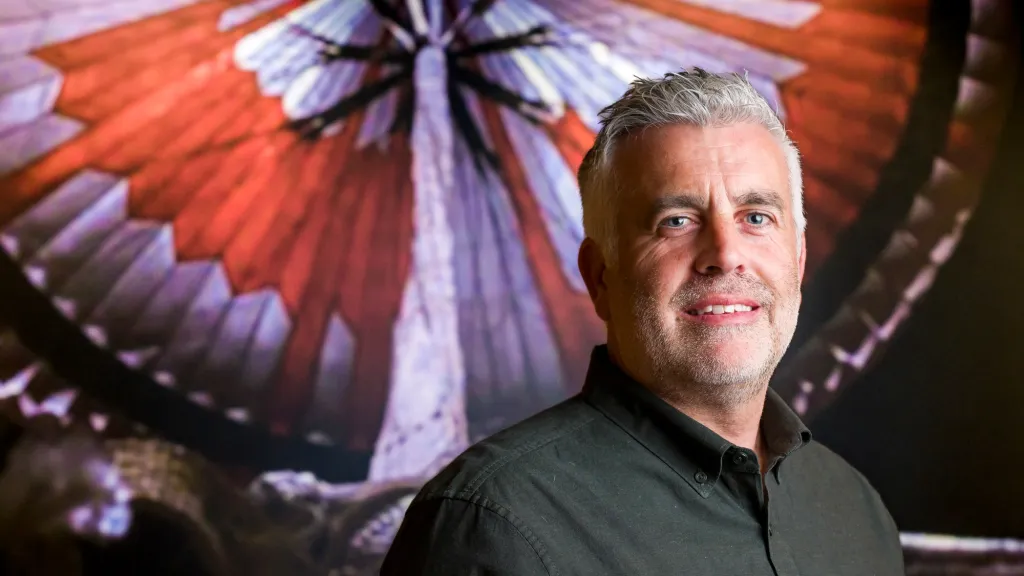
Ben Tutt, a warhead modeler turned parachute designer, has never jumped out of an airplane to see if the nylon canopies attached to cords and a body harness really work.
Read more Santa Ana High Graduation 2026: Our best photos of the ceremony
“We have experts that do that,” said the 48-year-old, British-born Tutt, the director of engineering, space and recovery for Airborne Systems in Santa Ana. “Maybe when I was a lot younger I had a desire to do that kind of thing. But not so much now. It’s not a requisite to have jumped with parachutes to be able to design them or work for an aerospace company.”
At the company’s 160,000-square-foot factory along Segerstrom Avenue, Tutt oversees a team of 30 engineers and hundreds of sewing machine operators from a second-floor office where he has a panoramic view of the sprawling factory floor below. That’s where parachutes made of nylon and Kevlar are stitched together for everything from space capsules coming back to land on Earth or one day traveling to the surface of Mars or dropping military personnel on beachheads around the world.
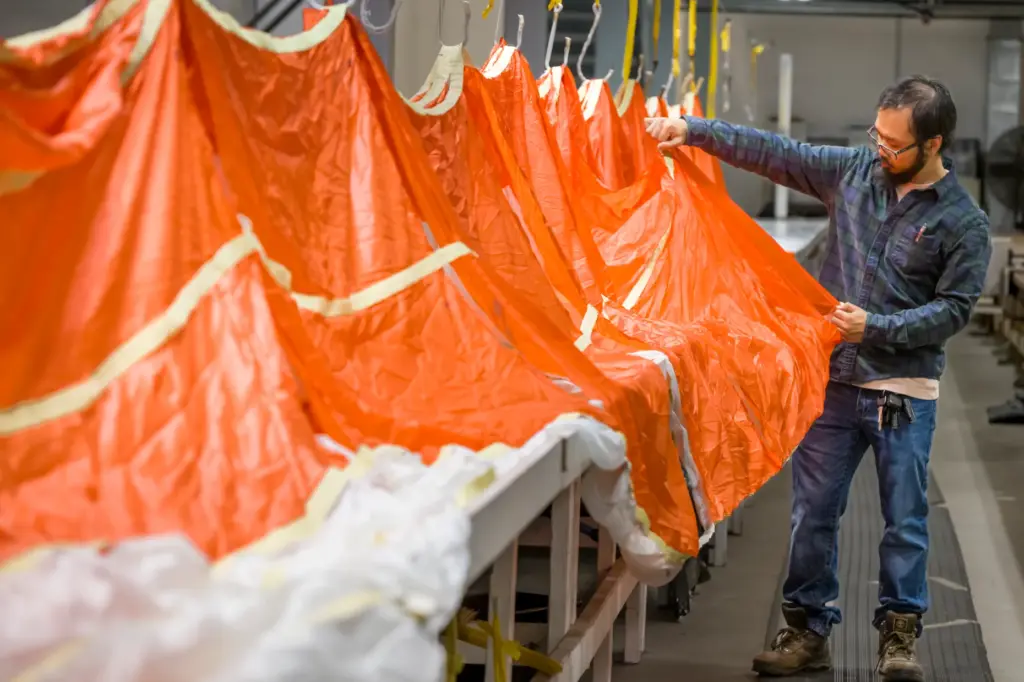 Parachute inspector Anthony-Minh Nguy examines a parachute to be used in a NASA Artemis II Orion spacecraft mission at Airborne Systems in Santa Ana on Friday, May 15, 2026. (Photo by Leonard Ortiz, Orange County Register/SCNG)
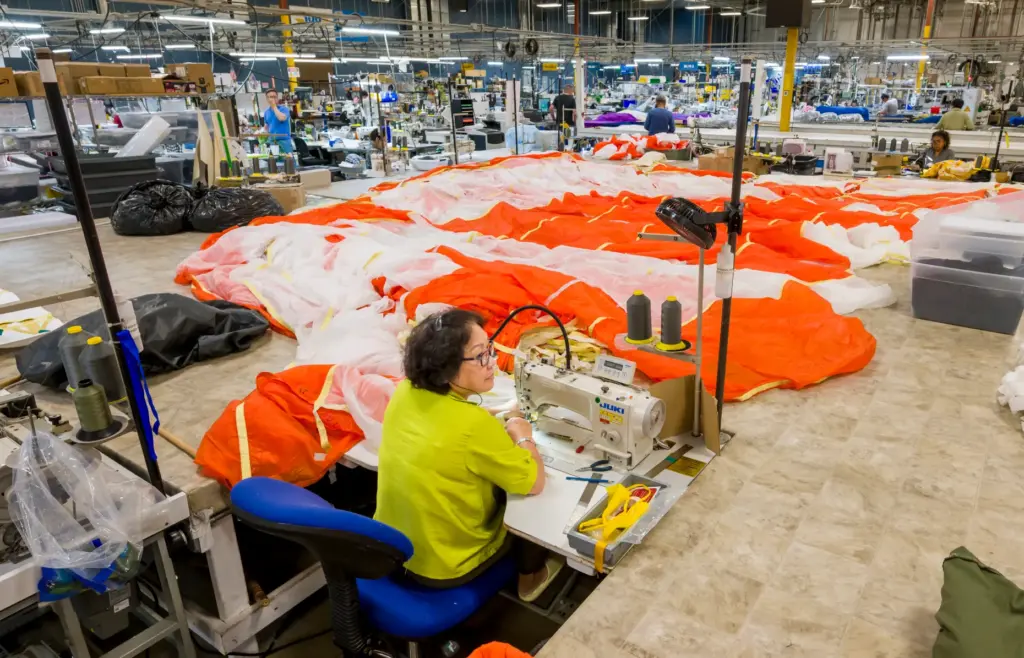 A sewing machine operator works on one of three parachutes for NASA’s Artemis II Orion spacecraft at Airborne Systems in Santa Ana on Friday, May 15, 2026. (Photo by Leonard Ortiz, Orange County Register/SCNG)
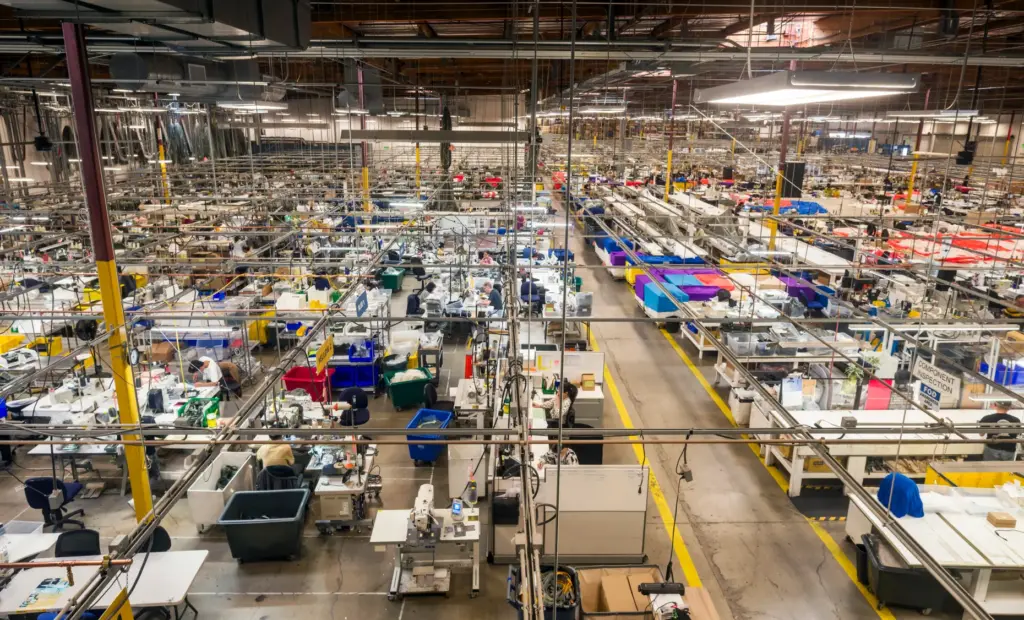 The 160,000-square-foot factory floor at Airborne Systems in Santa Ana on Friday, May 15, 2026. (Photo by Leonard Ortiz, Orange County Register/SCNG)
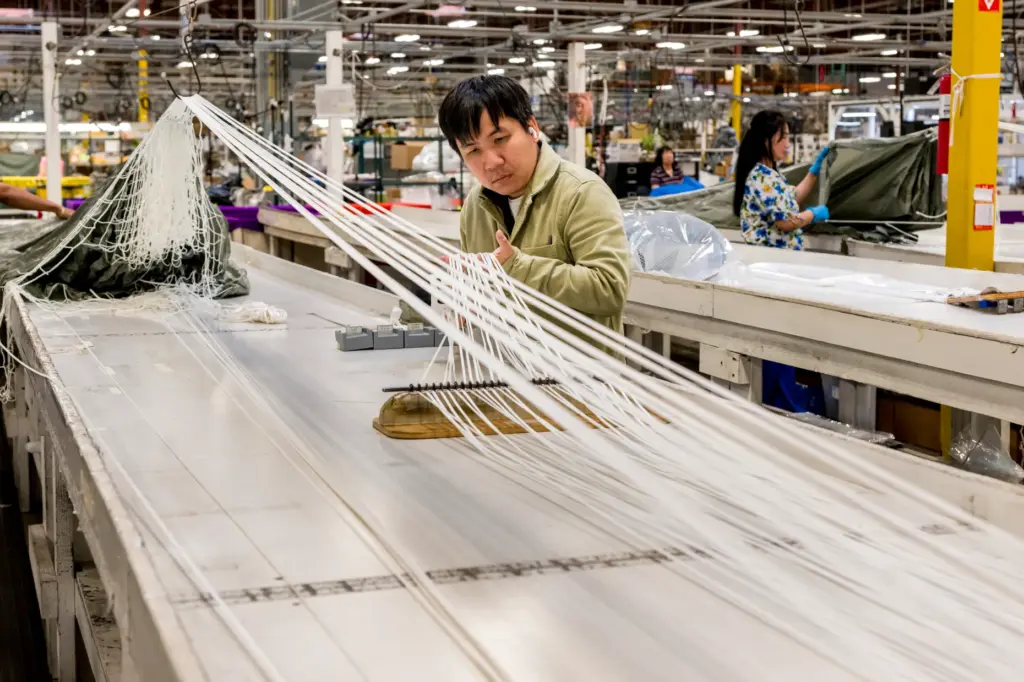 Minh Duong lays out parachute suspension lines at Airborne Systems in Santa Ana on Friday, May 15, 2026. (Photo by Leonard Ortiz, Orange County Register/SCNG)
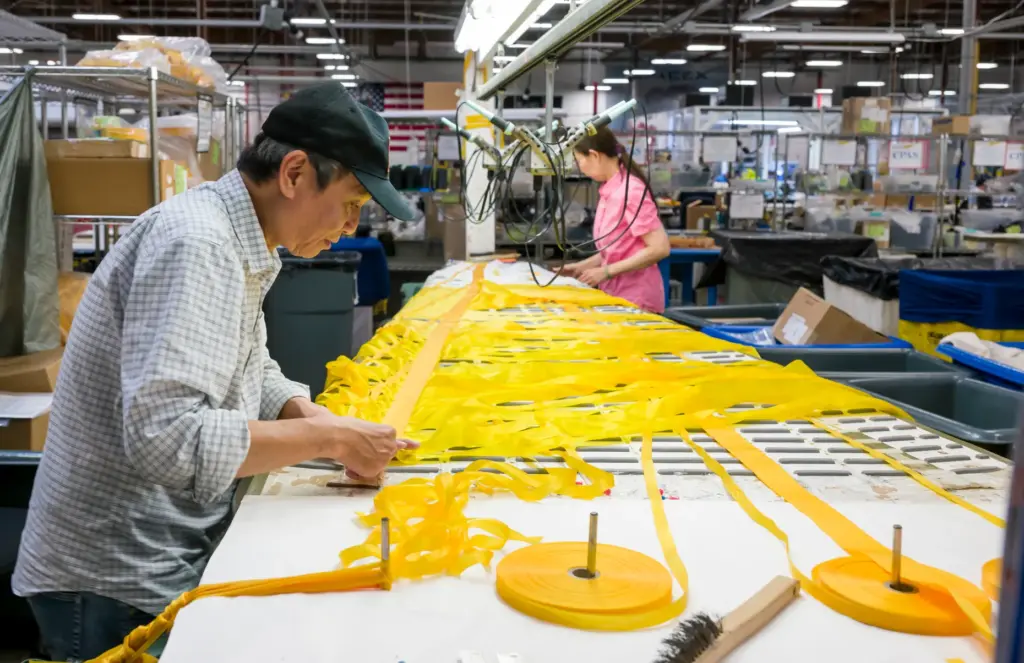 Workers, Hue Truong, left, and Vinh Long Nguyen, assemble ribbon parachutes for the Artemis drogue chutes at Airborne Systems in Santa Ana on Friday, May 15, 2026. (Photo by Leonard Ortiz, Orange County Register/SCNG)
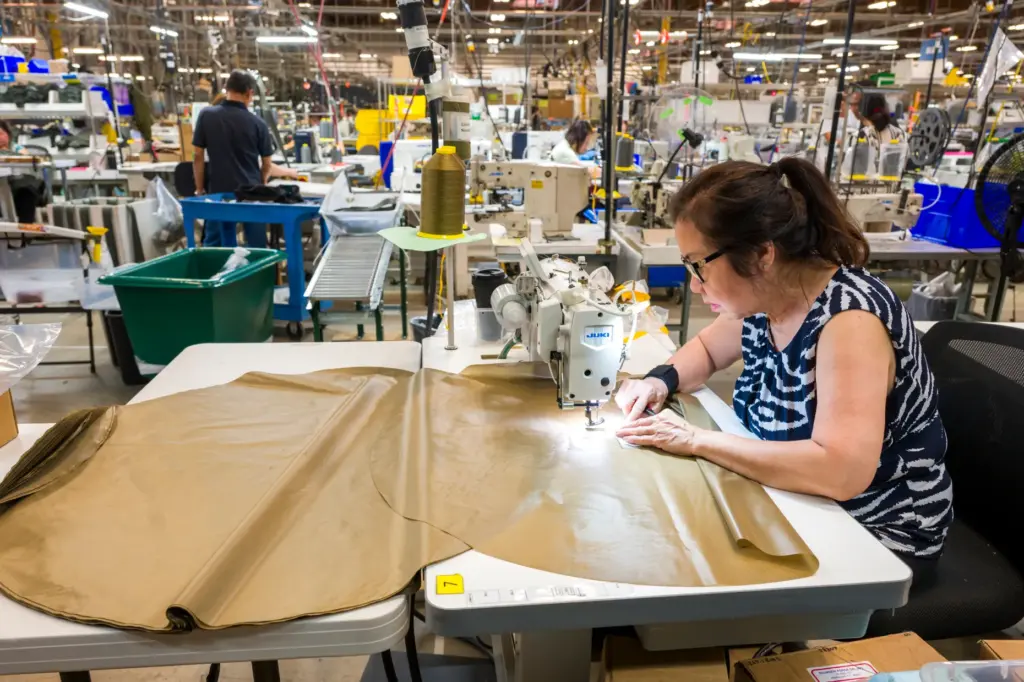 Hang Vuong, a sewing machine operator, sews a personal military parachute at Airborne Systems in Santa Ana on Friday, May 15, 2026. (Photo by Leonard Ortiz, Orange County Register/SCNG)
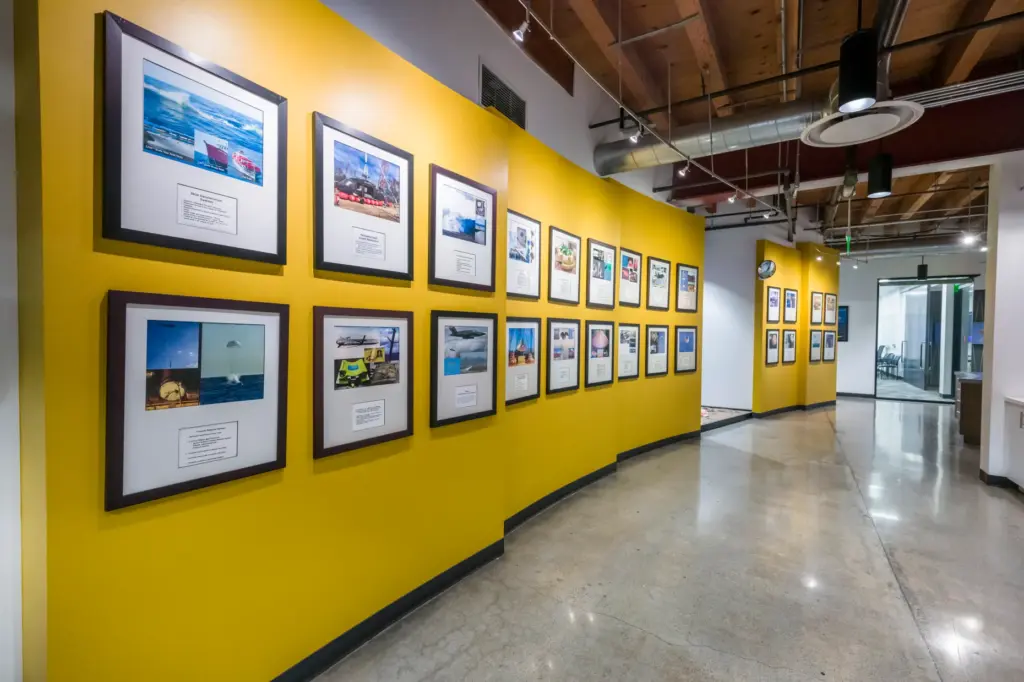 On display at Airborne Systems in Santa Ana on Friday, May 15, 2026, are photos of the multiple space and military projects the company has manufactured over the decades. (Photo by Leonard Ortiz, Orange County Register/SCNG)
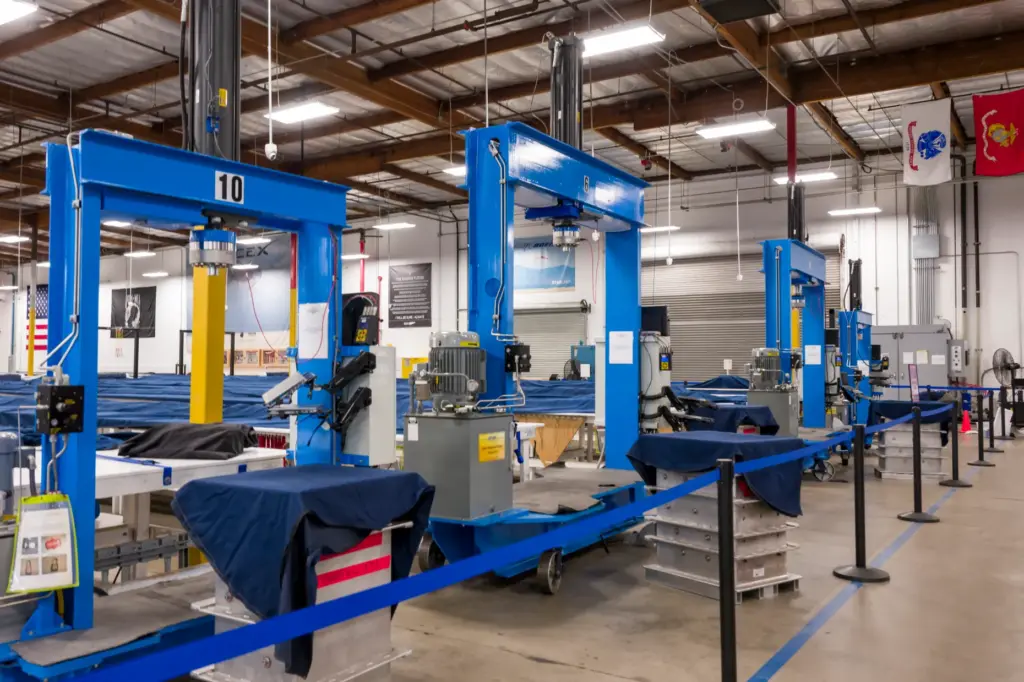 Giant blue steel frames support the hydraulic presses that compress the folded parachute into a smaller package at Airborne Systems in Santa Ana on Friday, May 15, 2026. (Photo by Leonard Ortiz, Orange County Register/SCNG)
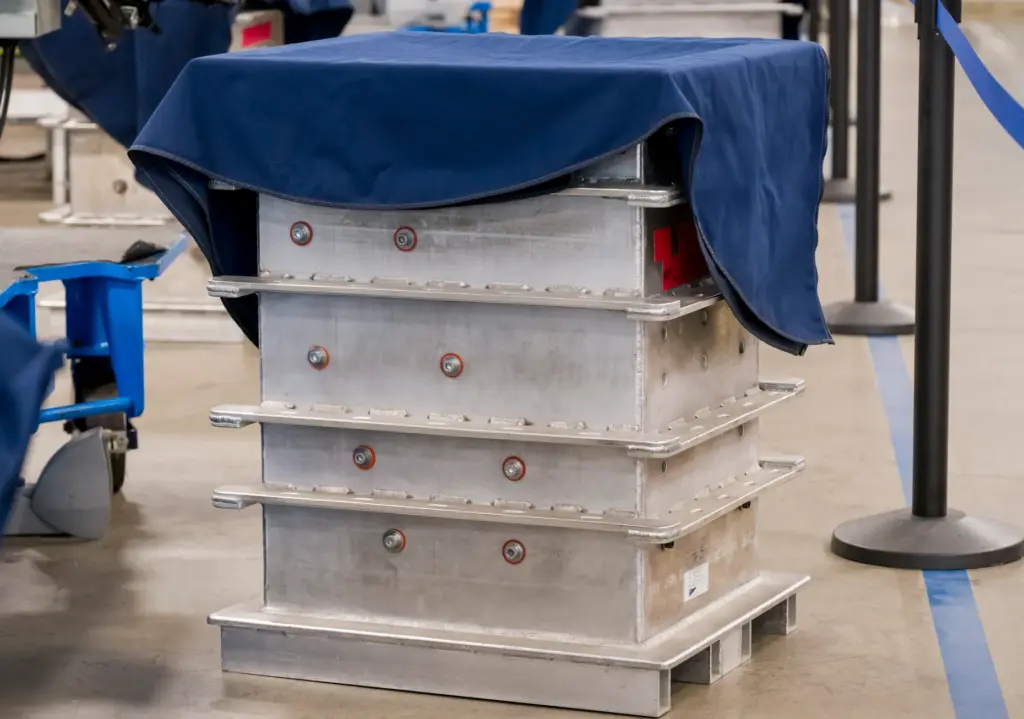 Hydraulic presses folded parachutes into these boxes as part of the approximately 4-week parachute-folding process at Airborne Systems in Santa Ana on Friday, May 15, 2026. (Photo by Leonard Ortiz, Orange County Register/SCNG)
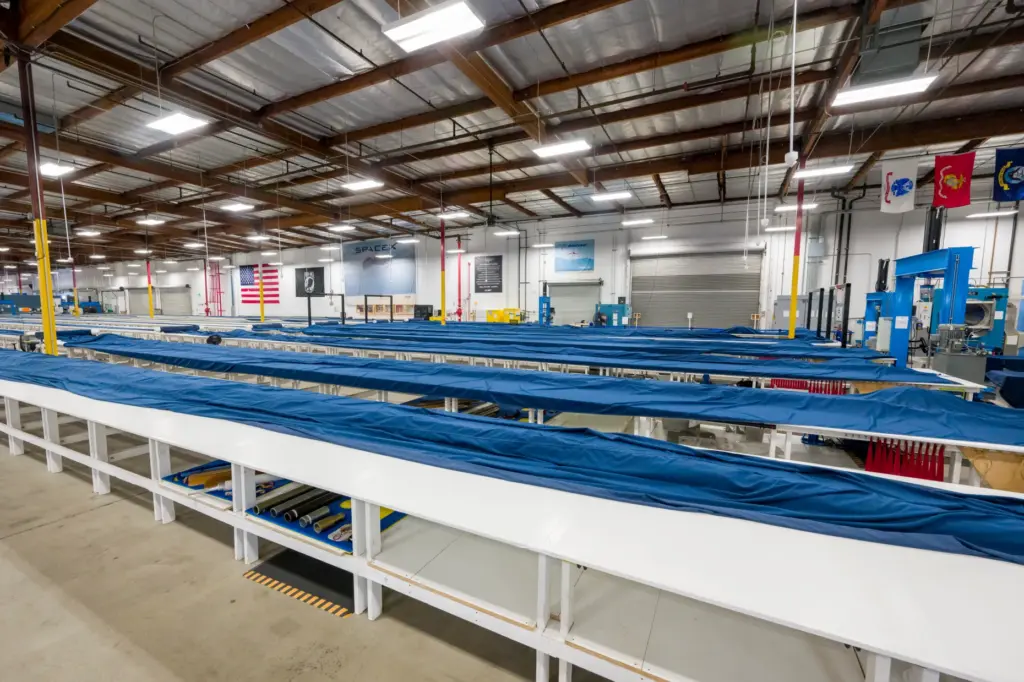 Rigging tables at Airborne Systems in Santa Ana on Friday, May 15, 2026, are used to lay out, fold, and compress parachutes. (Photo by Leonard Ortiz, Orange County Register/SCNG)
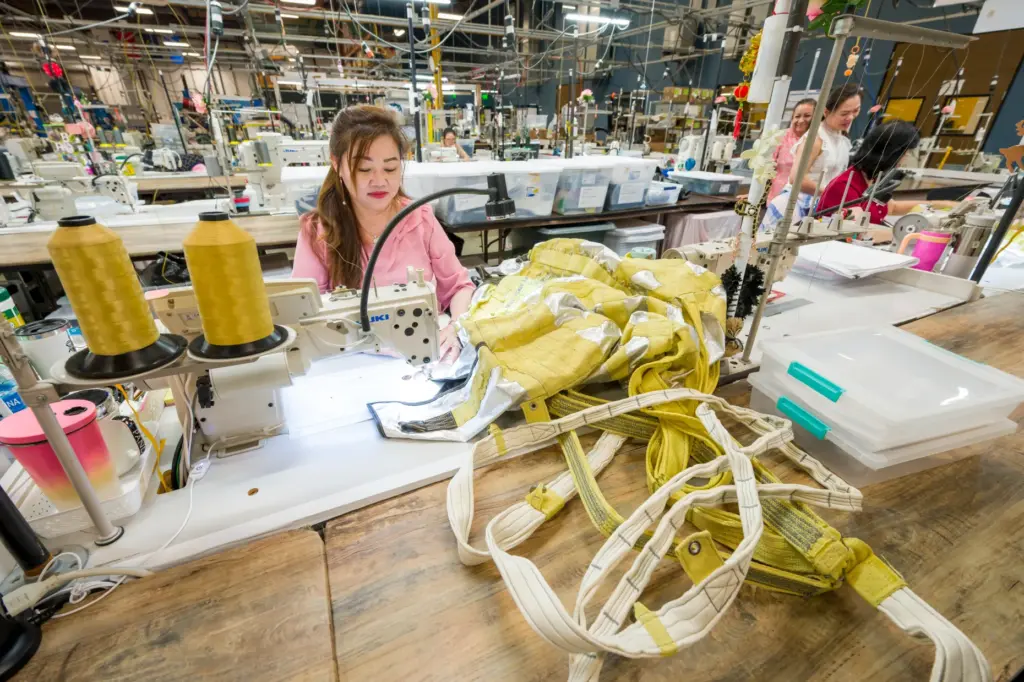 Lan Ngo sews a parachute deployment bag at Airborne Systems in Santa Ana on Friday, May 15, 2026. (Photo by Leonard Ortiz, Orange County Register/SCNG)
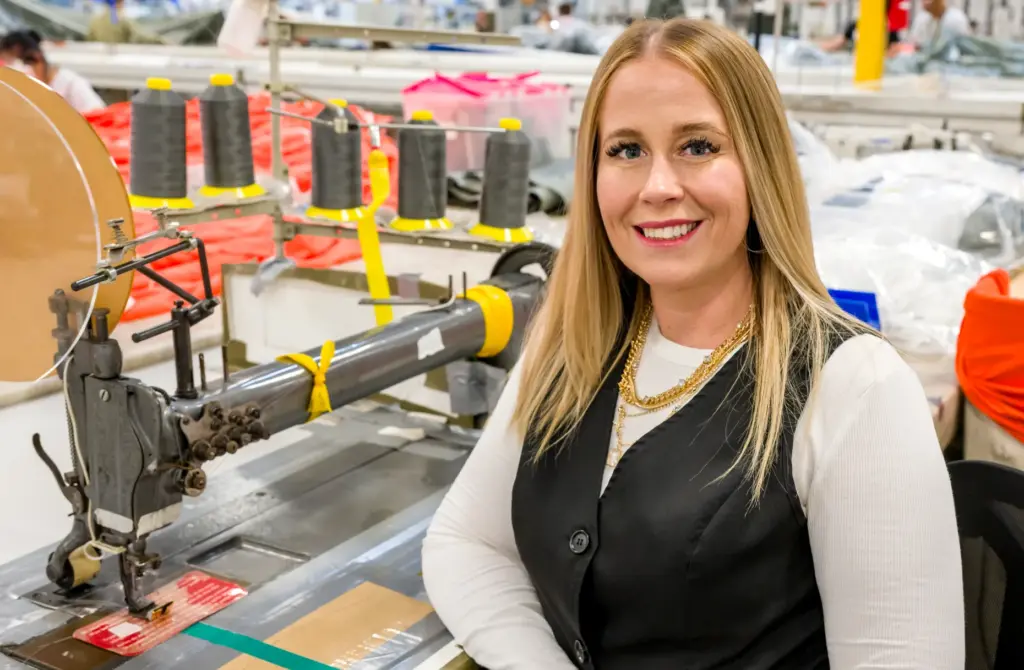 Amanda Morres, the operations program manager at Airborne Systems, is seated next to a 100-year-old, four-needle Singer sewing machine used to stitch together the Artemis Orion parachute in Santa Ana on Friday, May 15, 2026. (Photo by Leonard Ortiz, Orange County Register/SCNG)
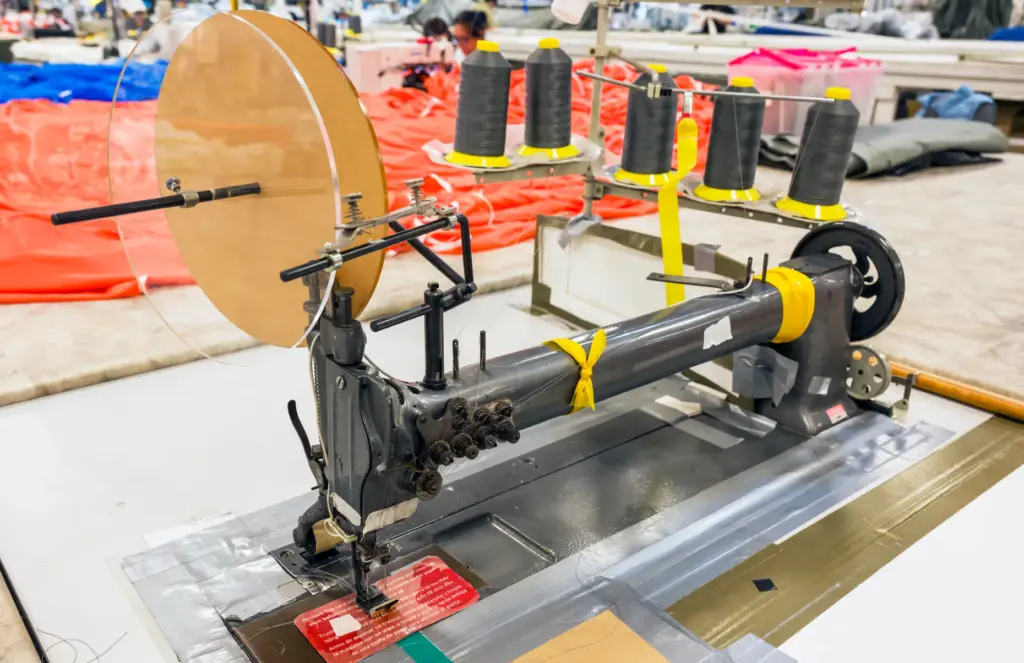 This 100-year-old, four-needle Singer sewing machine was used to stitch the panels for the 116-foot in diameter panels for the Artemis II Orion spacecraft mission at Airborne Systems in Santa Ana on Friday, May 15, 2026. (Photo by Leonard Ortiz, Orange County Register/SCNG)
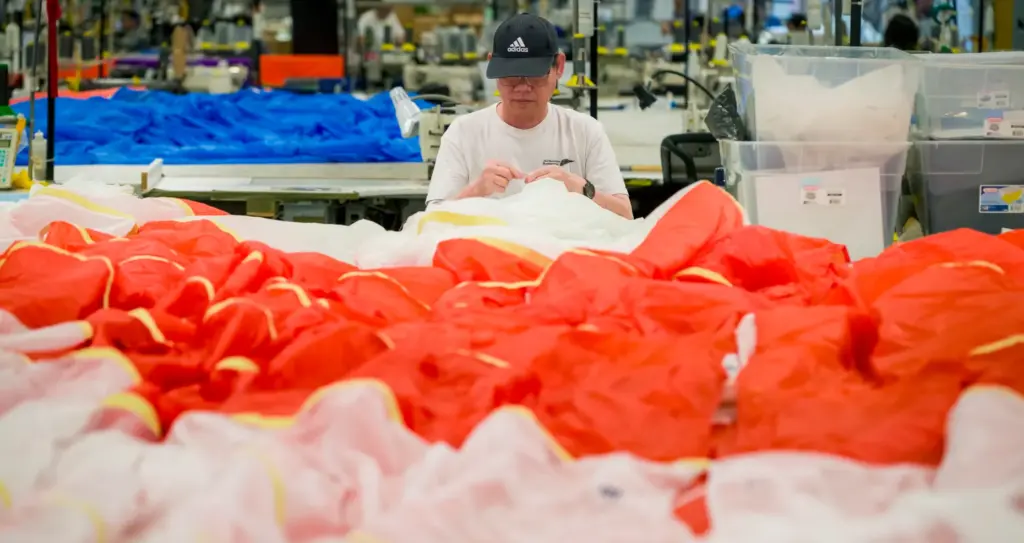 An employee works on one of the three canopies for the Artemis II Orion spacecraft at Airborne Systems in Santa Ana on Friday, May 15, 2026. (Photo by Leonard Ortiz, Orange County Register/SCNG)
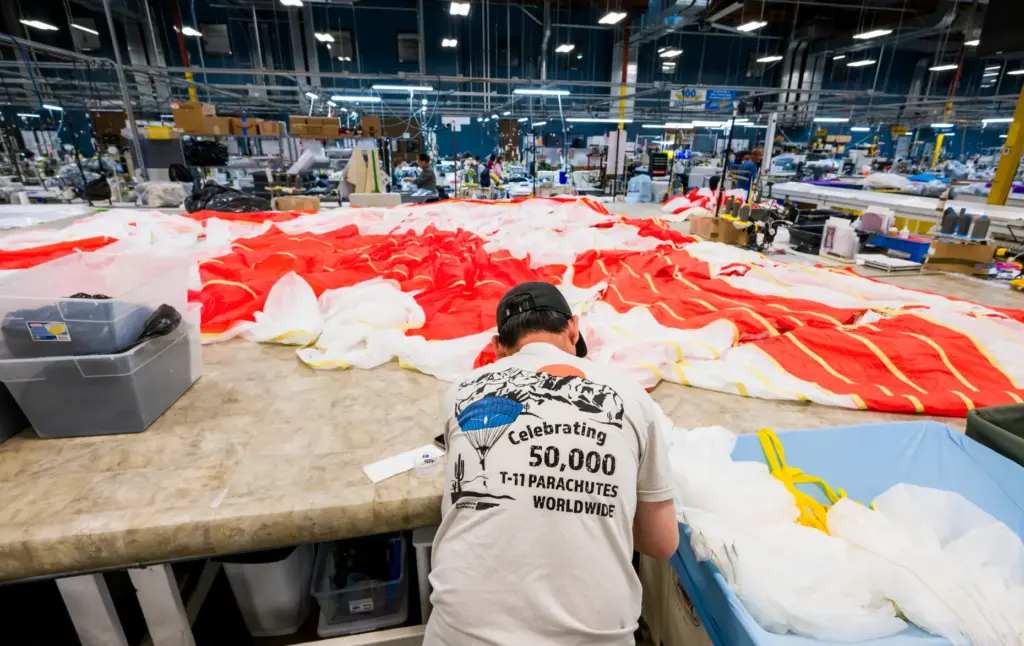 An employee works on one of the three canopies for the Artemis II Orion spacecraft at Airborne Systems in Santa Ana on Friday, May 15, 2026. (Photo by Leonard Ortiz, Orange County Register/SCNG)
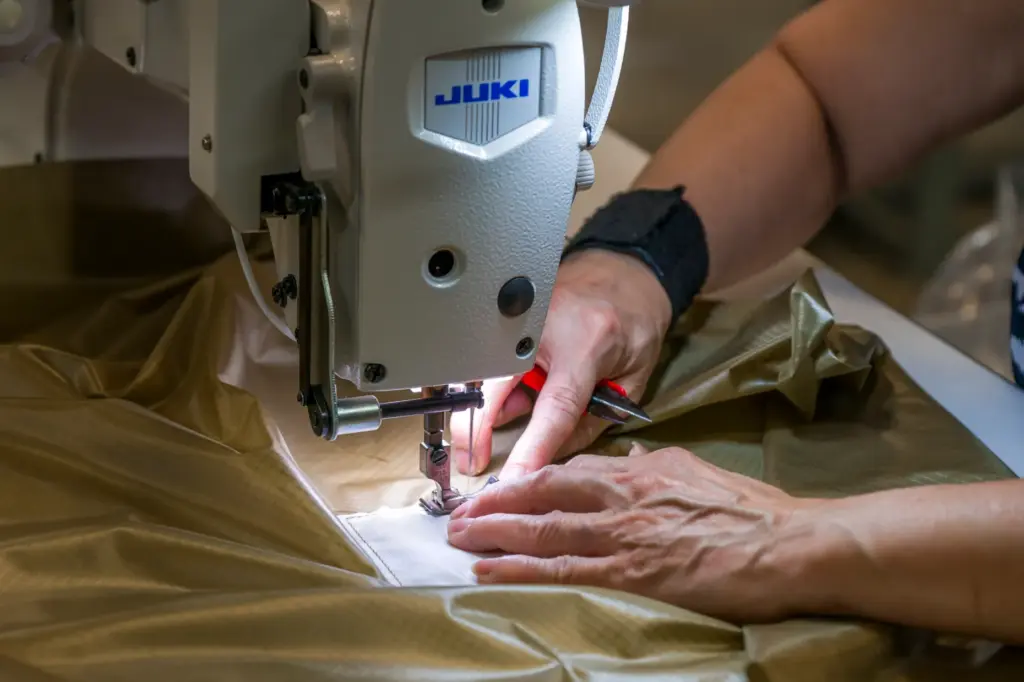 Hang Vuong, a sewing machine operator, works on a Juki machine to sew a personal military parachute at Airborne Systems in Santa Ana on Friday, May 15, 2026. (Photo by Leonard Ortiz, Orange County Register/SCNG)
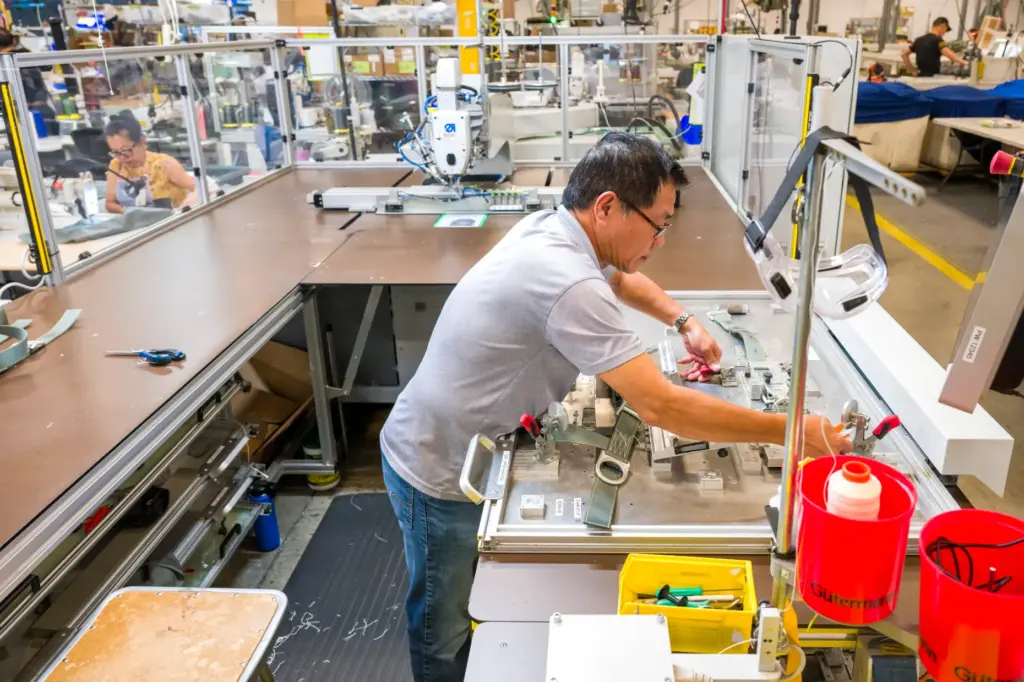 Assembler Quoc Anh Nguyen works on an automated pack tray assembly at Airborne Systems in Santa Ana on Friday, May 15, 2026. (Photo by Leonard Ortiz, Orange County Register/SCNG)
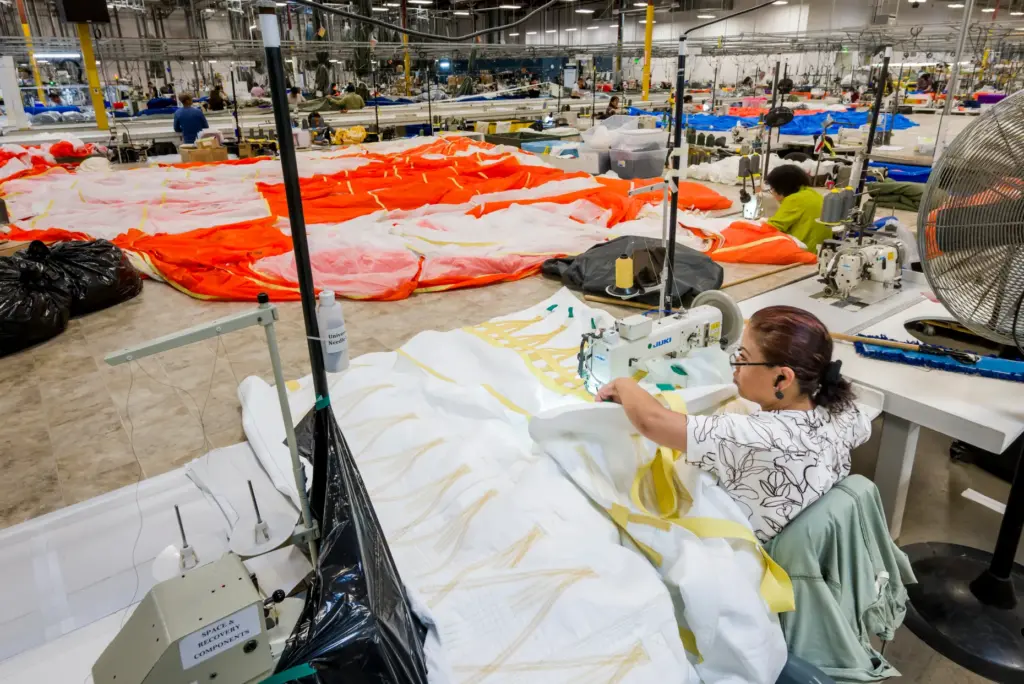 A sewing machine operator works on one of three parachutes for NASA’s Artemis II Orion spacecraft at Airborne Systems in Santa Ana on Friday, May 15, 2026. (Photo by Leonard Ortiz, Orange County Register/SCNG)
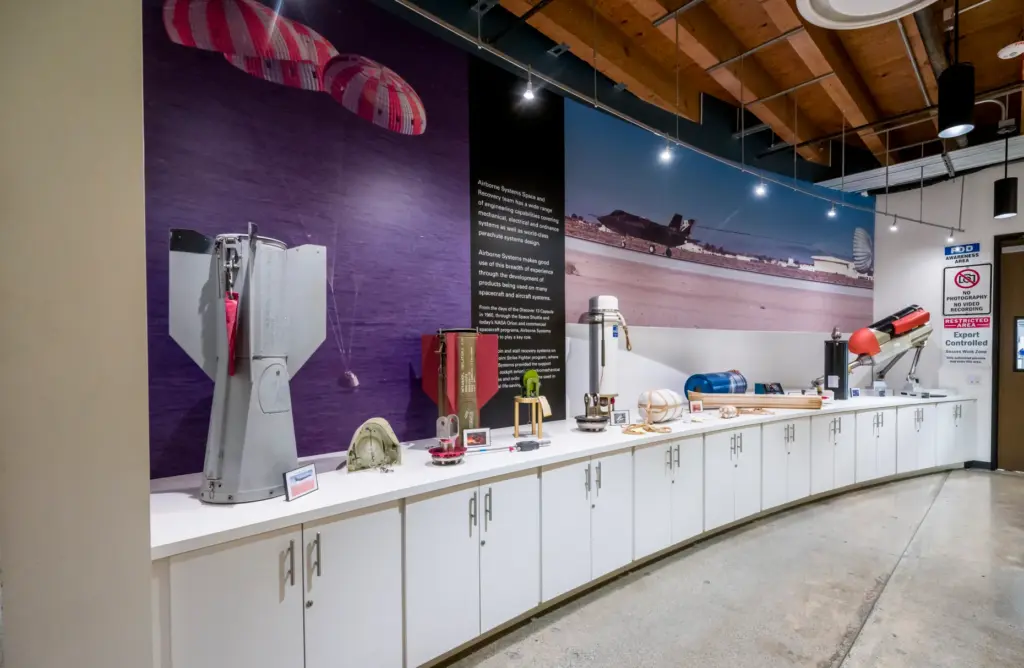 On display at Airborne Systems in Santa Ana on Friday, May 15, 2026, are samples of the space and military systems the company has manufactured over the decades. (Photo by Leonard Ortiz, Orange County Register/SCNG)
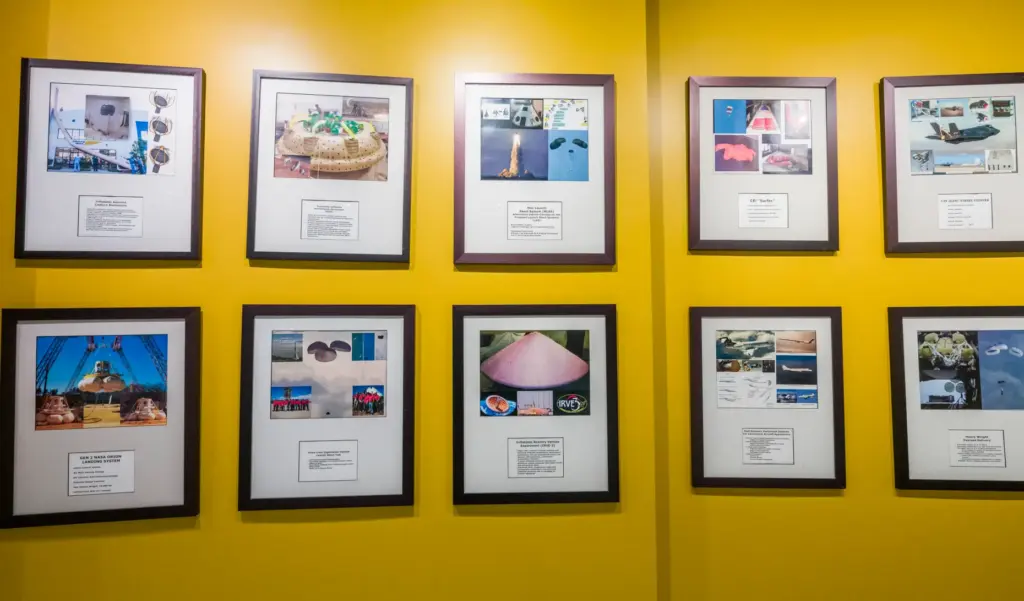 On display at Airborne Systems in Santa Ana on Friday, May 15, 2026, are photos of the multiple space and military projects the company has manufactured over the decades. (Photo by Leonard Ortiz, Orange County Register/SCNG)
That factory is part of aerospace manufacturing giant TransDigm Group based in Cleveland. Tutt and his teams have worked on engineering designs to safely drop anything needing a sturdy parachute — including the Orion capsule that splashed down last month off the coast of San Diego after its 477,710-mile journey to the moon and back.
As astronauts hurtled toward the ocean, Tutt said the Orion parachute was top of mind as he vacationed with his wife in Key West, sipping key lime cheesecake margaritas with friends and watching the successful return home from a cell phone at their bar table.
“There’s definitely a lot of things that can go wrong, and once everything goes right, it’s a big relief. It’s a big weight off your shoulders,” he said. “The other people that I was with didn’t have an engineering background, so they were just super-impressed that we could still do this kind of thing.”
Also see: 12 surprising things made in O.C.
The Santa Ana factory also is involved in making personnel parachutes for the Army — called T-11s — and has stitched together at least 60,000 units since 2010.
Airborne Systems traces its origins to 1919 when Leslie L. Irvin, a stuntman for the fledgling California film industry, made the world’s first free-fall parachute jump by pulling a ripcord in the same way skydivers do today.
The original corporate name, Irving Air Chute Co., included a misspelling due to a clerical error. Cash was tight in the early days to pay the $25 fee to fix it, so the name stood uncorrected until 1968, when the firm was renamed Irvin Industries Inc.
Since establishing the first factory in Buffalo, New York, the company has had several owners and moved its corporate headquarters several times — including to Lexington, Kentucky, and Hope Mills, North Carolina, where it took advantage of a pool of garment workers. It finally consolidated its North American operations in Santa Ana in 2003.
Airborne Systems is known for many different kinds of parachutes.
Notably, Tutt made significant contributions in the design of the intricate parachute system used on NASA’s Artemis II Orion spacecraft mission. The system relied on an 11-parachute sequence to safely decelerate the capsule carrying a crew of four astronauts from over 25,000 mph in space to a gentle 20 mph splashdown.
A year before the Artemis II mission, hundreds of seamstresses in the Segerstrom factory pushed and pulled nylon fabric connected with ribbons of tough Kevlar through industrial-sized, two-needle sewing machines — many carrying brand names like Brother, Consew and Juki.
The workhorse machine used to stitch together the three massive main parachutes — the most visible during the capsule’s final descent — is a 100-year-old, four-needle Singer. This relic from the past sewed together the 116-foot diameter panels that covered an area of roughly 16,000 square feet.
The 4-foot-long sewing machine is so ancient that Airborne Systems has assigned employees to comb through eBay, searching for spare parts to buy. “At this point, we made the machine,” jested Amanda Morres, operations program manager for Airborne Systems.
The plant has also seen a revolving door of billionaire visitors who came to see that their chutes work as advertised.
In 2018, Elon Musk, who is a few weeks away from taking SpaceX public, visited the plant to oversee development of a parachute system designed to slow the capsule of SpaceX’s Dragon spacecraft fromsupersonic speeds to a safe splashdown.
As an astronaut, NASA Administrator Jared Isaacman, a billionaire who made his wealth in the payment process industry and defense aviation, visited the factory prior to his 2021 spaceflight with a crew of private citizens aboard the Dragon.
Former Google executive Alan Eustace also stopped by the plant over a dozen years ago to check on the parachute he used to make a free-fall space dive from the stratosphere, a world record.
Other buyers of parachute systems from Airborne Systems include Blue Origin’s New Shepard reusable rocket system developed for space tourism and research (which has been paused by the company owned by billionaire Jeff Bezos); NASA’s Dragonfly, a mission to send an autonomous, nuclear-powered helicopter to explore Titan, the largest moon of Saturn; Boeing’s Starliner capsule designed to transport astronauts and cargo back and forth to the International Space Station and other low-earth orbit destinations; and the Mars Rover Perseverance, which was landed with a parachute system on the surface of Mars in 2021 to search for signs of ancient microbial life and pick up rock samples for future retrieval.
Read more Beckman High Graduation 2026: Our best photos of the ceremony
The business also has made Space Shuttle drag parachutes for the orbiter, and parachutes that deploy from the tails of F-22 and F-35 military jets to break them from unrecoverable stalls or spins.
We asked Tutt about his role in the industry and the challenges he faces. His answers have been edited for clarity and length.
Q: How many business units does Airborne Systems have?
A: We officially have three business units. One of those business units is essentially making parachutes for U.S. and North American countries. And those are sort of built-to-print type parachutes that we’ve designed in the past. Another business unit is one where we sell those same parachutes, or similar parachutes, to allied countries around the world.
The third business unit is called the Space and Recovery business, where I work as well as the bulk of the engineers in the Santa Ana office. We’re working with our customers to develop custom recovery systems. It’s the unit where the Orion parachutes were made for the Artemis mission to the moon.
Q: What materials are used in making parachutes?
A: With a parachute, the cloth, cords and the webbing gets purchased from other suppliers, and then our manufacturing floor turns those materials into the actual products that we sell. (Webbing in a parachute is a strong, tightly woven flat or tubular fabric — usually made of nylon — designed to absorb immense shock loads. It forms the backbone of the parachute’s harness and risers.)
We think of parachutes as coming in almost two different parts. There’s the big, obvious parachute canopy that you see when Artemis returns — the big orange and white parts of the parachute. That’s the cloth, and that’s predominantly made out of nylon. And then there’s the structural grid of that parachute that is really the strong part that is designed to handle all of the loads and the high forces that are generated when the parachutes are deployed. And those for the Orion parachutes, for Artemis, are predominantly Kevlar — often associated with bulletproof vests.
The nylon fabric panels are sewed together with strips of Kevlar.
We have a wide variety of sewing machines to do this. We use nylon and Kevlar thread to attach the nylon panels together, and we spend a lot of time designing those joints between the different parts of the parachute. Those are often the weakest parts.
Q: What is the strongest parachute as far as load capacity?
A: The strongest load is a little bit nebulous for us. The parachute that is designed for the highest load might be the ones that we make for the Missile Defense Agency, but certainly we’ve made lots of smaller parachutes that, for their weight, could handle a lot more load.
When you’re talking about the weight of the payload, the Orion capsule, for instance, was about 20,000 to 23,000 pounds.
The system that we developed for the Missile Defense Agency, we extract a target from the back of a C-17 military transport aircraft, and then that target gets released from the parachute system, and then flies off and acts as a target. It’s like a rocket that is separated from the parachute system. The target is often used for the THAAD system. (Terminal High Altitude Area Defense is a mobile anti-ballistic missile system designed to intercept and destroy missiles in their final phase of flight. The military and NASA routinely use the C-17 to air-drop mock ballistic missiles and space capsules via parachute to test missile defense systems like THAAD and spacecraft reentry systems).
Q: Where do you test the parachutes?
A: It depends on the size of the parachute and the application. We have a couple of hangars at an airfield in Eloy, Arizona, and we’ll routinely go and test some parachutes there. But for larger programs like the Orion capsule, we need to use military aircraft military bases that have all of the capabilities and the resources to do that testing, and for Artemis, that was all secured through NASA.
We used the White Sands Missile Range for the Boeing Starliner project. The most common one is Yuma Proving Grounds in Arizona, for military applications and NASA applications — like for the Artemis program.
Q: How long does it take to make a parachute system for the Orion?
A: With the material that we use, it can take a long time to purchase. It can take four months to buy the material, and then for a system as complicated as the Orion, you can take nine to 12 months to manufacture the system.
Q: How do you test the strength of parachutes?
A: We do a lot of testing on the different components of the parachutes that are sewn together. When you sew two materials together, it kind of weakens the material. We have some tensile testing machines where we take lots of different samples and pull-test them to make sure that we’re getting repeatable results, and we know that those weakest parts of the parachute are still strong enough to do their job.
We can also test those joint samples at elevated temperatures or cold temperatures or in different environments. Right now, we’re working with NASA to develop the parachute system that is going to deliver the nuclear-powered quadcopter drone Dragonfly to explore Titan, the largest moon of Titan.
About Airborne Systems
Address: 3100 Segerstrom Ave., Santa Ana
Revenue: Estimated at $100 million-$200 million.
Founded: 1919
Employees: 360 in Santa Ana and 175 in Pennsauken, New Jersey, where it makes parachutes for special forces and cargo delivery from transport planes.
Parachute systems: Orion capsule for Artemis II moon mission; Mars “Perseverance” Rover, Blue Origin’s New Shepard, SpaceX’s Dragon capsule, canopy recovery systems for the F22 and F35 military jets, hypersonic missiles, and T-11 parachutes for military personnel.
Rivals: IrvinGQ, owned by Transdigm in the U.K., Mills Manufacturing Corp. of Woodfin, North Carolina; Capewell, a South Windsor, Connecticut-based unit of Heico Corp., Costa Mesa-based FXC Guardian Corp., and ParaNetics Inc. of San Luis, Arizona. For drone systems, Fruity Chutes Inc. and Drone Rescue Systems.
Read more Bus hits cars in Virginia, killing 5 people and injuring 34, state police say