
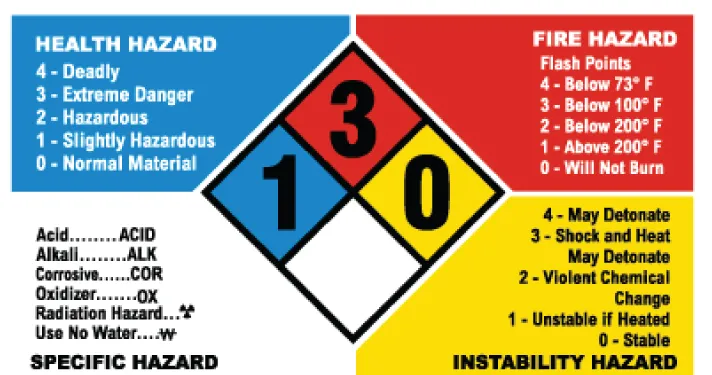
Dangerous materials are around us all the time and the United States has been regulating their transport for 160 years.
Read more Luka Doncic invests in Italian basketball team with NBA Europe aspirations
The first federal law for transporting hazardous materials was passed in 1866. This legislation regulated transporting explosives and flammable materials and was followed up in 1871 by a law making it a criminal offense to ship certain dangerous substances on passenger ships in U.S. waters.
The establishment of the Interstate Commerce Commission in 1887 was the first step in creating a uniform code that applied across the country and would eventually cover all modes of transport.
The fatal accident that many credit with driving the nation’s regulators to action occurred in San Francisco on April 16, 1866. A shipment of unmarked crates had arrived at the harbor two days earlier from New York via Panama. Eventually, a wharf employee noticed one of the crates was leaking an oily substance. The concerned wharf staff forwarded the package to the office of the carrier of record, Wells Fargo and Co.
The crate was opened by some men and later described in a newspaper article: “The last seen of these gentlemen alive, they were standing near the box, with several other employees, having tools as if about to open the box. It is supposed they made the attempt, when the explosion took place by concussion, which resulted in a terrible loss of life and destruction of property.”
Fifteen people died, including the clerks and many in nearby buildings. Many more were horribly injured. The Wells Fargo office was turned to rubble and extensive damage to buildings could be found for blocks. A few days later, a freighter in Panama loaded with hundreds of boxes of nitroglycerin and destined for California exploded, killing 50 people.
The public was suddenly very much aware of the risk they’d been ignoring. The first regulations were aimed at rail transport and passenger ships, but eventually highway and even the newest form of transport, air, were incorporated.
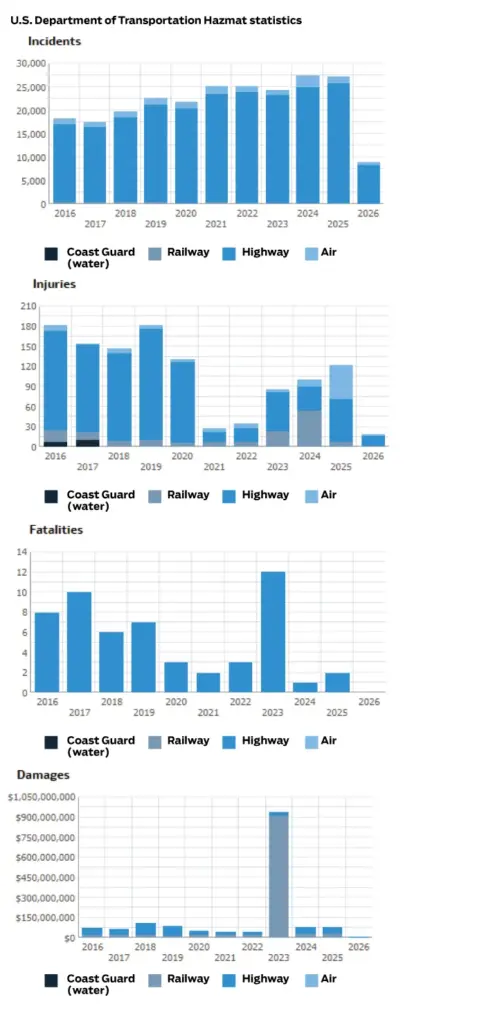
What Makes a Material Hazardous?
The Environmental Protection Agency, founded in 1970, uses numerous standards to make it easier to determine whether or not a material is hazardous.
Ignitability: Materials are ignitable if they can cause fires in specific conditions or spontaneously burst into flame. Ignitable materials usually have a flash point lower than 140 degrees Fahrenheit.
Read more As Garden Grove chemical threat turns to cleanup phase, efforts start to recoup costs
Corrosivity: Materials are considered corrosive if they are an acid with a pH lower or equal to 2 or a base with a pH more than or equal to 12.5. These materials are capable of causing corrosive damage to barrels, storage tanks and other metal containers.
Reactivity: Reactive materials can be dangerous because they can cause toxic fumes, explosions and harmful vapors under heat or in water. Explosives and lithium batteries are commonly identified as reactive materials.
Toxicity: Materials are considered toxic waste when they cause physical harm when absorbed through the skin or ingested. Lead and mercury are considered toxic waste.
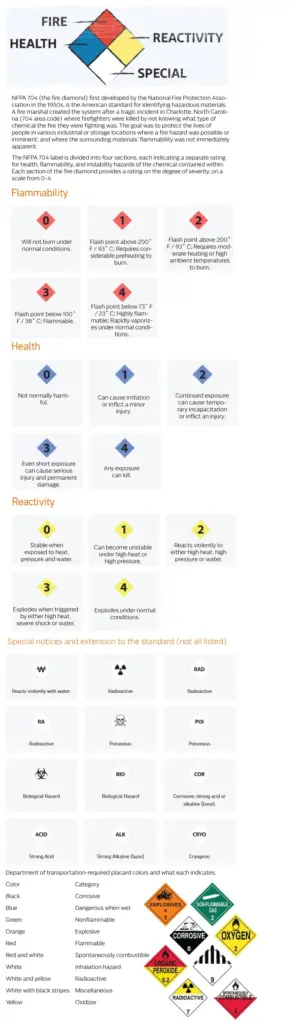
NFPA 704 (the fire diamond), first developed by the National Fire Protection Association in the 1950s, is the American standard for identifying hazardous materials. A fire marshal created the system after a tragic incident in Charlotte, North Carolina (704 area code) where firefighters were killed by not knowing what type of chemical fire they were fighting.
The goal was to protect the lives of people in various industrial or storage locations where a fire hazard was possible or imminent, and where the surrounding materials’ flammability was not immediately apparent.
The NFPA 704 label is divided into four sections, each indicating a separate rating for health, flammability, and instability hazards of the chemical contained within. Each section of the fire diamond provides a rating on the degree of severity, on a scale from 0-4.
Sources: Hazardous waste experts, Department of Transportation, Environmental Protection Agency, University of Texas at Dallas
Read more Waymo to deploy robotaxi built with Zeekr to expand public rides