
Nearly 2 million Californians live within 3 miles of a chemical plant using methyl methacrylate, the compound involved in the Garden Grove tank crisis over Memorial Day weekend, according to the U.S. EPA’s Toxics Release Inventory, the federal system tracking hazardous waste.
Read more No. 1 UCLA baseball stunned by Saint Mary’s to open NCAA Los Angeles Regional
A majority of those residents, or 1.6 million, are right here in Southern California, with roughly 117,000 living even closer, within a mile of such a facility, in Los Angeles, Orange and Riverside counties, records show.
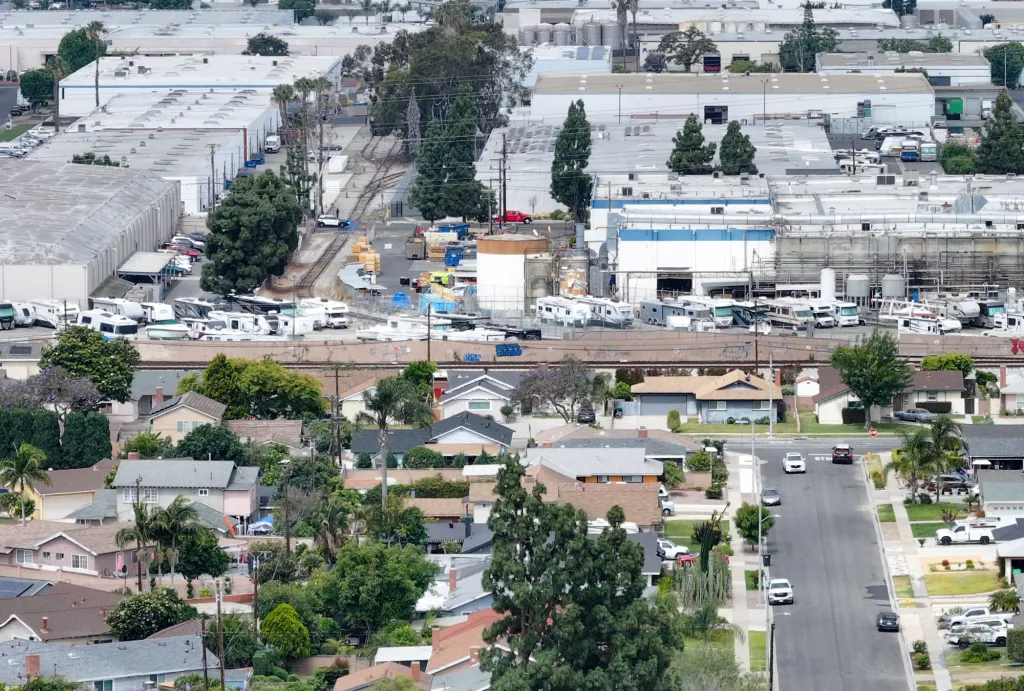
A malfunctioning storage tank at GKN Aerospace in Garden Grove cast a national spotlight on the intersection of these industrial plants and residential neighborhoods. The close proximity of the plant to homes and schools led to widespread outrage and now dozens of lawsuits after residents were displaced for days.
First responders rushed to GKN on Thursday, May 21, after a pressurized storage tank containing 7,000 gallons of methyl methacrylate — a chemical used in acrylic plastics manufacturing — began careening toward either a dangerous leak or an even more dangerous explosion. Evacuation orders forced 50,000 people in Garden Grove and neighboring cities into shelters and hotels through Memorial Day weekend until Tuesday night, when it finally became clear the risks of an explosion had been seemingly averted, thanks in part to a crack in the tank.
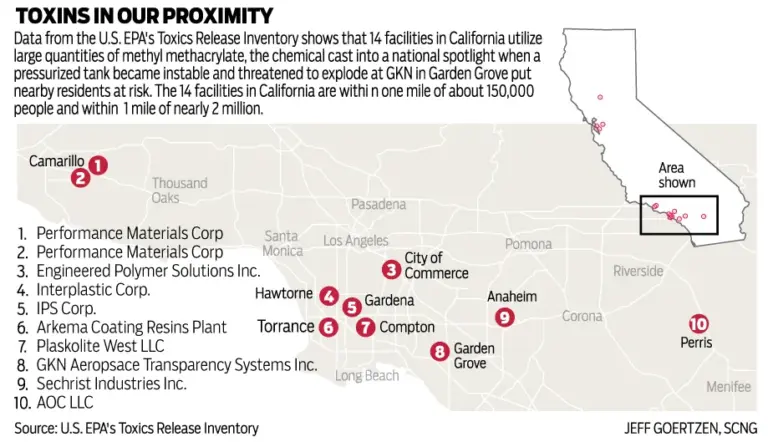
Fourteen facilities in California used methyl methacrylate, or MMA, heavily enough to make it onto the Toxics Release Inventory list. They collectively produced 333,518 pounds of MMA waste in 2024, the most recent year reported.
Such plants are predominantly located in communities of color, with an average of 77% of the residents within a mile identifying as such, according to census data.
In Southern California, those companies include:
- Performance Materials Corp., 45500 Fremont Blvd. and 460 Calle San Pablo, Camarillo.
- Engineered Polymer Solutions Inc., 5501 E. Slauson Ave., Commerce.
- GKN Aerospace, 12122 Western Ave., Garden Grove.
- Plaskolite West LLC, 2225 E. Del Amo Blvd., Compton.
- Arkema Coating Resins Plant, 19206 Hawthorne Blvd., Torrance
- IPS Corp., 17109 S. Main St., Gardena.
- Interplastic Corp., 12335 S. Van Ness Ave., Hawthorne.
- Sechrist Industries Inc., 4225 E. La Palma Ave., Anaheim.
- AOC LLC, 19991 Seaton Ave., Perris.
GKN topped the list that year, generating 131,779 pounds by itself, nearly double what it reported in 2023. That was the largest increase in the plant’s more than 30-year history, records show.
The company typically sends the MMA waste off to a facility in Arizona, where it is burned to generate heat and energy, records show.
GKN did not respond to questions about the significant increase in waste.
The second highest waste generator that year, Tesla’s plant in Fremont, produced 115,136 pounds of MMA waste, by comparison, records show. About 2,200 people live within a mile of Tesla’s Fremont facility, about 10 times less than those within a mile of GKN, according to the EPA’s data.
MMA is a widely used chemical that can self-react to form a type of plastic. This reaction, however, produces heat, which can be controlled through adding chemical inhibitors or utilizing release valves, chemists say.
Experts said while these types of chemical reactions happen “more often” than people might think, safety systems usually prevent such situations from spiraling out of control in the same way it did at GKN. Even when those systems fail, some storage tanks are designed to fail in “benign” ways to release pressure, much like the crack that formed on GKN’s tank, the experts said.
Multiple investigations at the state and local level are underway to unravel the full cause of the near disaster.
A failure in the chemical storage tank’s cooling system led officials to believe a “boiling liquid expanding vapor explosion,” or BLEVE, could occur that would have likely caused massive damage and released a toxic — and highly flammable — chemical plume into the air.
In the short term, MMA causes respiratory and skin irritation, but little is known about the longterm effects of the substance on humans, officials have said. The larger and more immediate risk came from the possible explosion.
Michael Kleinman, an environmental toxicity professor at UC Irvine, said it appears that valves to introduce the inhibitor or safely bleed MMA from the tank were inoperable in the Garden Grove crisis.
“This event could … be a wake-up call for companies using and storing MMA, or many of the hundreds of other toxic chemicals that feed our industries, to carefully review their safety and emergency measures,” Kleinman said. “If the plants are well-maintained, and appropriate safety measures are current and in place, there should be low cause for concern.”
However, a look at records maintained by the South Coast Air Quality Management District show that some plants that use MMA have checkered pasts for keeping up with regulations.
A 2007 inventory at GKN’s Garden Grove plant showed that a maximum 200,000 pounds of MMA was stored at the plant, outside at the southeast corner of the property. About 244,692 people live within 3 miles of GKN, records show.
In 2014, GKN was put on notice by the Garden Grove Fire Department for failing to submit a hazardous materials business plan, including an inventory of dangerous chemicals used at the plant and ways to mitigate an emergency.
The company was penalized $2,550 by the state Department of Industrial Relations in 2018 after an inspection revealed the company wasn’t inspecting or maintaining all machinery and equipment in service, including “fabricating and adding a top cover on head cover of Fadel CNC machines and using appropriate cutting coolant.”
Following an on-site inspection in November 2020, the South Coast AQMD cited GKN Aerospace in 2021 for failing to maintain required emission records for volatile organic compounds, which are gases emitted from paints, coatings and solvents.
The AQMD is a regional agency responsible for regulating air quality in Southern California.
The inspection also found that GKN had operated new equipment without obtaining a permit, operated existing equipment that did not match the description in a permit, and modified permitted equipment without applying for a permit change, as required by the AQMD.
GKN paid more than $900,000 as part of a settlement with AQMD in 2021.
Scrutiny at other plants
Plaskolite West at 2225 E. Del Amo Blvd. in Compton has been cited five times by the AQMD since 2003, including once for an MMA leak in March 2022 that generated hundreds of odor complaints from nearby residents. About 9,000 people live within a mile and 172,229 people live within 3 miles of Plaskolite.
Read more US commander meets with Cuban military officials as Trump pressures island nation
A report in the Los Angeles Times indicates the odor was from a bag of MMA that had cracked open inside a baking oven.
Plaskolite was cited for causing a public nuisance, according to AQMD documents. It was the second time that MMA had leaked from the plant. In 2003, vapors of 60,000 parts per million leaked from a pressure relief valve on a rail car storing MMA, records show.
Other violations throughout the years included creating another public nuisance in 2006 that generated more than 10 complaints and operating equipment contrary to its permit.
Residents near the Plaskolite site have long complained about odors from the plant, according to an air monitoring study sponsored by the state.
Sechrist Industries, which produces medical equipment at 4225 E. La Palma Ave. in Anaheim, had no AQMD violations and two notices to comply with regulations to use proper coatings and maintain proper records. About 134,000 people are within 3 miles of it, according to the EPA.
No AQMD files could be found online for AOC LLC. at 19991 Seaton Ave. in Perris, which produces high-performance resins. The company seemingly generated no MMA waste in 2024, and it’s unclear why it remained on the Toxics Release Inventory list.
IPS Corp., at 17109 Main St. in Gardena, produces residential and commercial plumbing products. It has been cited seven times by the AQMD since 2012 for such things as failing to report breakdowns and failing to maintain a system that measures and records temperatures.
Several times the plant was cited for not completing required compliance reports in a timely manner.
Engineered Polymer Solutions Inc., at 5501 E. Slauson Ave. in Commerce, a subsidiary of Sherwin-Williams, generated the third highest amount of MMA waste — 28,248 pounds — after GKN and Tesla in 2024, records show. It develops resins and colorants for architectural, industrial, construction and adhesive markets, according to its website.
The facility had 262,327 people living within 3 miles of it.
In 2021, the EPA accused the company of failing to perform daily checks of a chemical tank, not containing MMA, for 25 days, failing to properly label hazardous material and having excessive levels of volatile organic compounds — 20 times the allowable limit — near a vent. The company agreed to pay a civil penalty of $306,426, according to
Interplastic Corp., at 12335 S. Van Ness Ave. in Hawthorne, has received eight notices of violations from the AQMD in the last two decades. It produces polyester and vinyl resins, gel coats and colorants, according to its website. Interplastic had the most residents in proximity, with 348,635 within 3 miles.
A notice of violation from the AQMD in September 2025 declared the facility a public nuisance and alleged the company was operating without a valid permit. Another in 2024 accused the company of failing to keep equipment properly maintained and for failing to report a breakdown in a blending kettle, records show.
Another resin company, the Arkema Coating Resins Plant, at 19206 Hawthorne Blvd. in Torrance, did not have any notices of violations from the AQMD. The EPA did briefly find a series of minor violations during a compliance inspection in February 2023, but all of the issues were resolved within a month and no citations were issued, according to the EPA’s Enforcement and Compliance History website.
About 241,900 people live within a 3-mile radius of Arkema.
Arkema was the only company to respond to a request for comment. Spokesperson Dave Schrader confirmed that Arkema does store MMA on site and continuously monitors the storage area to detect unusual conditions “far in advance of a problem.”
The company reviewed its safety protocols this week in response to the situation at GKN, which is not connected to Arkema.
“The facility conducts regular emergency response drills with its own teams multiple times a year and with local emergency responders at least once a year to ensure the site is prepared in the unlikely event of an emergency,” Schrader said. “Arkema will review and consider any findings and recommendations from the Garden Grove incident.”
Regulations under scrutiny
At the same time that the GKN situation was unraveling, the rupture of a chemical tank containing a different chemical mixture killed 11 people at a paper mill in Washington state.
The two situations sparked renewed calls for stronger regulations around chemical plants and refineries. Last year, the EPA proposed repealing a 2024 rule that tightened safeguards designed to prevent explosions and chemical releases, according to Scientific American magazine.
The EPA argued those rules, the Risk Management Plan, threatened national security by making “sensitive facilities in America vulnerable to attack.”
Environmental advocates, however, argue the RMP helps protects residents near chemical facilities by requiring preventative safety measures and should be strengthened and expanded, according to the Coalition to Prevent Chemical Disasters. MMA is not currently one of the regulated substances, they noted.
“Every single chemical evacuation or lockdown and the industrial chemical tragedies that continue to happen show a strong need for EPA to fully implement and build on the Safer Communities Rule finalized in 2024, instead of taking away, weakening or delaying life-saving protection as EPA has proposed to do,” said Emma Cheuse, an environmental attorney with Earth Justice, in an email.
“With chemical emergencies and fatal disasters continuing to happen like clockwork around the country and disaster prevention measures available, it should be obvious to anyone concerned about the safety of millions of families and children in harm’s way that now is not the time to go backward on safeguards from toxic chemical incidents.”
The Coalition to Prevent Chemical Disasters maps and tracks every chemical disaster reported by the media on its website.
Read more Ghanaian mother and child who arrived in US on valid visas to fly home after detainment, lawyers say