
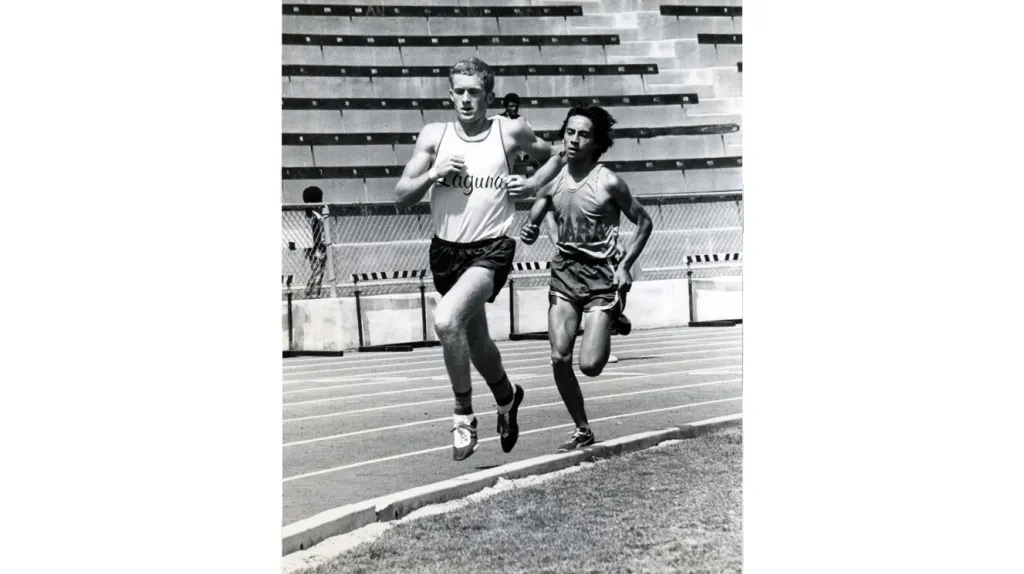
A few years ago Ralph Serna, the world champion runner from Loara High, and Robert Angel, an old high school rival at Huntington Beach, were waiting for a friend at a Fullerton sports bar when they struck up a conversation with another customer.
Read more Dodgers make series of roster moves with Teoscar Hernandez going to IL
There was a track meet on one of the televisions and the customer asked if he and Angel ran in high school?
The pair said they did.
“What years did you guys run?” the customer asked.
“I graduated in ’75,” Serna responded.
“Oh, you would have run against my older brother, he’s five years older than me,” the customer said. “Where did you go to high school?
“I went to Loara,” Serna answered.
“Did you ever meet Ralph Serna?” asked the customer, suddenly becoming excited.
Angel started laughing.
“I wasn’t there but …” the customer continued, his voice growing with the same enthusiasm that brought a crowd of nearly 16,000 to its feet that scalding afternoon 51 years ago, but still unaware that he was speaking to the man himself.
It was a scene Serna has encountered for decades, a conversation that, with or without him, had endured just as the race that inspired it has. The man at the bar recounting that epic race that more than a half-century later remains seared in the memory of those who witnessed it, a legend passed down from brother to brother, father to son, generation to generation.
It is a discussion that comes up especially this time of year, on the eve of the CIF State Track and Field Championships, a time when old runners and those who coached or followed them gather and debate past meets and generations and the impact of technology, the conversations invariably circling back to the race that stands above all others.
Hulst vs. Serna, San Diego’s Balboa Stadium, June 7, 1975.
The perfect race.
***
For years Ralph Serna ran it over and over and over again in his head, both haunted and searching, as if somehow he could change the result, retracing each step of the 1975 CIF State Championships 2 mile looking for something, anything that he could have done to reclaim a second, that single second that separated Serna and Eric Hulst at the end of the greatest high school race in California history.
Through eight unforgiving laps, Serna, a senior at Loara, chased Hulst, a Laguna Beach junior, around a track hotter (and harder) than Georgia asphalt, the pair pulling so far away from a field that included some of the nation’s best, indeed some of the world’s top teenage runners that they had created their own separate race, a duel in the sun that the crowd could not take its eyes off of, oblivious to anything in their wake.
It was a race that had been highly anticipated in California and in track and field circles nationally for nearly a year, the classic showdown of opposites: Hulst, the relentless frontrunner, who the previous summer at only 16 had knocked off older, more experienced Soviet runners to win the U.S.-USSR Junior dual meet 10,000 meters, versus Serna, the kicker, the nation’s top miler.
“We were playing poker with our cards up,” Serna said. “There were no secrets after the first couple of times we raced. Eric is going to go out hard and try and grind me and I’m going to try and stay close to him and hopefully have just enough to outsprint him because I knew I had better leg speed. There was no doubt. And that’s what happened.”
They were nearly a whole straight stretch ahead of the rest of the field as they entered the final lap, where Serna tried to pass three times and three times Hulst held him off, winning by a mere second in an 8-minute, 44.9-second clocking, setting a state meet record that would stand for 33 years.
“When Serna moved up to my shoulder on the gun lap, I was aware that he was there,” Hulst told reporters. “But it didn’t make me nervous. It made me run faster.”
A devastated Serna found no solace in the knowledge that only Hulst and Steve Prefontaine had run faster than his 8:45.9 during a high school season.
“It was the most competitive, most enduring State 2 mile I’ve ever seen,” said Don Chadez, a longtime photographer for Track & Field News. “It was just incredible.”
“Eric,” said Laguna Beach coach Jim Toomey, “ran the perfect race.”
“HIS NAME IS ERIC HULST”
As Toomey looked for a seat to watch the race that day at Balboa Stadium, he was spotted by his old cross-country coach at Palo Alto High School, Forrest Jamieson. Jamieson was a legendary coach in the Bay Area and took his sport so seriously that in the 1960s, he traveled to New Zealand to pick the brain of Arthur Lydiard, the influential coach of Olympic champion Peter Snell.
Toomey was primarily known as a standout baseball player in high school. The track star in the family was his brother Bill, the 1968 Olympic decathlon gold medalist.
“Toomey what are you doing here?” Jamieson asked.
“I’m a track coach,” Toomey said.
“Really?” Jamieson said. “Who are you coaching?”
“I’m coaching a kid in the next race,” Toomey said. “His name is Eric Hulst.”
“And he looked at me like, ‘Are you kidding me?’” Toomey continued, laughing.
By then, Hulst was already well known in the U.S., and even in international track circles for two years.
Hulst entered Laguna Beach High School in the fall of 1972 as a tennis player before catching the eye of the school’s cross-country coach, Len Miller. On March 1 the following spring, Hulst won his varsity singles tennis match that afternoon and then came back to win the varsity 2-mile in a dual meet that night. Two weeks later, Hulst gave up tennis.
By the end of the year he had lowered the national freshman 2-mile record to 9:04.5 and appeared in Sports Illustrated.
“I love to run against the best competition available and I really feel fortunate to be living in Southern California, where there are so many excellent distance runners,” Hulst said in a 1975 Runner’s World feature on him and Serna titled, “Best Of The Fast New Breed.”
Indeed, across Orange County, another phenom was also emerging. Serna ran a 4:19.7 mile as a ninth grader, then the state frosh record.
Hulst and Serna were opposites in almost every way other than their shared obsession with running.
Hulst was 5-feet-10, 150 pounds, his short red hair usually covered by a white ball cap when he ran. Serna was 5-6, 112 pounds, with long black hair.
Serna was outgoing.
“I always felt really close to Ralph,” said Roy Kissin, a San Ramon Valley star who roomed with Serna at the 1975 World Cross Country championships in Morocco. “A really good guy.
“Eric, I didn’t know so well. He was very quiet. He seemed sort of reserved. He was a bit of a mystery to me.”
“He was such an interesting kid,” Toomey said of Hulst. “At times he acted 17 or 18, or other times he acted like 35.”
Hulst ran 10 to 15 miles nearly every morning along Pacific Coast Highway, frequently carrying in each hand a 2.5-pound weight made out of melted down hubcap bolts.
“Emerald Bay to Corona del Mar and back,” Toomey said. “And that’s how he started his day.”
“I doubt if I did half of Eric’s mileage for a week,” said Serna, whose training focused on intervals, in particular quarter-mile repeats.
When Hulst was a sophomore, Miller moved on to coach at UC Irvine. One day, Miller spotted Toomey running around the Laguna Beach track and stopped him.
“You know track,” Miller said. “I need a track coach.”
“Well, I’ve been to track meets,” Toomey said. “But I’m a baseball player.”
It didn’t matter. Toomey was Hulst’s new coach.
One of Hulst’s go-to workouts was devised by Toomey and called “31 Hills.” Hulst would start in a hilly stretch of Laguna Beach, charge up one hill, then run at the top to the next block, down that street, run another block and sprint up that street, repeating the process up and down 31 hills.
“I was two miles from Disneyland, which is the flattest concrete jungle you could imagine,” Serna said. “We had no hills. Somehow Eric never beat me in cross country in high school.”
It was on the cross-country courses that the contrast in their running styles and strategies emerged.
“Ralph was such a beautiful runner to watch,” Kissin said. “Ralph had a graceful, effortless stride, where Eric would just sort of slug his way through.”He would just grind you down. He was a force.”
And he was fearless.
At the 1974 State meet in Bakersfield, Hulst followed Rich Kimball of De La Salle, the reigning World junior cross country champion, through a blistering opening mile in the 2 mile and then took the lead on the last lap before Kimball regained it, going on to win in in 8:46.5. Hulst finished in 8:50.5, a national sophomore record, and the fastest non-winning time ever in a high school 2 mile.
Kimball came back later in the meet to win the mile in 4:06.6 with Serna fourth in 4:09.2.
A few weeks later in what Track & Field News called a “stunning upset,” Serna knocked off Kimball to win the U.S. Junior (19 and under) Championships 5,000 meters by more than five seconds, lowering the national junior class 3-mile mark en route. Hulst made the U.S. team in the same meet, finishing second in the 10,000 meters.
Two weeks later, Hulst won the 10,000 in the U.S.-Soviet Union dual meet in Austin. Kimball just held off Serna to win the 5,000 by four-tenths of a second.With Kimball moving on to Oregon State, even more attention in California and nationally was focused on a rivalry that had been making headlines around Southern California for nearly a year.
“Serna, Hulst Race Today,” read a headline above a lengthy Los Angeles Times story before a November 1973 cross-country showdown. Serna at the time was a junior. Hulst was not even halfway through his sophomore year.
“Serna, Hulst duel featured,” was the headline before the 1975 CIF Masters track meet.
“In a meet loaded with prep ‘superstars’ – no less than five boys’ events boast national leaders – the two mile stands out,” read the story.
“That was the rivalry,” Serna said. “One hundred percent.”
“I wouldn’t bet against Eric at any time,” Toomey told a reporter in 1975. “And I wouldn’t bet against Ralph.”
They met four times in the fall of 1974, each race following a similar pattern: Hulst setting a hard pace from the gun with Serna trying to hold on long enough to outkick him in the end. Serna won all four races by a combined total of 7.2 seconds. He won the Orange County Cross Country Championships by just two strides, covering the 2-mile, 50-yard course in 9:10, a second ahead of Hulst.
In the National Postal 2-mile race on the track that November, Serna pulled away from Hulst on the last lap to run 8:56.0, the national post race record, with Hulst finishing in 9:00.2.
They would meet again that April at the Arcadia Invitational, the nation’s most prestigious prep meet, in the mile, Serna using a 59.8 last lap to blow away Hulst with a nation leading 4:07.0 to 4:11.3.
Serna used a similar strategy to win the CIF Masters mile, the state qualifying meet, finishing in 4:08.3, a new CIF record, with Hulst third in 4:10.2.
Hulst came back later in the meet to claim the 2 mile, taking the lead on the second of the race’s eight laps, finishing in 8:51.8, Serna running a personal best 8:55.6.
But then things got complicated.
THE DECISION
The CIF Masters meet followed the regular high school meet schedule with the mile as one of the first events and the 2 mile the next-to-last race. But at the State meet, officials alternated between sticking to the normal race schedule and running the 2 mile early in the meet and the mile later as had been the case in 1974 at the State meet in Bakersfield.
Those wanting to double at State also had to contend with mile qualifying heats on Friday, meaning runners would potentially have four miles of races in 24 hours.
Hulst and Toomey decided to withdraw from the mile at the State meet. Serna chose to double even though his best race would be the second of the two finals that Saturday.
Serna not only had confidence from his victory against Hulst in the national postal 2 mile the previous November but also his upset of Kimball at the U.S. Junior Championships and his 15th-place finish in juniors race at the World Cross Country Championships in Morocco in February, helping the U.S. win the team title.But Serna and his coaches were also influenced by Kimball’s State double a year earlier.
“I had been doubling in meets since my junior year,” Serna said. “They said after seeing Rich Kimball win the double in ’74 I should take a whack at it and do the same thing. That’s why I decided to take it all the way through to the State meet.”
“It made sense. ‘Rich Kimball did it. Why can’t I? I’m better than Rich Kimball,’” Toomey said of Serna. “And Rich Kimball was damn good.”
Still the decision surprised Toomey.
“Somebody convinced Ralph he could double and I think that was a big mistake,” Toomey said. “He deep down knew he could beat Eric, but you know what he didn’t.”
“THIS IS GOING TO BE INTERESTING”
A current of mixed emotions coursed through the State meet as it opened that weekend: the buzz surrounding the Hulst-Serna showdown and a sense of tragic disbelief over the death of Prefontaine a week earlier.
“Despite the presence of the nation’s best shot putter (Newport Harbor’s David Kurrasch) and the best pole vaulter (Villa Park’s Keith Schimmel), this has been the year of the distance runner in Orange County,” said the lead paragraph in meet preview story in the State meet program.
A moment of silence was observed before the meet’s first event. Prefontaine’s death hit Serna especially hard.
A neighbor had woken him up the morning of the CIF Masters meet to tell him that hours earlier, Prefontaine had been killed in an automobile accident in Eugene following a meet at Hayward Field. Serna had trained with Prefontaine, holder of all seven American records between 2,000 and 10,000 meters, on a March recruiting trip to Oregon.
“I ran with Pre twice on that trip and had to run really hard to stay with him,” Serna recalled. “He didn’t cut me slack as to be expected.”
Read more Angels experiment with prospect Christian Moore in left field at Triple-A
Now on Saturday afternoon in San Diego, as Serna joined 25 other runners on the starting line for the State 2 mile, he expected the same from a fresh Hulst.
The conditions that day were hardly ideal. The patched up, uneven Balboa Stadium track was so hard that regular artificial surface spikes had trouble penetrating it. Toomey was late getting to the stadium because he had spent much of the day driving around San Diego finding smaller needle spikes. Corona Del Mar’s Brian Hunsaker, the runner most likely to challenge Serna and Hulst, suffered blisters so badly that he spent the next two weeks on crutches.
“It was like running on a road,” Toomey said.
“I think I would have rather run on a freeway on a hot day,” Serna said. “At least it would have been level. Because it was all patchy and worn out. It was a terrible track.
Then there was the heat. The race started at 2:50 p.m.
“Worst time of day,” Serna said. “Tt was just terrible. A terrible, terrible day.”
“It was probably 90 degrees,” Toomey recalled, “and the track was probably over the 100 degrees.”
Hulst was determined to set a pace that would only increase his opponents’ suffering.
“He was going to make sure it was hard the whole way,” Toomey said.
Over dinner the night before the 2 mile, Toomey and Hulst came up with a plan to go through the first mile in 4:20 and then keep the pressure on in hopes of taking the sting out of Serna’s kick. Serna had already competed in the mile qualifying heats that Friday afternoon, running 4:13.3.
“The only guy in that race he was worried about was Ralph Serna,” Toomey said of the 2 mile. “And he knew that basically he had to make it a little difficult for Ralph to have any kind of kick at the end. He had been outkicked many times in cross country. And so that’s the results we came up with.”
Hulst, lined up in the second of two rows at the start, just over Serna’s right shoulder, got boxed in when the gun went off.
“The start was pretty treacherous,” Kissin said.
While Hulst tried to fight his way through traffic, Serna was in unfamiliar territory.
“Coming off first turn, somehow I found myself in the lead,” he said.
By 200 meters, Hulst had charged into the lead.
“I just remember Eric went out so hard,” Kissin said.
Serna tucked in behind Hulst.
“For the remainder of the race,” Serna said, “I couldn’t have been any closer to him.”
He was right on Hulst’s heels as the Laguna Beach star passed the first quarter mile in 65.3, there when Hulst upped the ante through the next two laps of 63.9 and 64.4.
“A couple of times Brian Hunsaker tried to move in between us and I just knew if I let anyone between us and they weren’t running the same race I was, which was stay as close to Eric as I was, I knew there could be a gap that opened up,” Serna said. “And I couldn’t let that happen running against Eric because once that happened, he’d be gone.”
Hulst passed the mile in 4:20.8, on pace to challenge both Steve Prefontaine’s 1969 8:41.5 clocking, the fastest ever 2 mile during a high school season, and the 8:40.9 run by Illinois schoolboy Craig Virgin in a national invitational after the 1973 school year.
“I was happy when I heard the mile time,” Hulst told reporters after the race. “I knew everybody would be tired with that pace.”
Serna was two-tenths back in 4:21.0.
“My first mile was 4:24, which was the fastest I’d ever gone out,” Kissin said. “But I’m still well back at that point. Eric and Ralph were well out in front.”
Hulst kept hammering lap after lap through the second mile but still could not shake Serna.
They passed the bell with a lap to go just inches apart, the crowd on its feet. At the CIF Masters mile the previous week, Serna had blasted away from Hulst with 300 to go.
“I made up my mind I’m not going to ever take the lead until I’m ready to win the race and go,” Serna said.
Now as the race approached the final backstretch, Serna was ready to pounce.
“I literally tried to pass him three times in the last 400,” Serna said.
In the stands, Toomey braced himself.
“When I saw him try and pass Eric (with 330 yards left),” the Laguna Beach coach recalled, “I thought, ‘Well, this is going to be interesting.’ And then he didn’t.”
“I tried to get him on the turn,” he said. “Didn’t make it. Backed off.”
With 220 yards remaining, Serna tried again.
“Tried to get ahead of him before we reached the final turn,” he said. “Didn’t make it. Backed off.”
To Toomey, it was the decisive moment of the race.
“I thought, ‘That’s it. Eric is going to win,’” Toomey said. “I just had a feeling.”
Serna, however, would make one more attempt to get past Hulst.
“And then we came around for the last 150 yards and tried to go and my tank was empty,” he said. “And that’s where it ended. And he ended up stretching it a little bit to a one-second win.”
Hulst’s 8:44.9 broke Kimball’s state meet record and made him the third fastest prep ever over 2 miles outdoors. His state meet record would stand until German Fernandez of Riverbank ran 8:34.23 for 3,200 meters (the equivalent of 8:37.43 for 2 miles) at the 2008 State meet. Serna’s 8:45.9 made him the fourth fastest prep in history. It was a time that would have won every 2 mile or 3,200 meters in the State meet’s 106-year history with the exception of 1975 and 2008. Kissin was third in 8:56.2.
“The best high school race I’ve ever seen,” Toomey said. “Two of the top distance runners of that whole decade.”
Hulst, in the moments right after the race, reminded Serna that his race had an additional distinction.
“He stopped me and congratulated me on having the all-time fastest losing time,” Serna said. “If it was anyone but Eric, you would be upset. But he was genuinely happy that I walked away with something, which was I was the fastest loser. I mean, call it that.”
It wouldn’t be his last loss of the day.
He had entered the weekend the nation’s fastest miler, the favorite to win the mile 80 minutes later that afternoon.Instead, Serna, physically and emotionally fried, was never a factor, finishing ninth in 4:22.6, 15 seconds off his U.S. leading time.
“It was a jog through basically,” he said. “For me, that was my mental moment there, I was done. As soon as I finished that 2 mile, without knowing, I was already done for the mile. I was just done.”
OUT OF GAS
Hulst finished in a virtual dead heat with Rudy Chapa, a junior out of Hammond, Indiana, in the U.S. Junior (Under-20) Championships 10,000 meters later that month, both runners clocked in 29:11.2, knocking six seconds off the national high school mark set 11 years earlier by Gerry Lindgren in an upset victory in the U.S.-Soviet Union meet at the Coliseum.
The following February, Hulst won the juniors race at the World Cross Country Championships in Wales, leading Team USA to a 44-point victory over second-place Spain.
“Eric, except for Prefontaine and Gerry Lindgren, was the best long-distance and cross-country runner ever,” Toomey said. “You put Eric on a 10,000 meter cross country course with hurdles, and I’m not sure there’s anybody who could beat him.”
Serna, then a UC Irvine freshman, was 19th in that World Cross Country race, picking up his second world champions gold medal. A month later, running in UCI’s Meet of Champions, Hulst became the first prep and the first world junior runner to break the 29:00 barrier, regaining the national record with a 28:54.8 mark, picking up the 6-mile standard as well (27:58.0).
Chapa, a future NCAA champion and American record-holder at Oregon, reclaimed the national record that April at the Drake Relays, qualifying for the U.S. Olympic Trials by running 28:32.8, nearly eight seconds under the Olympic qualifying standard. It was a new national high school record and world junior record by more than 20 seconds. Fifty years later, it remains the national high school record with Hulst still the only other prep to break 29:00.
Hulst took one more shot at the qualifying for the Olympic Trials that year, leading the AAU national championships race at UCLA before fading and finishing 29:30.6. It had been a long season.
“He just ran out of gas,” Toomey said.
That fall, Hulst joined Serna and miler Steve Scott at UC Irvine, the trio leading the Anteaters to the 1976 NCAA Division II cross country title. But suffering from a chronic knee injury, Hulst never again reached the heights he had as a prep and dropped out of college as a sophomore.
Serna won the 1975 and 1976 NCAA Division II individual cross country titles. But like Hulst, he was also hampered by injuries. He was 18th place at the 1981 Boston Marathon in 2:14:16, well under the Olympic qualifying standard. But he was unable to compete in the 1984 Olympic Trials because of an Achilles’ tendon injury.
Hulst tried to return to racing in the early 80s but again could not regain the form he showed in chasing the Olympic standard. He finished 28th in the 1982 Boston Marathon, his last major race.
Seventeen months earlier, in December 1980, Hulst and Serna were part of a world-class field for a 10,000-meter road race that finished at Anaheim Stadium. Serna was 16th in a race won by Scott, the Olympic Trials 1,500 champion, with Hulst four spots back. These two great rivals never raced each other again.
Hulst diagnosed with brain tumor
Serna, a shoe designer for Etonic, was on a trip to the company’s factory in Taiwan in February 1991 when a former UCI teammate reached out with bad news.
Days earlier, Hulst was unable to close his mouth after yawning while walking out of a movie theater with his mother. He was taken to the emergency room at a local hospital, where tests revealed a golf ball-sized tumor in his brain.
Serna finally reached Hulst after a few days.
“It was like nothing was wrong, he didn’t try to hide anything,” Serna said. “He was very up front about everything. This was just another challenge he’d get through, and if you knew Eric, you wouldn’t doubt it. If he said he was going to beat it, he was going to beat it.”
Surgery removed 80 percent of the tumor. The doctor intentionally left the remainder of the tumor as a precaution against possible brain damage due to excessively invasive surgery. In the following months, Hulst underwent alternative cancer treatment in Mexico.During the ordeal, Hulst sent out a card he made to friends thanking them for their support. On the front of the card was a scan of his brain showing the tumor on it.
“You’ve been on my mind,” read the front of the card.
“That was his sense of humor,” Serna said. “It was like, ‘Wow, holy smokes.’”
Serna planned a several-day layover in Orange County during a business trip in June 1992 in order to see Hulst, but was unable to reach his old friend.
Finally Serna got Hulst’s roommate on the phone. The tumor had expanded. Hulst was back in the hospital. Serna and Hulst never got the chance to speak one last time.
Toomey spent an afternoon with Hulst in his final weeks.
“A lot of memories,” Toomey said. “Went over in two hours his whole running career.”
Toomey paused for a moment.
“Eric was just special,” he said. “The guy had a heart that belonged to a Mercedes-Benz.”
Hulst died on June 21, 1974. He was 34.
A converted bedroom in Serna’s Anaheim home contains his track memorabilia. There among his U.S.A. and Soviet Union and West Germany singlets, part of his collection of 400 pairs of running and track shoes, the adidas spikes worn by 1956 Olympic 1,500 champion Ron Delany (SP) from Ireland, shoes belonging to New Zealand’s John Walker, the first man under 3:50 in the mile, the Jim Ryun autobiography signed by Ryun, American record holders Jim Grelle, Wes Santee and Snell, is one of Hulst’s singlets, a gift from Hulst’s mother Sharon on Serna’s 60th birthday.
“It’s there among my prized possessions,” Serna said.
A reminder of the man he will forever be linked to, the ghost he chased through the years.
IN SEARCH OF THE PERFECT RACE
Serna had planned to go out for a celebratory dinner with his girlfriend, her sister and the sister’s boyfriend on the way back to Anaheim from Orange County after the 1975 State meet.
Instead, he said, “I just remember I was kind of like a zombie. I didn’t have anything to say. They knew. They were very kind. They gave me my space.
“I don’t know if I said more than 10 words for the next three, four hours. I was just running it over and over.”
And he would continue to run it over and over in his head, step after step, lap after lap, year after year, still in search of that second, the second that would forever separate he and Hulst.
Finally he had an epiphany.
“I just came to realize I had run my perfect race,” he said. ” I had PRed by almost 10 seconds from the week before.”
It was a realization that came after he began to see the race through the eyes of those who witnessed it, the realization that he hadn’t been the only one who kept running the race running over and over in their head.
Two, three, four times a year, strangers would come up to Serna at meets, at social functions, in sports bars and bring up that June 1975 day.
“The first thing they would always say was, I was in junior high school or I was ahead of you or I saw you run once and I can stop them and say, ‘Balboa Stadium, 1975’ and they would say, ‘Yes, that was the greatest race I ever saw. I couldn’t believe it.’
“That’s the way people saw it.”
“Once I started hearing that more and more, I realized, you know what, I ran a great race, it was a perfect race. It took me those years to come to the epiphany that you know I did run a perfect race. That was it. It was two perfect races. I just happened to run against a guy who had a better perfect race, who also ran a perfect race and his perfect race was one second faster than mine.
Read more Angels’ 7th-inning meltdown leads to loss against Rays
“So how can I be mad at that? I can’t be.”