
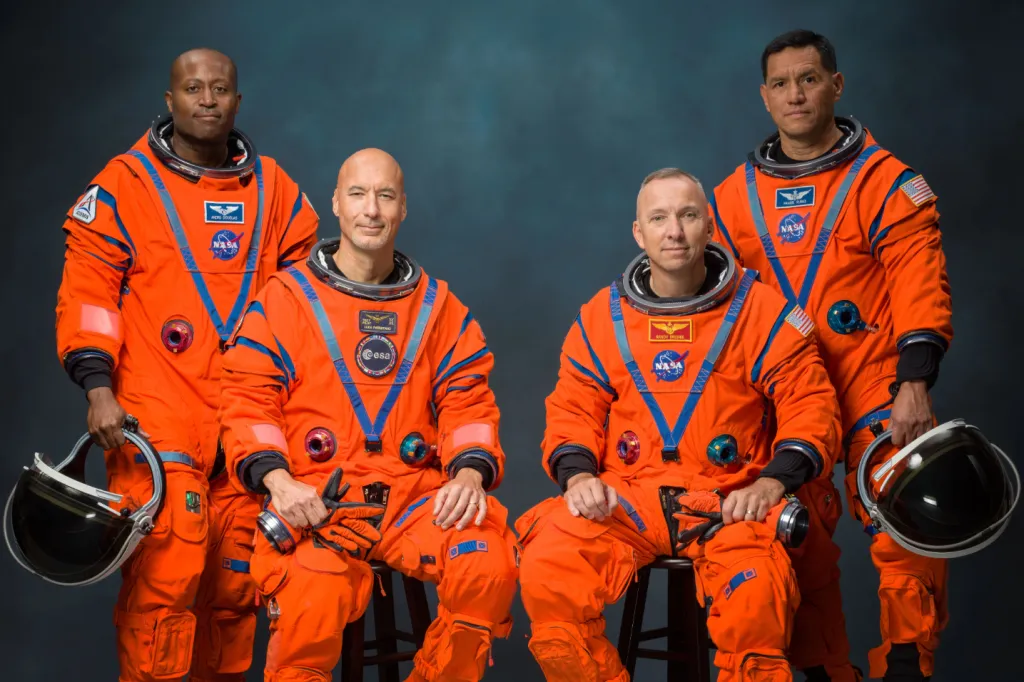
They won’t be flying to the moon, but will be paving the way. NASA announced today the four astronauts assigned to Artemis III, a mission targeting launch from Kennedy Space Center next year.
Read more UK, France and other Western nations issue new sanctions on Israeli settlers in the West Bank
“So you want to find out who the astronauts are?” Isaacman said jokingly before revealing the quartet during an event at Johnson Space Center in Houston.
Commanding the crew is NASA veteran Randy Bresnik who will be leading pilot Luca Parmitano of the European Space Agency along with mission specialists and NASA astronauts Frank Rubio and Andre Douglas.
“Wow, what an amazing day it is today,” Douglas said. “My brain, it is going a mile a minute right now, but my heart, my heart, it is so warm, it is so full.”
Douglas, 40, a Miami native but raised in Chesapeake, Virginia, was NASA’s backup astronaut for the Artemis II mission. He was chosen as part of the 2021 class of astronauts and was previously a commander in the U.S. Coast Guard.
He went on to thank his mom and dad, wife and kids.
“Dad, that work ethic that you showed, that work ethic, I was trying to emulate you, you,” he said. “Oh, by the way, happy early Father’s Day.”
Bresnik, 58, flew on Space Shuttle Atlantis on STS-129 in 2009 and then on a Soyuz mission in 2017 for a long-term stay on the International Space Station. Bresnik was born in Fort Knox, Kentucky, chosen as part of the 2004 class of NASA astronauts and retired with the rank of colonel from the United States Marine Corps.
“It is an honor and a blessing to be a part of such a stellar crew. I must also say thanks to our spouses and our families. Without their support and sacrifice, we would not be standing up here before you right now,” Bresnik said, noting it’s the “support of our families that’s going to carry forward from today when we start training very soon, carry us all the way to when we launch off Earth until we are returned to them safely after splashdown back here on planet Earth.”
Parmitano, 49, is a two-time spaceflight veteran having flown on Soyuz to the space station in 2013 and 2019. Born in Palermo, Sicily, Parmitano was chosen as an ESA astronaut in 2009 and is also a colonel in the Italian Air Force.
“There are many parts that need to come together for a space launch, and you need a launch pad, and for me that launch pad is my country, Italy,” Parmitano said. “Its education system, the Italian Air Force, they gave me the professional tools to bring me here today, the Italian Space Agency, they gave me the first flight to put those skills to proof, and for that I’m very grateful.”
He then likened the ESA as the launch tower, NASA the rocket, and his wife and family as the fuel.
“You are the energy that feeds my soul, you and your love is the spark that ignites every passion. Thank you. Grazie,” he said.
Rubio, 50, born in El Salvador but raised in Miami, spent nearly 371 days in space having flown to the space station on a Soyuz spacecraft in 2022 for what was supposed to be about a six-month stay, but ended up lasting more than a year after Roscosmos elected to send the damaged spacecraft home. His spaceflight holds the record for longest by an American. Chosen as a NASA astronaut in 2017, Rubio was previously a flight surgeon in the U.S. Army and also holds the rank of colonel.
Rubio called out the NASA support teams and the rest of the astronaut corps saying, “We look forward to representing you guys and to helping take the next step, so that we can watch you guys continue to make history.”
NASA also announced that veteran Bob Hines, who most recently flew on the Crew-3 mission to the space station, will be the backup for the four crew of Artemis III.
The mission will mark the third launch of NASA’s Space Launch System rocket and Orion spacecraft, but only the second with crew on board following this year’s successful lunar flyby Artemis II mission.
Read more FDA OKs first new sunscreen ingredient in more than 25 years
“We’ll use Artemis III to get into the rhythm of multi-launch campaigns, test the interoperability across several systems while close to home, learn and improve, and inform the changes necessary when the torch will be passed once again,” Isaacman said.
Instead of returning to the moon, Artemis III will remain in low-Earth orbit with its primary objective of testing out Orion’s docking capability with one or both of the two lunar landers that could be tasked to fly the next mission, Artemis IV.
Those are SpaceX’s Starship and Blue Origin’s Blue Moon MK2 landers. NASA had previously stated that pathfinder versions of both landers equipped with docking capability were pushing toward being ready for what had been targeted as a mid 2027 launch.
“The most important Artemis mission will always be the next Artemis mission,” Bresnik said. “Where we are doing flight tests on every single flight, incrementally determining the flight envelope, expanding it, proving out capabilities, and making the operational procedures that we have more and more precise. Because every single mission we will do after this will be more challenging and more complex.”
NASA also updated the mission plan in addition to the astronaut assignments.
The flight plan calls for a two-week trip during which it will first dock with Blue Moon, then Starship before returning home. It also plans to have a version of Axiom Space’s lunar spacesuit to interact with at least one of the landers while in orbit.
The plan would be to launch Blue Moon first, which can be up in space for 90 days, and gives more flexibility for a rendezvous with Orion.
SpaceX remains in testing phase with Starship, which most recently flew this month on its 12th suborbital flight from the company’s Texas launch site Starbase. The spacecraft, though, for now remains grounded by the Federal Aviation Administration following an issue with the Super Heavy booster that was not able to make a controlled return after the upper stage Starship separated from it after launch.
Elon Musk’s company continues to build out a launch tower at KSC’s Launch Complex 39-A adjacent to its Falcon 9 and Falcon Heavy launch pad. SpaceX’s goal is to begin operational launches from KSC before the end of the year.
Blue Origin’s lander was supposed to launch atop the company’s New Glenn rocket from Cape Canaveral Space Force Station’s Launch Complex 36, but that pad suffered major damage after a massive explosion of a New Glenn rocket during a static fire test last month.
NASA Administrator Jared Isaacman said that despite the pad damage, NASA and Blue Origin were pushing forward with the Blue Moon work, and stated confidence New Glenn would be available to launch to partake in the mission.
“Artemis III is an incredibly exciting, complicated, and highly coordinated multi-launch campaign. It’s going to happen in a short period of time with three of the world’s most powerful rockets,” said Artemis Program Manager Jeremy Parsons.
If both landers are ready, the Artemis III mission could feature three launches: SLS from KSC’s Launch Pad 39-B, Starship from KSC’s tower at 39-A and Blue Moon from Canaveral’s LC-36, potentially.
“This mission is deliberately designed to take calculated risks, so that future crews will be safer and ultimately successful when we put boots on the lunar surface,” Parsons said.
The agency would then pick one of the two landers for Artemis IV, which remains on NASA’s target calendar for launch in 2028 before the end of Trump’s presidency.
That’s the mission that aims to return humans to the surface of the moon for the first time since Apollo 17 in 1972.
Read more MIT researchers channel AI to turn hand gestures into robot training data