
Read more How Sen. Alex Padilla has emerged as a leading Democrat in voter rights advocacy
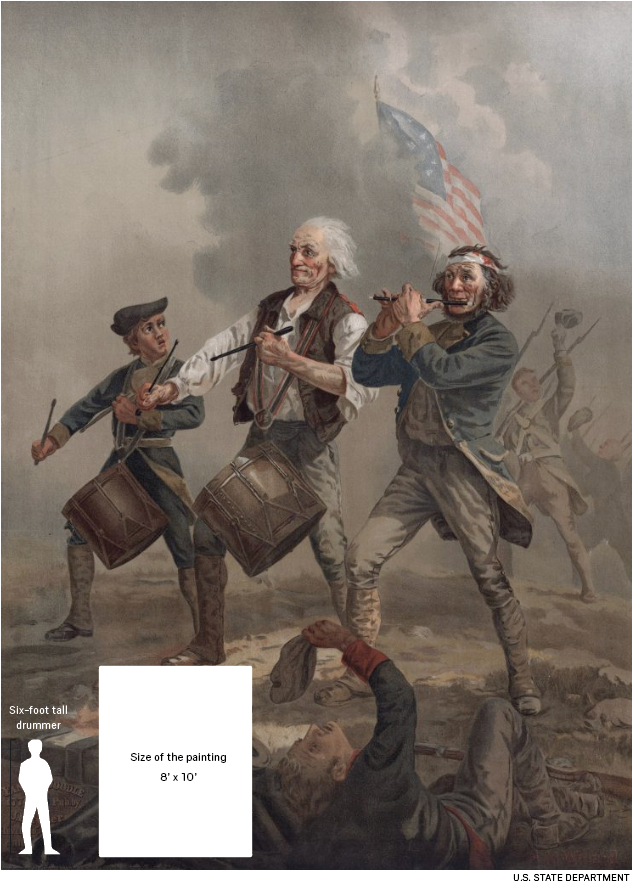
The 8’ x 10‘ oil painting was made in Ohio by Archibald McNeal Willard (1836-1918) for our country’s 100th year anniversary. He moved to New York City to study art in 1873. He first painted this work for the Philadelphia Centennial Exposition of 1876.
When first completed it was known as “Yankee Doodle,” and only later became known as “The Spirit of ’76.” Critics at the time considered it to be cartoonish but it seized the public imagination and wound up traveling across the country. After the Exposition, it went on tour from Boston to San Francisco, and was admired by sellout crowds wherever it was shown.
Hot in Cleveland The painting’s popularity led Willard to paint an estimated 14 more versions. Two copies are held in Cleveland, one at the Western Reserve Historical Society and the second at Cleveland City Hall. The one you see here is the property of the U.S. State Department and was most likely painted in 1875. The models were Hugh Moser, a Civil War veteran and friend of Willard’s playing the fife, Henry K. Devereux, son of Gen. John H. Devereux, (who bought one of the paintings) served as the model for the drummer on the left and Willard’s father (Rev. Samuel Willard) as the older drummer.
Yankee Doodle DandyThe words to this song were written as a slap in the face to Americans. “Yankee Doodle” is a famous example of an insult that backfired. The term Yankee is difficult to nail down but some historians say it is derived from Dutch words that were pronounced “John Cheese” in the 1850s. A “doodle” is a country hick, and a “dandy” is a conceited jerk. Riding on a pony is an insult as a proper military commander rides a horse. Stuck a feather in his cap and called it macaroni is insulting because a macaroni was a pejorative term used to describe a fashionable man with feminine traits of 18th-century Britain. British troops played the song while marching out of Boston to Lexington and Concord in 1775. The Colonists adopted the lyrics and tune for motivation.
Read more What I’d tell my 1984 self about real estate today
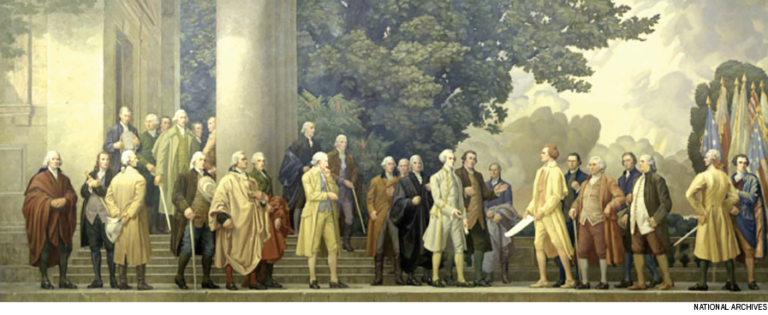
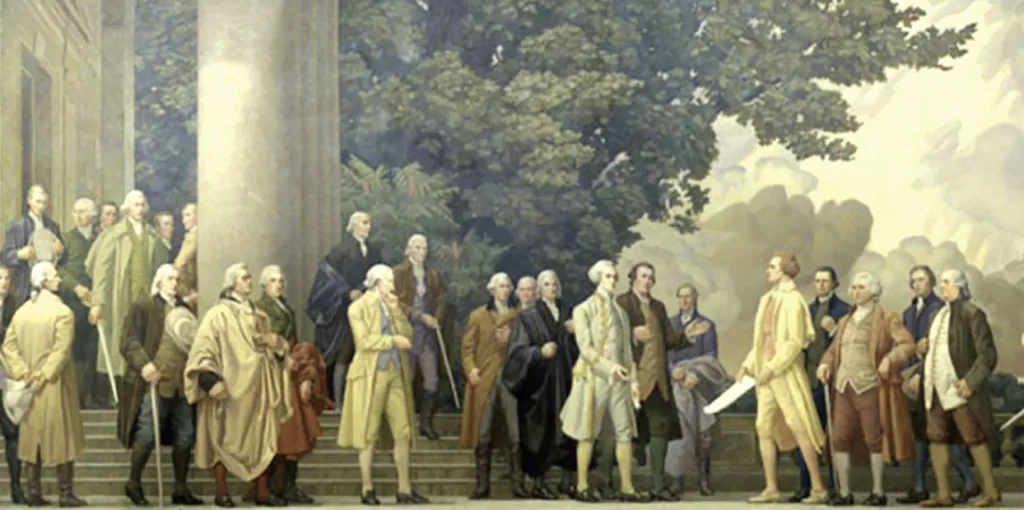
A mural in the National Archives Rotunda depicts Thomas Jefferson of Virginia handing over his carefully worded and carefully edited draft of the Declaration of Independence to John Hancock of Massachusetts. Many of the other Founding Fathers look on, some fully supportive, some apprehensive. The murals were installed 85 years ago in 1936 and restored in 2002. The Rotunda for the Charters of Freedom is the permanent home of the Declaration of Independence, Constitution of the United States and Bill of Rights. In a vote held by the National Archives, 75.9% of the participants named the Declaration of Independence the most influential document in American history.
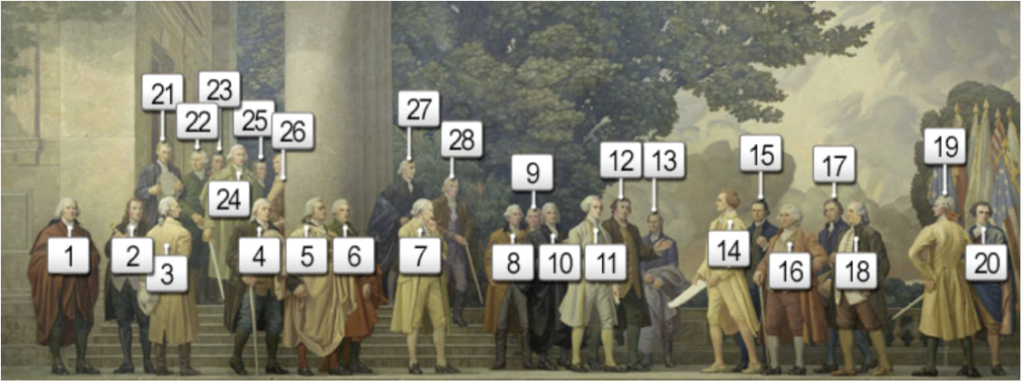
Who’s in the mural: 1. Robert Morris, Pennsylvania 2. Samuel Chase, Maryland 3. Charles Carroll, Maryland 4. Stephen Hopkins, Rhode Island 5. Samuel Adams, Massachusetts 6. Thomas McKean, Delaware 7. John Dickinson, Pennsylvania 8. Abraham Clark, New Jersey 9. William Ellery, Rhode Island 10. John Witherspoon, New Jersey 11. John Hancock, Massachusetts 12. Benjamin Harrison, Virginia 13. Samuel Huntington, Conn. 14. Thomas Jefferson, Virginia 15. Roger Sherman, Connecticut 16. John Adams, Massachusetts 17. Robert R. Livingston, New York 18. Benjamin Franklin, Penn. 19. Richard Henry Lee, Virginia 20. Thomas Nelson Jr., Virginia 21. Joseph Hewes, N.C. 22. Edward Rutledge, S.C. 23. Lyman Hall, Georgia 24. Josiah Bartlett, N.H. 25. Thomas Stone, Maryland 26. Francis Hopkinson, N.J. 27. George Wythe, Virginia 28. William Floyd, New York There were 56 who signed the Declaration of Independence.
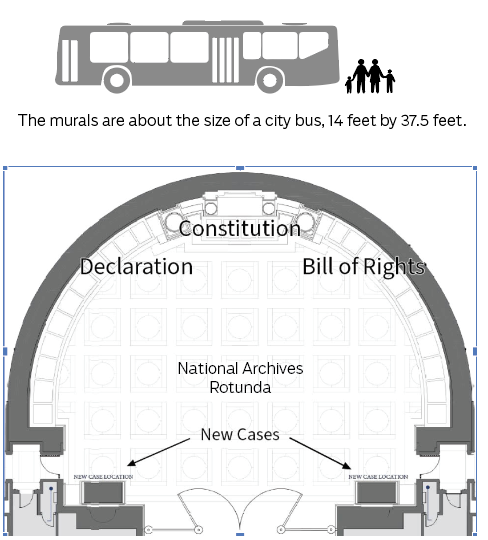
The National Archives Building’s architect, John Russell Pope, designated space for two large murals in the Rotunda for the Charters of Freedom. These oil-on-canvas paintings were executed by artist Barry Faulkner between 1933 and 1936. Faulkner created allegorical scenes depicting the writing and adoption of the Declaration of Independence (above) and the Constitution of the United States.
Sources: Americanrevolution.org, case.edu, National Archives, Whitehouse.gov, Smithsonian, Kennedy-center.org, Mountvernon.org
Read more UFC 329: Conor McGregor confident for rematch with Max Holloway