
There was no big ceremony, no champagne celebration on stage, no big check with prize money.
Read more How to protect yourself from the bad air caused by wildfires
Peter “PT” Townend got a call to meet up at the Outrigger Canoe Club in Honolulu for a photo op. Turns out, the Australian surfer had earned the most points in a series of surf contests held throughout the year, enough to be declared the first world pro surfing champion in 1976.
Fred Hemmings, who along with surfer Randy Rarick helped the pro surfing idea come to life, had a key to the outrigger club’s trophy cabinet and plucked out a shiny one as a photographer with the Honolulu Advertiser newspaper snapped photos of Townend proudly holding the impromptu surf trophy.
“That was the birth of pro surfing,” said Townend, 73, still an active, iconic fixture in today’s surfing scene.
This year marks the 50th anniversary of the first World Surf League pro surfing champion being crowned, a milestone in surfing’s history being celebrated as the US Open of Surfing gets ready to ride into Huntington Beach.
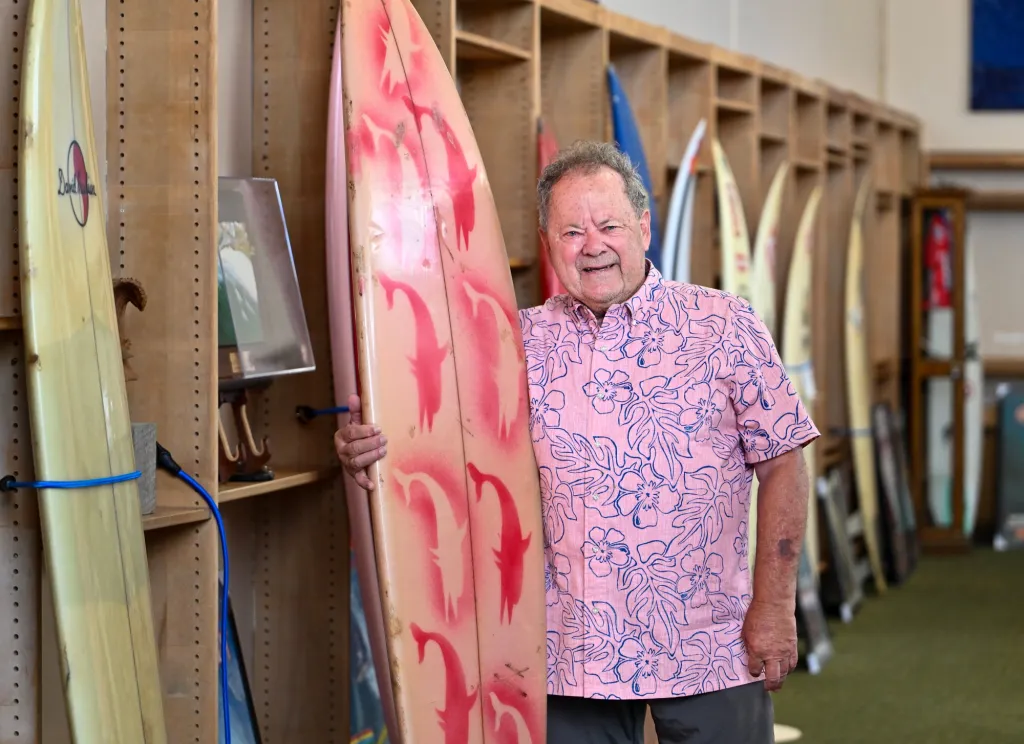
“Our dreams came true,” Townend said on a recent day, adorned in his trademark pink attire.
Addicted to surf
Townend’s dad made him a deal — get your lifeguard medallion, and you can get a surfboard.
Townend grew up in the Australian beach town of Coolangatta, and like many young kids on the coast, joined the area’s surf lifesaving club. A lifeguard bronze medallion was given after a “nipper” graduated from the training program.
He was 15 when he got his first surfboard for Christmas in 1966.
Townend’s grandmother had a house right on the beach, so straight after school each day he’d rush there to catch waves.
“I clearly remember my first day paddling out and catching my first wave,” he said. “And of course, you just get addicted. Once you get your first ride, then you gotta keep doing it more and more and more and more.”
And he got good. Really good.
At the surf lifesaving club competitions, Townend was winning all the contests, eventually becoming club champion.
He joined Australia’s national team, winning a bronze medal for his country in 1972 in an International Surfing Association World Championship contest in San Diego, not knowing at the time that Southern California would soon become his home.
The next step was to start competing on what was called the “gypsy tour” through the early ’70s, a series of contests held around the globe.
In Australia, Townend and a few others in 1975 had created the Australian Professional Surfing Association, with rankings based on Grand Prix races.
The next year, while in South Africa, they showed the system to Rarick, a fellow surfer, who then brainstormed the idea with Hemmings, the Hawaiian contest director.
Halfway through the 1976 season, the duo announced they were going to determine a world champion based on the points system at the end of the year. Some of the contests had already happened, and the competitors were just heading into the Hawaii season, where four of the 12 events were held.
“I was already experienced in Hawaii, and had some really good results already,” Townend said.
At the time, there wasn’t a big buzz about who would become the first world champ.
“It didn’t really mean anything, because there was nothing you could compare yourself to,” Townend said.
Mostly, they were excited to win events with the hopes of getting exposure in surf magazines, the only way to gain notoriety in those days.
“If you did well, that made you a famous surfer,” Townend said. “We wanted to be famous.
A good result could also put a bit of prize money in their pockets, enough to stick around Hawaii’s North Shore to surf more waves.
The biggest prize in those days was $5,000 for a big win. Townend earned fourth place in 30- to 40-foot Waimea waves on the North Shore of Oahu, earning a whopping $400 — needed funds because he had broken a surfboard in half during the contest.
During the tail end of that season in 1976, Townend had made three of the four finals, reaching the semi-finals at the Pipe Masters, and coming second to fellow Aussie and friend Ian Cairns in the World Cup, the last event of the year.
Rarick added up the points, and that’s when Townend got the call from Hemmings that he was declared the first pro surfing world champion.
“We were looking for any publicity we could get. Because that might mean we’d make some money,” said Townend, who at the time had joined forces with Cairns and other Australian surfers to create the “Bronze Aussies,” a marketing effort to help make a name for themselves in the mainstream.
When he got home to Australia, images of Townend and his trademark pink board — an idea his mom had so he would always stand out — were splashed across newspapers. One paper had him on the front cover alongside singer Rod Stewart.
“It was a big deal in Australia,” said Townend, met at the airport by a swarm of media.
He was officially famous.
A clear vision
The pro surfing circuit, today known as the World Surf League’s World Tour, was based on the concept of Formula One racing and a world tennis tour at the time.
“We want to be those guys. Multiple stops, a scoring system, all that stuff,” Townend said. “We clearly had that vision.”
The group of surfers pushing for a professional tour also included Australian Cairns, who now calls Laguna Beach home, and a group of South Africans, including Shaun and Michael Tomson, as well as a handful of Hawaiian surfers.
Read more Trouble getting weight loss drugs covered by insurance? Here’s what to know
Townend was just getting geared up for the next competitive year when he got a call from Laguna Beach filmmaker Greg MacGillivray to do the surf film “Big Wednesday.”
The most he could make winning another championship was $26,000. But the film would pay $1,000 a week.
So he stepped back from the competitive surfing scene, still holding the world champion title, to try to make money in Hollywood.
Documenting a surf exploration in El Salvador, “Big Wednesday” was a hit.
In 1978, Townend went back to competing to give another shot at a title and came in fifth in the rankings, placing the same the following year.
He had met a girl from Fountain Valley, and they were expecting the first of what would be their three children, so Townend planted his roots in Huntington Beach, drawn to the town’s rich surf culture.
He wasn’t making the money as a pro surfer to raise a family, so he became the executive director, alongside Cairns, of the National Scholastic Surfing Association.
Townend would then team up with Cairns to form Sports and Media Services. They would create the O.P. Pro Surfing Championships, the precursor to the US Open of Surfing, first held in Huntington Beach in 1982.
At the OP Pro, they introduced the “priority rule” for the first time, meaning the first surfer to get to a buoy set in the ocean has the first pick of waves, revolutionizing surf contests.
They created a scoring system, announced live to competitors and spectators on the sand.
After a few years, Townend became a surf coach, and in 1984 led the USA surf team to earn a gold medal at the ISA World Games, beating out his native Australia.
He then got a call from Bob Mignogna to join Surfing Magazine, where he worked in advertising sales for 10 years.
“That became a real job,” Townend said with a chuckle.
In the late ’80s, Townend helped create Surfing America, a junior’s program that would eventually become USA Surfing, today the governing body for the United States’ Olympic team.
“The US was in such disarray. We weren’t even rated in the Top 10 in the world and surfing. I just felt that we needed to do something, and we needed to make a change,” said Townend, who worked alongside then Surf Industry Members Association Executive Director Dick Baker to create the program. “We needed to get the stature of American surfing, specifically mainland American surfing, back on the map.”
Townend, the next year, became coach of the USA junior team that nabbed a silver medal in Tahiti.
Townend also became an original board member for the Surfing Walk of Fame, created in 1994 in front of Jack’s Surfboards on Main Street and Pacific Coast Highway — 200 names etched into granite in the years since.
He still spearheads the event and is the master of ceremonies each year during the US Open.
“I bleed surfing,” said Townend. “Surfing made me who I am.”
Fifty years of pro surfing
Since celebrations launched earlier this year to mark the 50th anniversary of the first World Surf League pro surfing champion, Townend has been to his homeland of Australia three times for meet-and-greets and parties, including during a stop in Coolangatta, where he had a big party with family and friends.
Now back in Huntington Beach, Townend is busy curating the Huntington Beach International Surfing Museum’s exhibit on the anniversary.
It will be the first exhibit in the museum’s new home at the Main Street Library, launching with a grand opening party on July 24, the day before the US Open of Surfing action gets underway.
Ten artists will showcase artwork illustrating moments and people in pro surfing over the past five decades.
Townend has acquired surfboards from well-known champions such as Kelly Slater, Lisa Anderson and Tom Curren.
“That, to me, is gonna be one of the cornerstones of this exhibit,” he said.
Surfboards beginning with the Duke Kahanamoku era at the turn of the century through modern days will be on display, all the way up to the current world champion, Brazil’s Yago Dora’s board.
The Brazilians becoming the dominant force in the surf scene is something Townend said he would have never predicted in those early years.
Women’s surfing is continuing to blow his mind, he said, especially the younger girls giving the veterans fierce competition.
Fifty years later, reflecting on the list of surfers with the title of “surfing world champion,” the designation means a lot more than it did in those early years, Townend said. There’s 11-time world champion Slater, and three-time champions Andy Irons and Gabriel Medina, and so many others forever immortalized on the list.
“A lot of people don’t even realize pro surfing has been around for 50 years. And I go, ‘I was the first champ. I was the first Kelly Slater,’” Townend said with a chuckle. “Because then they understand what it is. Everybody knows Kelly Slater.”
Much has happened since those early years, Townend said, when a younger version of himself became the first world champion.
He thinks back to the advice his mom gave him when he was a kid.
“Son, just be the best you can be,” he recalled his mom saying. “So in all the things that I’ve done, I’ve just tried to be the best I could be, in whatever that might be.”
If you go
The Huntington Beach International Surfing Museum’s grand opening exhibit will happen from 5 to 7 p.m. on July 24 at 525 Main St., Huntington Beach. It is open to the public and free to attend.
Read more Proposal to end California’s top-two jungle primary system moves forward