
The enemy of your enemy is…
Still your enemy because you still disagree about stuff like carbon footprints and social environmental justice, but not so much of an enemy that you won’t co-author a press release that says how your hair is on fire because of the latest federal attack on the state’s environmental laws.
Read more Europe’s early heat wave led to a spike in deaths, may have killed over 10,000
That’s a lot wordier and weirder than the actual adage: “The enemy of my enemy is my friend.” But it gets at the essence of what’s happening this month as Southern California’s sprawling, bickering world of environmental advocates is setting aside differences to collectively battle what they view as President Donald Trump’s push to neuter the California Coastal Commission and, with it, the state’s ability to chart its own environmental future.
The latest salvo – a federal review of the Coastal Commission that will include a series of public meetings scheduled for next month – is just the most recent punch in a long-running fight between the Trump administration and California’s environmental community.
The slugging has gone both ways, but the state’s losses have been piling up.
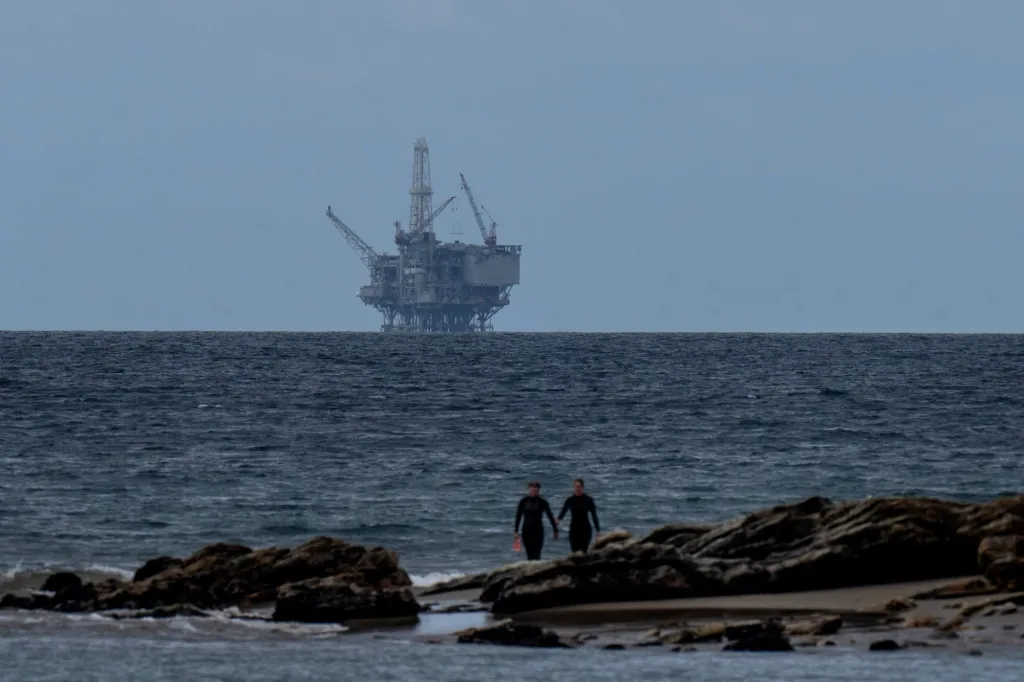
In 2019, for example, the Trump administration essentially yanked away a decades-old legal waiver that had allowed California to set its own clean air rules. And, last year, the administration offered to pay wind-power companies to kill clean-energy projects that California regulators liked. Most recently, the administration invoked a national emergency declaration to override the state’s objections to reopening an oil pipeline off the coast of Santa Barbara County.
All that losing has led to friction, even among people who generally share a belief that regulating natural resources is good for public health and the economy.
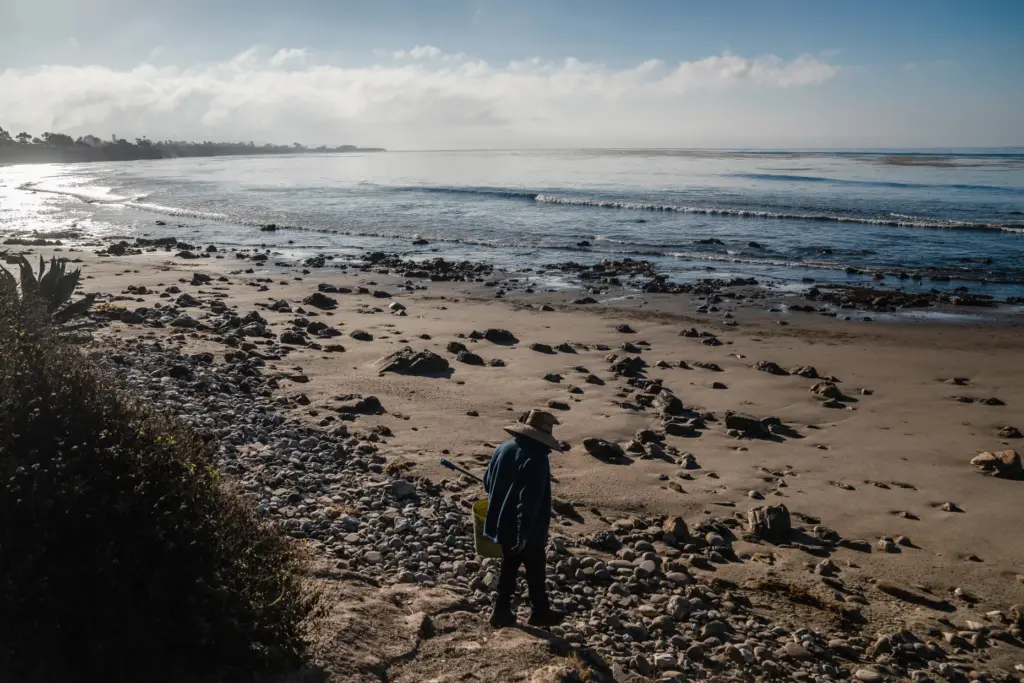 Sands Beach next to Coal Oil Point Natural Reserve in Santa Barbara, Calif. on June 27, 2026. The region is prized for its gorgeous beaches and ocean views. It also sits on one of the world’s richest offshore oil reserves. (Ariana Drehsler/The New York Times)
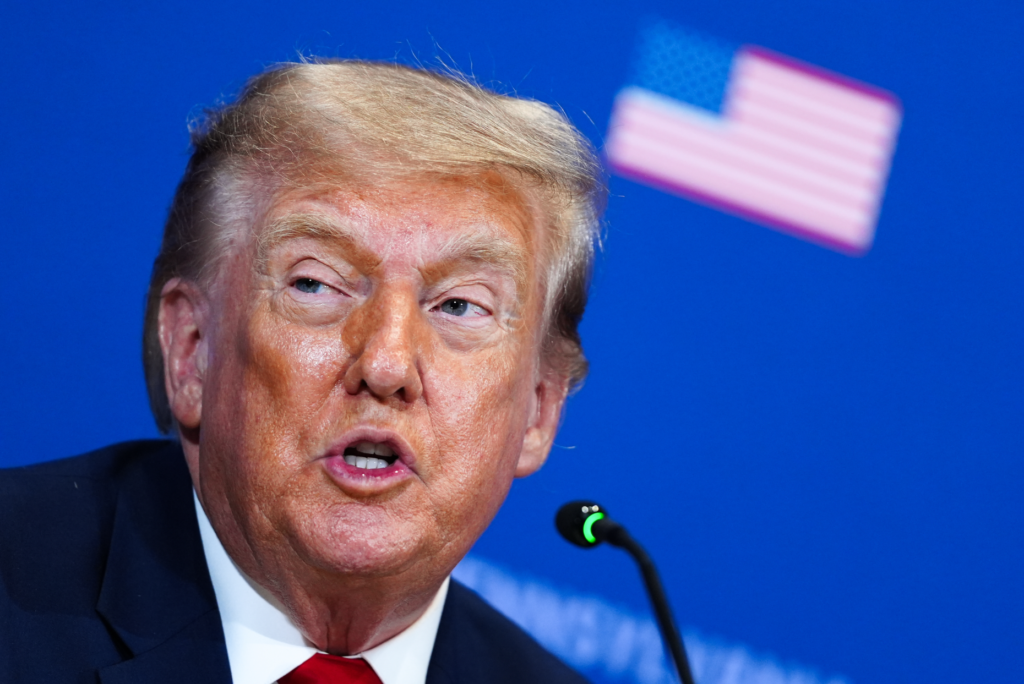 The Trump administration is interested in increasing oil production in California. (AP Photo/Julia Demaree Nikhinson)
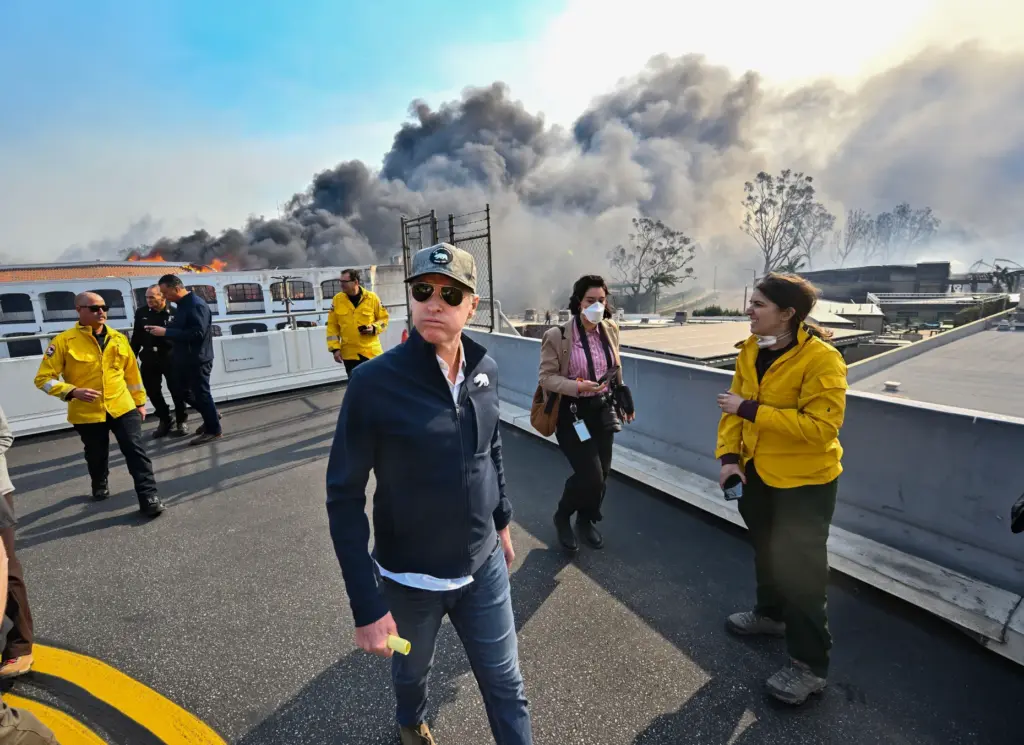 California Gov. Gavin Newsom, center, surveys damage during the Palisades fire in January 2025. The governor later drafted executive orders aimed at speedy rebuilding, which bypassed some California Coastal Commission approvals. (Photo by Jeff Gritchen, Orange County Register/SCNG)
“Trump has been pretty much kicking our (butts),” said Jolie Anderson, a Santa Monica single mother who said she volunteers with Heal the Bay and other environmental organizations.
“I have no idea who is responsible for that,” she added. “I don’t think there’s any one reason, or group, or whatever. It’s, like, people (in the environmental community) agree on big issues, but can’t get out of their own way when some other people want to do something that’s really bad for the ocean or the air or land.
“That’s frustrating.”
For its part, the state has fought back in court.
California currently is suing the Trump administration on a number of environmental fronts, including Trump’s effort to reopen offshore oil exploration and Trump’s move to spend $2 billion in congressionally allocated tax money to kill the wind projects. So far, none of the applicable open cases has moved up to the Supreme Court.
It’s just business
The ideological divide driving the fight isn’t in dispute.
Trump and members of his administration have been openly disdainful of California’s environmental regulations, saying they’re bad for the economy in general and particularly bad for oil and gas operators that want to do business off the coast. The Coastal Commission – a 50-year-old, voter-created agency that is widely viewed as both a consistent protector of the state’s 834-mile coast and, at times, mind-numbingly bureaucratic – is viewed by Trump officials as a ripe target.
In May, after the Coastal Commission raised what the administration described as “unfounded objections” to a request for more commercial space launches by Elon Musk’s SpaceX out of Vandenberg Space Force Base, the administration announced its plan to use federal law to try to rein in the agency.
At the time, Commerce Secretary Howard Lutnick also expressed personal disdain for the state’s stance on environmental protection.
“Obstructionist policies that delay critical national infrastructure in the name of environmental extremism are unacceptable. NOAA (The National Oceanic and Atmospheric Administration) will conduct its reviews consistent with the plain text of the (Coastal Zone Management Act), ensuring states give proper weight to economic development and the nation’s priorities.”
Environmental advocates are equally disdainful of Trump.
They note that Trump openly sought $1 billion from oil industry executives while running for a second term and, since his return to power, he’s tried to deliver on a promise to use the presidency to boost that industry’s profits. Some use terms such as “inane” and “flat-out stupid” to describe Trump’s efforts to roll back non-carbon businesses, such as electric cars and wind power.
And, critically, many argue that the administration’s definition of “priorities” referenced in Lutnick’s public comment is actually limited to just a few industries, particularly oil and gas. Some add that such industrial favoritism is a threat to the overall economy.
“The story that is not being told right now is that probably the largest constituency in opposition to what Trump is doing, regarding the Coastal Commission and environmental deregulation in general, is the business community,” said Grant Bixby, a Newport Beach real estate broker and member of the Business Alliance for Protecting the Pacific Coast, a group that includes more than 8,200 members of both political parties.
“When this administration says it wants to be ‘business friendly,’ it’s referring to oil and gas. But other businesses are harmed by that.
“As a business person, you sometimes have to make tough choices, and you may have to upset somebody. We understand that,” Bixby added.
“But it really doesn’t make economic sense, in our view, to try to appease that one industry. It’s actually bad for the overall economy.”
Oversight or intimidation?
Technically, the upcoming “performance review” of California’s coastal environmental regulation work won’t be limited to the Coastal Commission.
The public hearings slated to be held live, Aug. 10 at the Hilton Santa Monica Hotel, and online Aug. 11 and 12 (to attend, register via email to [email protected] by Aug. 8) will look at the state’s Coastal Management Program, which includes the California Coastal Commission, the California Coastal Conservancy and the San Francisco Bay Conservation and Development Commission.
Roughly 10% of the Coastal Commission’s $48 million annual budget is federally financed, and all three state agencies get some money from Washington. Because of that, the agencies all come under federal oversight as part of the Coastal Zone Management Act.
It’s unclear what, if anything, the review can do to change the state’s environmental stance. The amount of federal funding for the Coastal Commission and other agencies isn’t so large that it can’t be recouped in Sacramento. And the federal government – for now – doesn’t have a powerful voice in how states choose to regulate public resources.
Read more Visually impaired campers build confidence traveling Orange County
But some environmental advocates fear the fight is about attitude and power, and that anti-regulatory voices in Washington, and elsewhere, are shouting down long-held environmental goals.
“This fight is basically about intimidation,” said Garry Brown, founder of Orange County Coastkeeper, a Costa Mesa-based nonprofit that works to protect the ocean and other water quality in the region.
“The Trump administration is unhappy with the Coastal Commission for a lot of reasons; for SpaceX, and for offshore oil, the list goes on. But the real goal is to override the state’s right to set its own agenda. That’s the big picture here.”
As part of the review, officials from NOAA will hear from members of the public, business leaders, and others, to see if the state is doing enough to help “spaceport infrastructure, offshore oil production, pipeline maintenance, desalination projects and undersea cables.”
At least some in the administration have already determined that the Coastal Commission isn’t doing well at any of that.
“Under my leadership, I say this: ‘No more,’” Commerce Secretary Lutnick wrote, in May, as part of the department’s first step to review the Coastal Commission.
Until the latest move from the Trump administration, the Coastal Commission was facing similar, if less strident, criticism from some liberal lawmakers in California.
Last year, days after wildfires devastated huge swaths of Los Angeles County, Gov. Gavin Newsom moved to sideline the agency from playing a big role in fire-related rebuilding. At the time, Newsom was taking up common cause with Trump, who threatened to withhold federal rebuilding money unless the state defunded the Coastal Commission.
Since then, legislators in Sacramento have proposed more than two dozen laws that would, in some way, change how the Coastal Commission regulates projects that could affect ocean health and beach access.
At least one of those proposals – AB 1740 – would create small zones in some beach cities, starting with Santa Monica, that would be able to dodge Coastal Commission review entirely for certain types of development. The bill, which is still being considered and amended, has drawn supporters as diverse as condominium builders and nonprofit groups that favor more bicycle commuting.
But even as it’s been attacked, the Coastal Commission has drawn support from traditional backers and, according to recent polling data, a huge swath of California voters of all political stripes.
Supporters also point to data that suggests the Coastal Commission isn’t nearly as anti-business, or as paperwork-centric, as critics charge.
For example, the Coastal Commission’s 12-member voting board (six are elected officials, six are California residents, and a total of four, from both camps, are appointed by the governor) approve more than 90% of the projects they review. And, in recent years, the average wait time on an answer for those reviews has shrunk from months to weeks.
What’s more, business leaders and others note that the coastal region that the Coastal Commission protects – and, in the administration’s view, hampers – might be the state’s most important economic driver.
From 2011 through 2021 – a period when California’s population was virtually flat – the number of businesses in California’s so-called “ocean” economy grew by 26%, to about 26,000. The state’s six key ocean industries – marine construction, living ocean resource development, offshore mineral extraction, ship and boat building, shipping, and tourism and recreation – saw their combined employment grow by 8% (to more than 511,000 workers), wages jump by 8% (to more than $52,000 a year), and overall economic output jump by 7%, to $51.3 billion.
That last figure excludes the money generated by oceanfront real estate values, tourism to inland areas that is boosted by the beach, and even higher tips at ocean-close restaurants and bars.
That data, by the way, comes from a 2024 report from NOAA, the same agency that will be reviewing whether the Coastal Commission is or isn’t good for business.
“When you think about what is the draw to (Southern California), it’s the beach. In Orange County, we’re the beach for Riverside County, San Bernardino; even Arizona and Nevada,” said Bixby. “I have people who earn rental income from people who come from all over the country and even internationally to stay by the beach.
“Protecting that is critical.”
It’s also popular.
This week, a poll conducted by the Public Policy Institute of California found that environmental regulation will be a key factor when voters cast ballots for governor later this year. The poll found Democrat Xavier Becerra well ahead of Republican Steve Hilton (61% to 36%) among likely voters, and that 85% of voters say the candidates’ stance on the environment is an important reason for their support.
The poll also asked specifically about the California Coastal Commission and found that the agency remains among the most popular elements of state government: More than 8 in 10 Californians (82%) say the California Coastal Commission has been mostly a good thing for the state.
Read more Surf awards give honors to influencial, inspirational wave riders and innovators