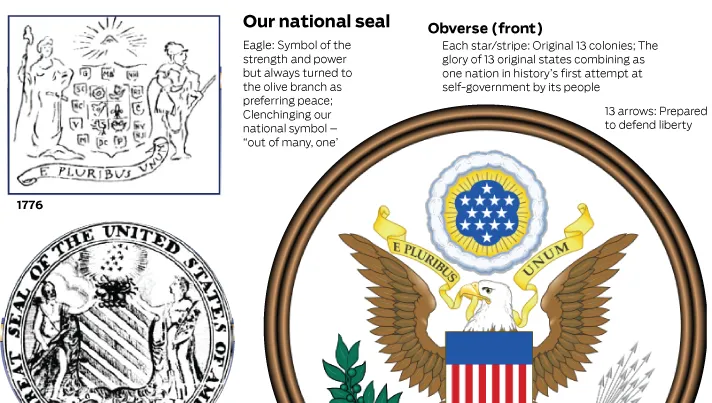
On July 4, 1776, the Continental Congress passed a resolution: Resolved, that Dr. Ben Franklin, John Adams and Thomas Jefferson, be a committee, to bring in a device for a seal for the United States of America.
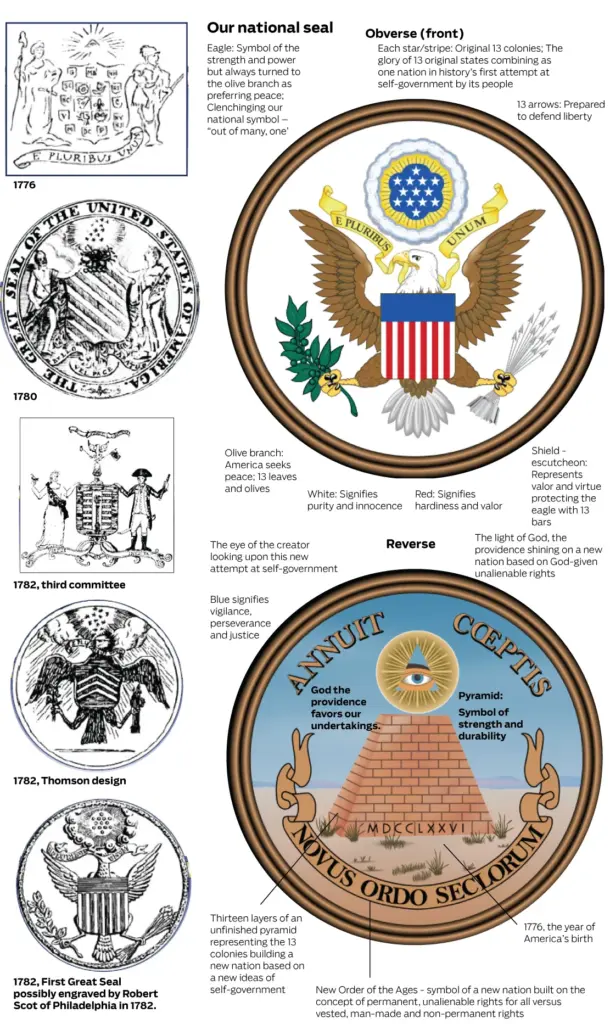
It was far more difficult than anticipated and took 6 years, two more committees and the combined efforts of 14 men before the Great Seal of the U.S. was approved on June 20, 1782.
The first committee
The challenge facing the committee was to translate intangible principles and ideals into graphic symbols. It came up with biblical and classical themes, including the Children of Israel in the Wilderness and the Judgment of Hercules and neither were successful. They enlisted the help of Pierre Eugene du Simitiere, who had knowledge of symbols in coats of arms. Simitiere created the Eye of Providence and the date of independence (MDCCLXXVI), which appeared on the final reverse side of the seal, and the shield and Latin motto, E Pluribus Unum (out of many, one), on the obverse side. The first committee submitted its design Aug. 30, 1776 but it was not approved.
More committees
A second committee was formed in March 1780; it contributed a design with 13 red and white stripes and 13 six-pointed stars but it was not approved. A third committee was formed in May 1782 contributing an eagle but Congress was unsatisfied and turned to Charles Thomson in June 1782.
Thomson was an Irish-born Founding Father of the U.S. and secretary of the Continental Congress (1774–1789 its entire existence). As secretary, Thomson prepared the journals of the Continental Congress. Thomson and John Hancock were the only two signatures appearing on the first printing of the Declaration of Independence.
The seal was first used on Sept. 16, 1782 by Thomson on a document authorizing Gen. George Washington to negotiate an agreement with Britain for better treatment of prisoners of war. Thomson continued as keeper of the seal until the Congress handed over power to the new government in 1789 and custody of the seal passed to the secretary of state.
There were a few minor revisions to the seal in the 1880s.
The Great Seal of the United States is a unique symbol of our country and national identity. Only one authorized Great Seal is in official use and is operated by the U.S. Department of State. The Great Seal is impressed upon official documents such as treaties and commissions. The Department of State affixes about 3,000 seals to official documents yearly.
Since 1935, both sides of the Great Seal have appeared on the reverse of the one-dollar bill.
Notable U.S. symbols
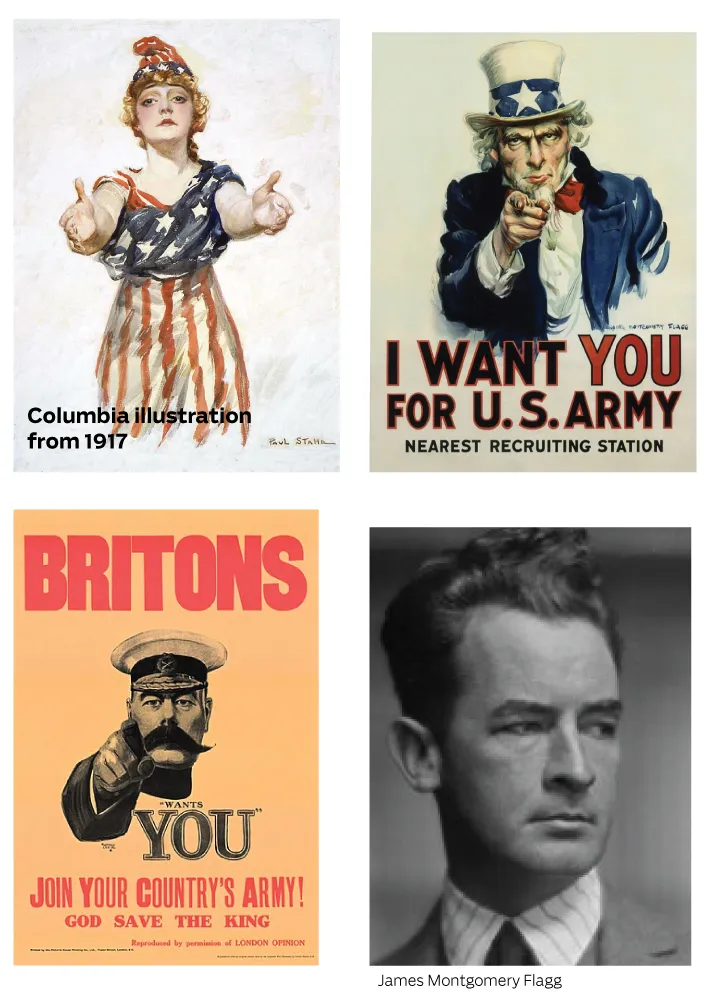
The first significant symbol was Columbia, a female figure (the name is derived from Christopher Columbus) and is still an often-used symbol of our country through the early 20th century. Columbia first appeared in 1738 to refer to the Thirteen Colonies that became the U.S., and was often depicted with Lady Liberty. The name is used in many cities across the U.S. and was chosen when the capital was named District of Columbia in 1801.
The image of Uncle Sam as a personification of our nation and government is widespread and instantly recognizable.
Uncle Sam didn’t become a popular figure in the culture with cartoons and illustrations until after the War of 1812. It’s a bit of a legend, but Uncle Sam is believed to be named after Samuel Wilson. Wilson served as a member of the Continental Army when he was a teen. Wilson went on to own a meat packing company that secured a contract to supply the U.S. troops in the War of 1812 with pork and beef barrels. Wilson became the meat inspector for the U.S. Army and a stamp on each barrel with U.S. was referenced to Uncle Sam. With Wilson’s familiarity with the troops, Uncle Sam became a friendly figure of speech to describe the U.S. government.
This poster is artist James Montgomery Flagg’s version of Uncle Sam for World War I recruitment in 1917. Flagg was born in Pelham Manor, N.Y. in 1877 and died in New York City in 1960.
The government printed 4 million posters during 1917 and 1918 and the image was used again during World War II. There are numerous spin-offs of the poster.
Flagg’s 1917 poster was based on the original British Lord Kitchener poster in 1914.
Flagg used his own face for that of Uncle Sam (adding age and the white goatee), he said later, simply to avoid the trouble of arranging for a model.
At his peak, he and Norman Rockwell were some of the most successful illustrators. Flagg worked for The Saturday Evening Post and Collier’s, which were two of the most popular U.S. journals.
Flagg gave his original drawing of the poster to the Smithsonian.
Symbol of liberty
The Statue of Liberty (its formal title is Liberty Enlightening the World) was a gift to the United States from the people of France.
Dedicated in 1886, the statue shows Libertas, the Roman goddess of freedom. Located in New York Harbor, the statue holds a torch in one hand and a tablet representing the law in the other. The date of the Declaration of Independence is inscribed on the tablet. A broken chain sits at Libertas’s feet. The statue is an iconic symbol of freedom. Protesters around the world have used the image of the statue in their struggles for political freedom; a replica was erected in 1989 in Beijing’s Tienanmen Square.
The idea for the statue is thought to be conceived as early as 1865, when the French historian and abolitionist Édouard de Laboulaye proposed a monument to commemorate the upcoming centennial of U.S. independence in 1876.
Due to funding shortfalls and the size of the project, it was not dedicated in New York until October 28, 1886.
The statue was administered by the United States Lighthouse Board until 1901, then by the Department of War until 1933 when the National Park Service took over its maintenance. It had its last restoration from 2011-2012.
Other national symbols:
The Minuteman (American Revolution)
Brother Jonathan (New England)
Overmountain Men (Appalachians)
Kamehameha (Hawaii)
Bald eagle
American bison
Timber rattlesnake
Sources: U.S. Department of State, Boston Museum of Art, Smithsonian, Britannica, Library of Congress, National Archives Images are from the Department of State, National Archives and Public Domain