
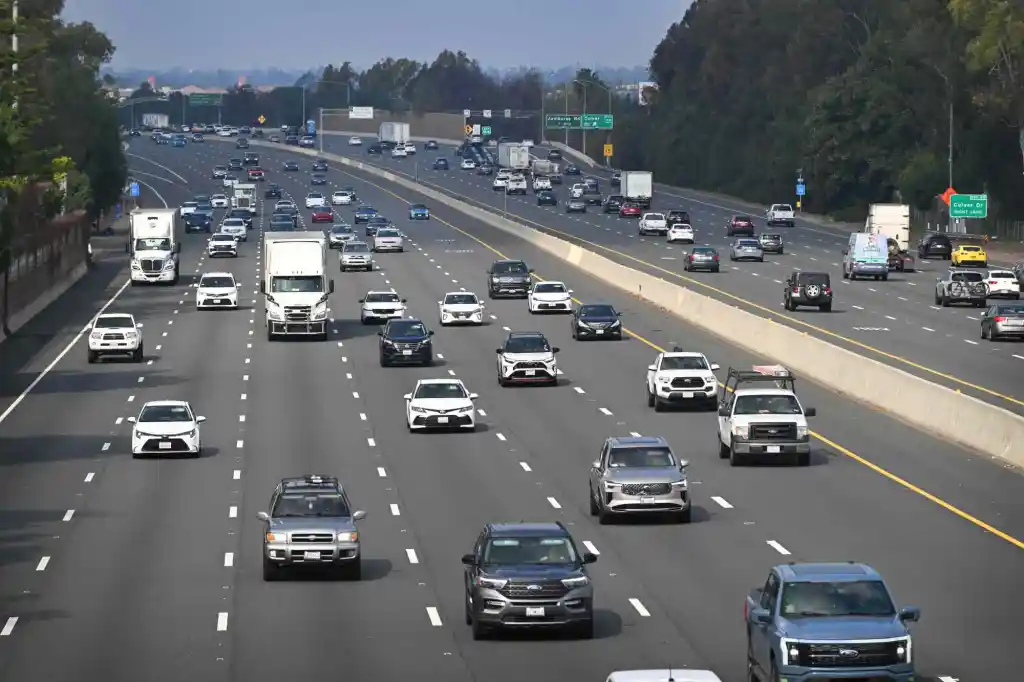
Orange County business leaders are urging congressional representatives to reauthorize “critical” federal transportation funding ahead of its expiration this fall.
Read more Anaheim’s newest district, OCVibe, is cultivating community through art, entertainment
On Sept. 30, funding through the Infrastructure Investment and Jobs Act, also known as the Bipartisan Infrastructure Law, is set to expire, which the Orange County Business Council said could disrupt long-term project planning and regional economies if not reauthorized.
OCBC said reliable transportation infrastructure is critical to the county’s economic growth, and while bipartisan discussions have occurred, “delays have increased the possibility that Congress may need to pass a short-term extension before reaching agreement on a comprehensive reauthorization.”
Funding through the BIL has been used for multiple transportation projects throughout Orange County, said Eric Carpenter, a spokesperson for the Orange County Transportation Authority.
Those include the 5 Freeway project in South County that was completed earlier this year, the 5 Freeway widening project that began in January and the 91 Freeway improvement project between SR-57 and SR-55. That’s in addition to a bevy of smaller projects, such as zero-emission bus purchases, paratransit vehicle replacements, traffic signal upgrades and mobility programs such as OC Connect, Carpenter said.
The BIL was enacted in 2021 under President Joe Biden. It authorized $1.2 billion in spending to invest in national infrastructure, including $550 billion in new spending over five years.
Since then, the BIL allocated $365 billion for roads and bridges, $108 billion for public transit and $102 billion for freight and passenger rail.
Funding from the federal measure is still being doled out.
This month, California’s U.S. Sens. Alex Padilla and Adam Schiff announced four road and highway repair projects — in Amador, Kern, Riverside and Orange counties — were awarded nearly $54 million from the U.S. Department of Transportation.
That included funding for Riverside County’s 15 Freeway/74 Freeway interchange improvement project in Lake Elsinore.
In Orange County, funding will go toward a project to add an eastbound lane on the 91 Freeway, from the 241 Toll Road general purpose connector to the 71 Freeway connector lane, near Anaheim Hills and Yorba Linda, as part of the 91 Freeway Eastbound Corridor Operations Project, according to a press release.
Of the lawmakers that represent Orange County, Reps. Mike Levin, D-San Juan Capistrano; Young Kim, R-Anaheim Hills; and Linda Sánchez, D-Whittier, said they support reauthorizing the funding
Rep. Derek Tran, D-Orange; Dave Min, D-Irvine; and Lou Correa, D-Anaheim, did not respond to a request for comment.
And Reps. Robert Garcia, D-Long Beach, and Ken Calvert, R-Corona — who could represent communities in Orange County by this time next year, because of the effects of redistricting — said they would support reauthorization as well.
Separate from the upcoming transportation reauthorization deadline, Congress is in the middle of a budget crunch. The House narrowly passed a funding bill Tuesday night, but it faces an uphill battle in the Senate.
Levin said the next transportation reauthorization Congress approves should build on the BIL’s progress.
“That law made the single-largest infrastructure investment in American history. I have made it a top priority to bring these investments back to pressing projects in our community, including life-saving street safety investments in Laguna Niguel and long-overdue resources to keep Amtrak and Metrolink running for commuters,” Levin said.
Investments in those train systems, he said, are needed as pump prices continue to rise as the Iran war enters its sixth month.
Read more Oil prices rise another 3%, while Wall Street drifts in mixed trading
Come September, Congress’ opportunity to sustain economic growth into regions like Orange County could come from a new bipartisan infrastructure spending package, said Paul Simonds, senior vice president and CEO of the Orange County Business Council.
Earlier this year, the House Transportation and Infrastructure Committee approved the BUILD America 250 Act by a vote of 62-2, marking the first milestone in the process to reauthorize federal surface transportation funding. The legislation is a bipartisan surface transportation proposal that would reauthorize $580 billion in spending over five years, through fiscal year 2030-2031.
If approved, which realistically wouldn’t occur until this fall at the earliest, the bill would represent “the largest ever investment in America’s bridges,” according to a press release from the House committee.
The bill would focus on making existing surface transportation infrastructure programs more efficient by streamlining environmental reviews, . It would also bring investments to passenger rail systems and provide “the first ever autonomous commercial motor vehicle framework,” the committee said. That framework would be a set of safety standards for commercial vehicles equipped with self-driving systems, according to the summary.
Investments made with this bill would create certainty for economic hubs, including Orange County, which sits “within one of the nation’s most important logistics regions,” said Simonds.
“It’s really about creating a predictable framework that, ultimately, would allow states and regions to plan for infrastructure investment over the next five years,” Simonds said.
“When you talk about infrastructure investment, it’s really an investment in economic growth,” Simonds said. “You’re talking about goods movement, you’re talking about workforce mobility, you’re talking about maintaining existing infrastructure.”
“We’ve got to have certainty as we’re planning these infrastructure projects. This reauthorization provides the certainty that Orange County needs, that businesses need from an economic development perspective,” he said.
Kim said she hopes the final package would be approved with a provision she added that “expands toll interoperability nationwide” that would make it easier for drivers “to travel seamlessly from coast to coast while protecting customer privacy.”
According to the National Association of Counties, the provision would allow toll transponders, the electronic devices fixed to car windshields that automatically pay tolls, to operate across multiple systems.
And Garcia said he supports reauthorizing transportation funding through the Build AMERICA 250 Act as it includes a provision of his own that aims to improve coastal piers.
Garcia is also behind an effort — attached to the Build AMERICA 250 Act — to bolster the total amount of U.S. Department of Transportation grant funding available to coastal cities to improve and repair piers.
Simonds said this is Congress’ opportunity to set the nation’s transportation policies long-term and provide funding for projects like highways, bridges and transit.
“The three greatest risks, from our standpoint, to ongoing economic development (in) Orange County are housing, infrastructure and workforce,” he said. “You got to have housing, you got to have workers and upskilling those workers and getting those folks in place, but if you don’t have reliable infrastructure as the underpinning of all of that, then you have a real problem. That’s why it’s so important for Congress to get this funding in place.”
Calvert, who is running against Kim for California’s newly redistricted 40th Congressional District, said the potential for this federal funding would be critical.
And while he supports reauthorizing these surface transportation programs that improve the roads and freeways Southern Californians rely on, Congress must also look to reform federal policies to cut “unnecessary red tape” so new transportation projects can be finished faster, for cheaper, Calvert said.
Read more Trump says US will destroy a bridge or power plant for each Iranian attack in the Strait of Hormuz