
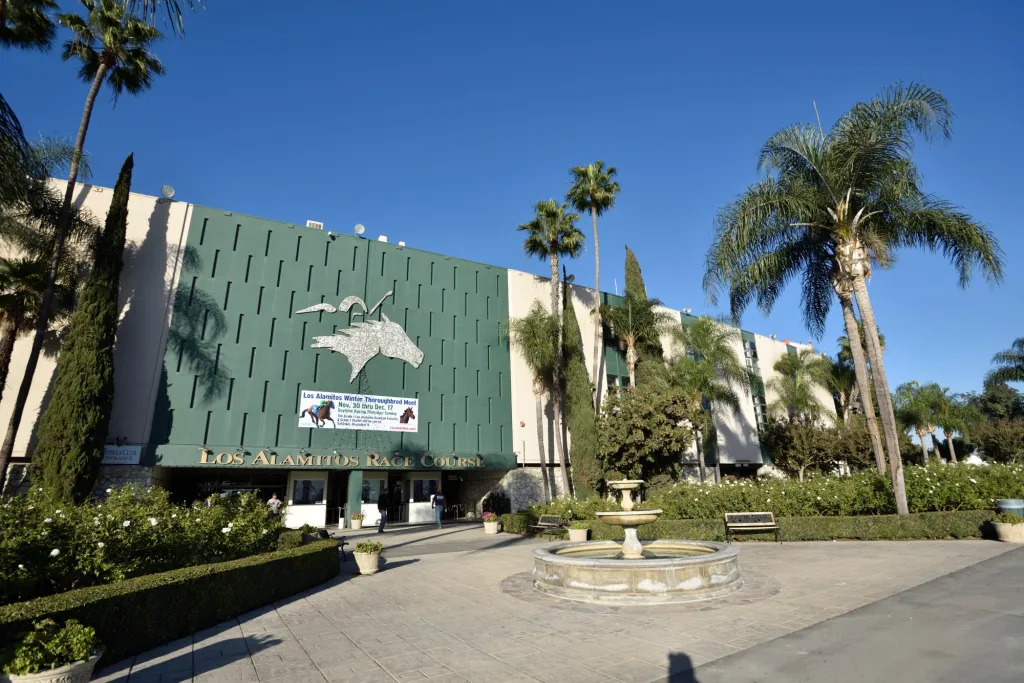
Developed in the 1950s, the Los Alamitos Race Course has operated for decades on the eastern edge of Cypress, where city officials are now considering a package of approvals that would decide how the roughly 150-acre property could be divided and redeveloped after the horses stop racing.
Read more Government withdraws subpoenas of 3 reporters for The New York Times after admitting legal errors
The City Council recently held off making a decision on the proposal until August after council members said they needed more time to review the details, revise legal language and they wanted time for residents to better understand what’s being considered.
The project area, which also includes property associated with Grace Church, could eventually become a neighborhood with homes, businesses, parks and new roads. A proposed subdivision map would carve the land into 14 lots that could be sold to future developers.
City staff described the redevelopment as a multi-step process. After racing ends — and there isn’t a current timeline for that — the racetrack and other existing structures would be demolished and the property cleared. Roads, drainage systems and other shared infrastructure would then have to be built before individual parcels could be fully developed with homes or businesses.
The council considered three items during a recent public hearing, including the certification of an environmental impact report, approval of a tentative subdivision map and a development agreement that would govern infrastructure, parks, maintenance and public access for the next 15 years. Mayor Leo Medrano is recusing himself because he lives near the racetrack.
The environmental report studied a potential build out with up to 1,791 residential units and 440,000 square feet of commercial space. Though the specific plan already approved by voters would allow as much as 880,000 square feet of commercial development, anything beyond the amount studied would require additional environmental review and council approval.
City staff emphasized that none of the items discussed at the recent hearing would authorize immediate construction of a specific housing or commercial project.
“The request establishes the long-term implementation framework for the future phase development of the property,” Community Development Director Alicia Velasco said.
Though voters have already approved the underlying zoning for the racetrack’s redevelopment, Councilmember David Burke said the council is still at the point of making consequential decisions on its future.
“This isn’t as simple as the voters approved all this already, you just have to put your rubber stamp down and we can go home,” Burke said. “There’s new things in this that we’re considering.”
Read more D4vd’s lawyers ask why more DNA testing wasn’t done on chain saws, car in teen girl’s killing
Cypress voters had approved the zoning framework for future development of the property with Measure A in 2018 and later approved changes under Measure S in 2024, which added capacity for up to 676 residential units as the city works to meet state housing mandates.
But residents raised at the recent hearing concerns about traffic, open space and whether the development would provide the parks and gathering places the community expected.
“Nobody in this room can tell me, once we take that track away, we punch Moody through there, this city will not be the same,” said Tom Moore, a 60-year Cypress resident who was referring to a planned extension of Moody Street through the racecourse property onto Siboney Street.
Moore also questioned what the project would offer the broader community. “I don’t see a theater. I don’t see a plaza,” he told the council.
Council members spent nearly an hour examining the development agreement, which would assign responsibility for roads, drainage, parks, maintenance and public access over a 15-year period. Those obligations would carry over to future property owners.
Much discussion focused on an approximately 8-acre public park that would also serve as a stormwater retention area, with about 4 acres expected to be used for drainage.
Council members pushed for stronger language ensuring that land counted as park space would remain safely available for active or passive recreational use. If part of the property could not be used by the public, the council discussed requiring replacement park space elsewhere within the project area.
Councilmember Kyle Chang said the city had recently received numerous emails about the proposals being looked at and that residents needed more time to review the presentation, watch the meeting and provide feedback.
The council is set to continue the public hearing on Aug. 25.