
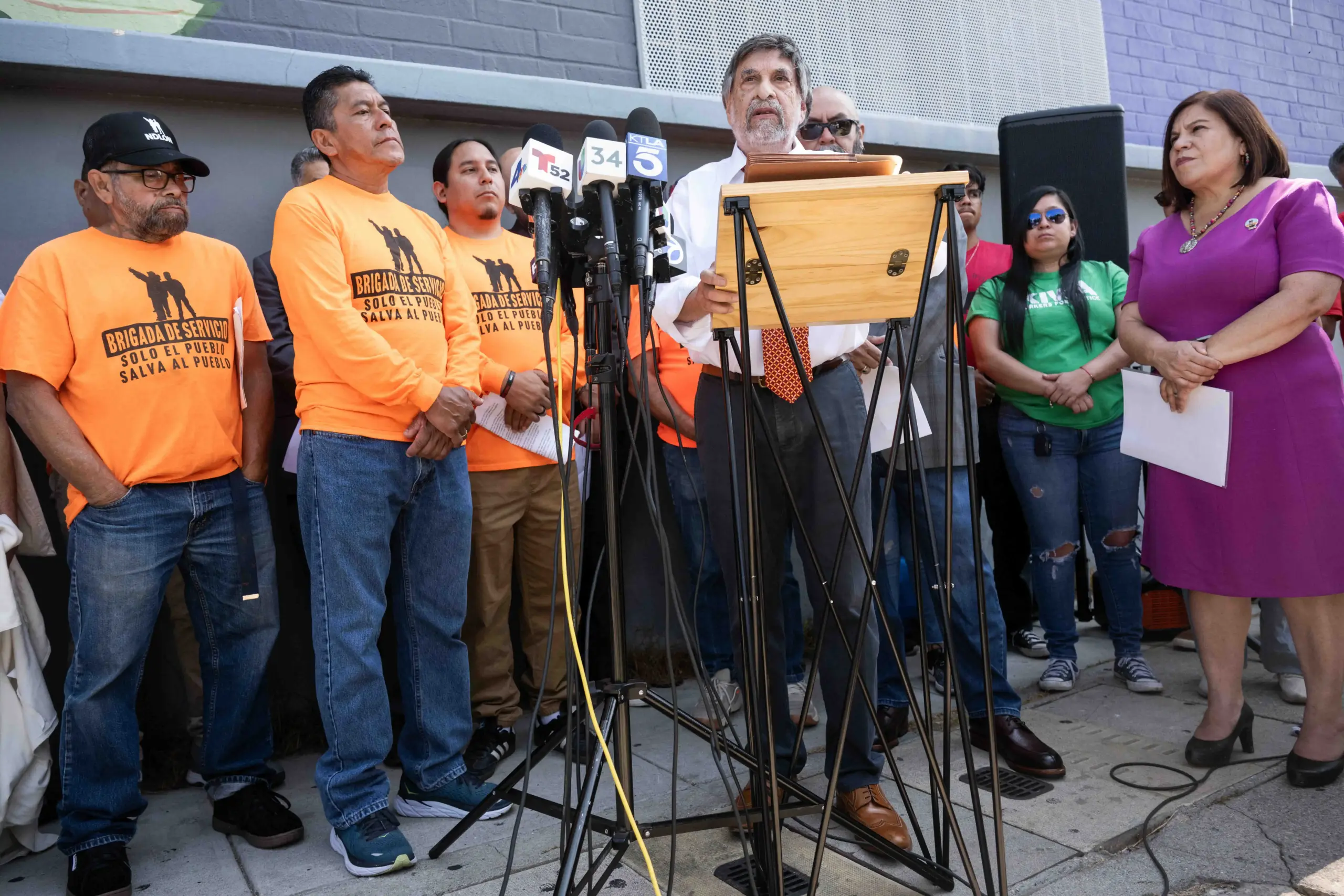
Federal agents allegedly used racial slurs to target Latinos while carrying out an ongoing campaign of “suspicionless and discriminatory” immigration enforcement stops in the Los Angeles area, according to a federal court filing.
Read more eBay agrees to pay nearly $50 million to couple sent cockroaches, bloody pig mask
The allegations came in a motion for a preliminary injunction in the closely watched Vasquez Perdomo vs. Noem case, a much-watched civil rights case with its roots in Pasadena. The motion asks that a federal court block agents from conducting what the plaintiffs contend are warrantless stops targeting “people who appear Latino and low-income or working-class,” according to the document.
According to the ACLU of Southern California, the stops across the Central District of California have continued even after last summer’s street raids ceased.
“We’re (still) doing the same thing just with a different name,” a federal agent admitted in a deposition cited in the motion filed Monday in Los Angeles federal court.
In a video also discussed in the filing, one U.S. Department of Homeland Security agent said to another: “Yeah, just plug us in wherever you see some tonks,” while other agents guessed whether people were “wet” simply based on appearance.
According to the ACLU, “tonks” is a derogatory and violent term understood to refer to the sound of a flashlight striking a migrant’s head. “Wet” is short for “wetback” and is a racist slur historically directed at Mexican and other Latino immigrants crossing the Rio Grande.
A message requesting comment sent to a DHS representative was not immediately answered. The White House press office did not immediately respond to a similar request.
U.S. District Judge Maame E. Frimpong, who is overseeing the case, set a Sept. 24 status conference to discuss the motion.
The filing includes body camera footage and depositions of federal agents as part of evidence ordered by Frimpong after the U.S. Supreme Court stayed an earlier temporary restraining order in the case last September.
Read more The future of the UK’s renowned Lovell radio telescope is in question after a funding cut
Plaintiffs argue the Constitution prohibits law enforcement from using race as a substitute for individualized suspicion. The motion alleges the stops violated both the Fourth Amendment and the Fifth Amendment’s guarantee of equal protection.
“Our communities have been denouncing foul play from day one,” Angelica Salas, executive director of the Coalition for Humane Immigrant Rights, a plaintiff in the case, said in a statement Tuesday. “The evidence doesn’t lie: these arrests were never about safety, they were about skin color. We repudiate this racial profiling in the strongest terms — our communities deserve better.”
The high-profile Vasquez Perdomo vs. Noem case has its roots in Pasadena. Day laborers Isaac Villegas Molina, Pedro Vasquez Perdomo and Carlos Alexander Osorto — were sitting at a bus stop on June 18, 2025, at the beginning of a summer marked by intense federal immigration raids sweeping through Los Angeles County.
Four cars suddenly stopped at the spot, and six masked and armed federal agents emerged, detaining the men without immediately identifying themselves, according to the lawsuit filed by Public Counsel and the American Civil Liberties Union and other attorneys representing Southern California residents, workers and advocacy groups.
A district court judge ruled in favor of the plaintiffs, and wrote that federal authorities were “conducting roving patrols without reasonable suspicion” during raids.
The ruling placed a temporary restraining order against roving ICE agents in Southern California. A panel of the 9th Circuit Court of Appeals upheld that decision.
However, the U.S. Supreme Court ruled 6-3 to grant a stay to the temporary restraining order, allowing ICE agents to continue with the street raids that had largely been conducted based on perceived race or ethnicity.
“A year ago, farm workers across California were terrorized by brutal and unconstitutional raids based on racial and class profiling,” said Teresa Romero, president of the United Farm Workers, also a plaintiff. “Today, the fear left behind by those raids continues. Farm workers go to work afraid they may not come home, even as they put food on all of our tables. America owes the workers who feed it much better. The workers who feed this country deserve so much better.”
Read more Taylor Farms’ White House ties queried by top California Democrat amid cyclospora outbreak
City News Service contributed to this report