
If you want some peace of mind about the stability of the housing market, you must flash back to real estate’s ugliest moments.
Read more Fauci’s decision to invoke the Fifth Amendment tees up a legal debate and a contempt vote
My trusty spreadsheet reviewed a CoreLogic report for the first quarter of 2026 detailing a curious measure of housing health that compares borrowings with estimated values for 49 states – Vermont wasn’t included, and the District of Columbia. That gap is what’s called a homeowner’s equity – the byproduct of down payments, housing appreciation and swings in loan balances.
The warning signals can be hidden within the concept of “underwater” mortgages, also known as negative equity. That’s when borrowers owe more than a property is worth – upping the risks they’ll walk away from the home, defaulting on the home loan if financial conditions worsen, since they have no equity to lose.
CoreLogic figures show that California had 55,568 underwater properties as of the first quarter of 2026. That was the fourth-highest among the states, behind some economic archrivals: Texas at 91,568 and Florida at 69,431. No. 3 was New York at 55,629.
But before you gulp, note that California’s underwater loans are just 5% of the nation’s 1.2 million. Meanwhile, California has 11% of the nation’s mortgaged homes.
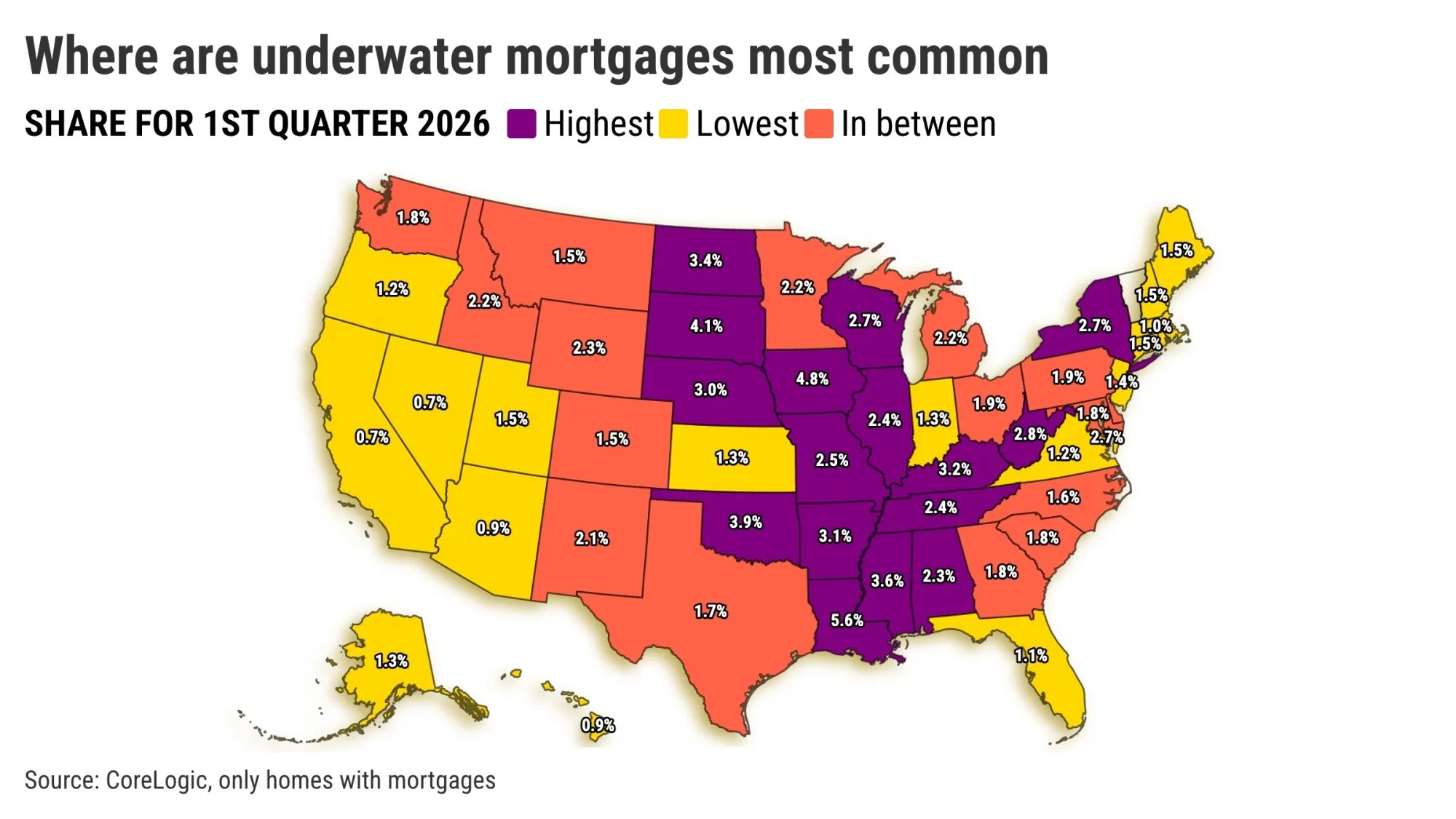
So just 0.7% of California’s mortgages are underwater. That’s the lowest share among the states and less than half of the nation’s 1.7% rate. No. 2 was Nevada at 0.71%, followed by Hawaii at 0.9%. Florida was seventh-lowest at 1.1%.
Where are underwater mortgages most common?
Louisiana’s 5.6%, Iowa’s 4.8% and South Dakota’s 4.1%. Texas ranked No. 30 at 1.7%.
Where we were
How few are today’s underwater mortgages?
Go back to the real estate debacle of the Great Recession, spurred largely by shoddy and aggressive lending practices. Once folks couldn’t afford those loans, foreclosures skyrocketed, and home values tanked.
As a result, between 2009 and 2013, California’s share of underwater mortgages peaked at 37%.
Yes, there was a time when more than one-third of Californians owed more than their home was worth.
It wasn’t some California craziness. The nation’s peak was 26%. And five states topped the Golden State: Nevada at 73%, Arizona at 54%, Florida at 51%, Michigan at 42%, and Georgia at 40%.
They were ugly times, and today’s conditions can’t compare.
By the way, underwater mortgages peaked in Texas at 13%. Its lending laws throttled much of the mortgage madness that fueled a housing bubble that eventually burst.
What’s next?
Underwater mortgages weren’t growing in early 2026.
Home values remain stubbornly high, and most lenders have been stingy about who gets a loan, taking an ultra-cautious approach dating back to reforms following the Great Recession.
In the past year, California’s number of underwater mortgages was essentially flat, while the nation’s total fell by 9%.
These troubled loans jumped in just one state: South Dakota, up 45%. Florida did have the fourth-highest increase, but it was only 4%.
Underwater loans fell most in New York, off 24%, Illinois, off 23%, and Alaska, off 21%. And Texas was off 11%.
California housing has plenty of challenges, but shaky mortgages isn’t one of them.
Jonathan Lansner is the business columnist for the Southern California News Group. He can be reached at [email protected]
Read more Abdul El-Sayed wins Michigan Senate primary in major victory for Democrats’ progressive wing
- Try Jonathan Lansner’s Substack collection of economic trends. CLICK HERE!