
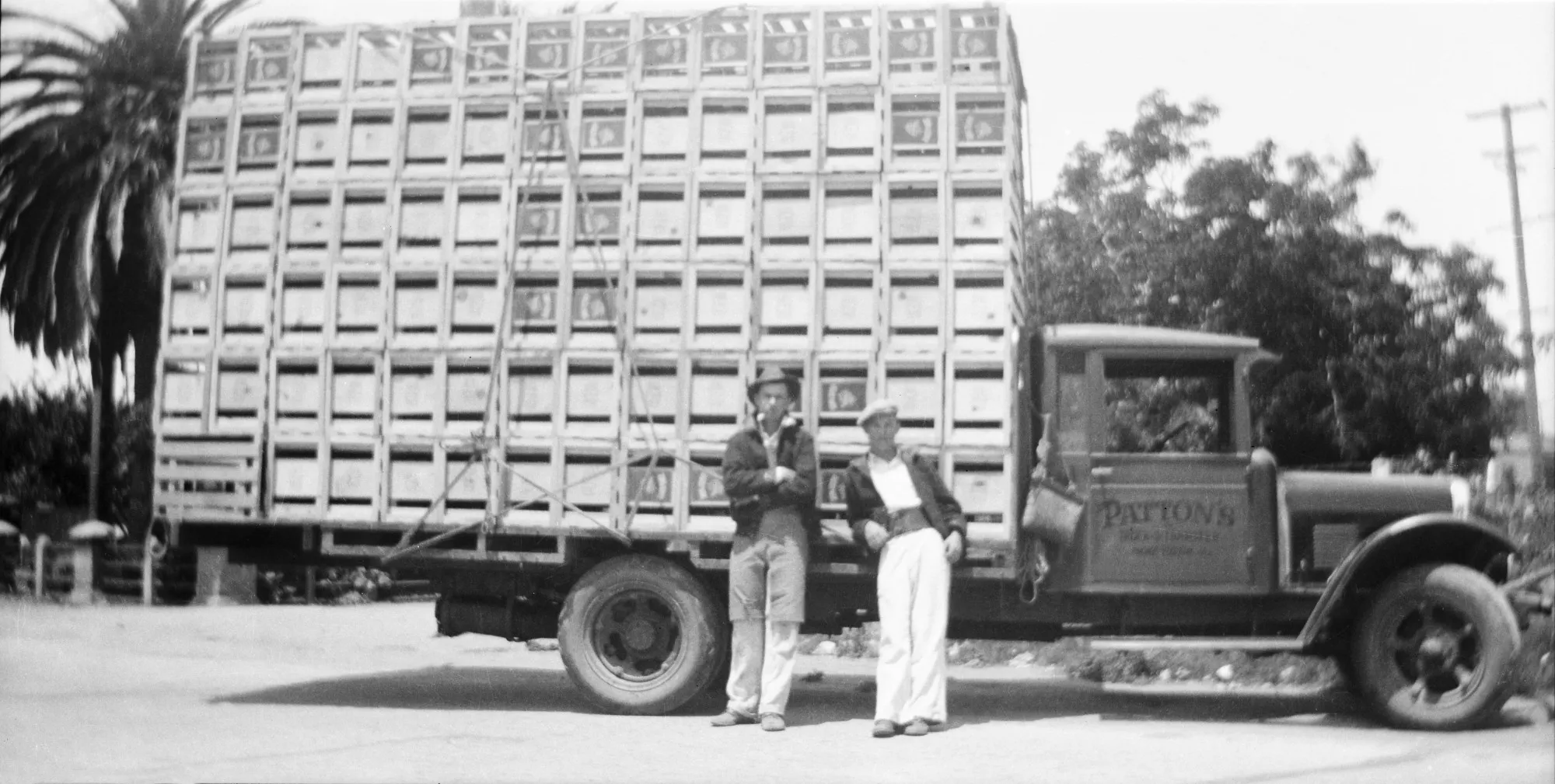
Long before the interstate highway system, the roads of Southern California became an unlikely battleground between the growing trucking industry and government agencies trying to protect roads not designed for heavy trucking.
Read more Senior living: What geriatric emergency departments do differently
Agricultural products and crude oil were among Southern California’s primary exports in the late 1800s, and railroads were the only efficient means of transportation, that is until motor trucks became an option in the early 1900s.
The first vehicles appeared in Southern California in the late 1890s, and in a whirlwind of development, all manner of self-propelled vehicles began operating on the undeveloped dirt roads of the region.
Trucks, automobiles, and highways experienced rapid expansion, and while their futures were intertwined, development in the automotive world outpaced the highways.
Heavy vehicles could be particularly destructive road surfaces, especially when their weight was concentrated on narrow, solid-rubber tires. Those tires were common on trucks into the 1920s, and they provided little cushioning while transmitting the vehicle’s weight and impact directly to road surfaces.
For centuries, road builders had been developing various forms of road surface materials to make roads smoother and longer lasting. The earliest surfaces consisting of paving stones, bricks, or crushed stone were effective, but too expensive.
In 1898, Los Angeles County took a major step in road improvement by contracting for 383 miles of oiled roads. Spraying roads with a thick coating of oil helped keep the dust down, but the surface broke down quickly.
By the early 1900s, macadam roads built from carefully graded and compacted layers of crushed stone were widely used. Road builders soon began blending tar or petroleum-based binders into the surface, creating a more durable roadway. During the 1920s, asphalt, a mixture of petroleum products, sand, and gravel began to replace macadam.
Macadam was initially a good solution for roads, but the early versions were not thick enough to support the ever-increasing weight of the trucking industry and the surfaces cracked and broke apart.
The Sept. 1916, issue of the Riverside Daily Press carried an article stating that city and county officials were attending a conference to discuss damage to local roads, noting that damage “is reaching the point of menace by reason of the terrific weight which some trucks carry.”
In 1917, Ford began producing the Model TT, which was a truck chassis derived from the Model T automobile. Owners often added their own custom truck beds, and the smaller trucks popped up everywhere.
Truck traffic exploded between 1915 and 1920, and government agencies were desperately looking for ways to preserve their expanding highway infrastructure.
In 1919, the California Vehicle Act was amended to include statewide weight limits on trucks: 30,000 pounds gross for four-wheel vehicles, 40,000 pounds for six-wheeled vehicles. However, the law also allowed county supervisors to require lighter loads on county roads. San Bernardino County had a maximum weight of 20,000 pounds.
Read more Fuel prices at record Labor Day high in US thanks to Iran War and refinery issues
Around 1920, Southern California police departments began enforcing local weight limit laws, and mobile weight scales called “Loadometers” were deployed.
Aggressive enforcement resulted in the arrest of truck drivers, leading to high-profile trials trucking companies used to challenge weight ordinances.
One of the most noteworthy cases was the arrest of Los Angeles truck driver J.A. Mackenzie on Oct. 26, 1920, in Ontario. According to Ontario police, Mackenzie’s truck was 24,000 pounds over the county weight limit of 20,000 pounds.
Cases like Mackenzie’s became part of a broader legal fight by commercial trucking interests against the patchwork of different weight limits across the state.
In successful challenges to local restrictions, the truckers argued that the California Motor Vehicle Act of 1915 (amended in 1917 and 1919) took precedence over county rules, and that varying county weight limits made interstate and regional commerce difficult and costly.
The legal and regulatory problems exposed by the frequent arrests of truck drivers contributed to demands for greater uniformity. In 1923, the state Legislature repealed the earlier act and enacted the rewritten California Vehicle Act that established new statewide laws governing vehicle weights and highway use. The act established uniform, statewide weight and axle limits, and prohibited counties from arbitrarily restricting weight on state highways. However, the act still allowed counties to limit weights on county roads.
The asphalt wars played a significant role in organizing the trucking industry and the trucking interests helped shape future highway regulations and road design standards.
Macadam was gradually replaced by thicker, better prepared asphalt surfaces, and major highways began using long-lasting and more durable concrete road surfaces.
Evidence of the evolution in highway construction can still be seen in Southern California. One of the best places is in the Cajon Pass, where today’s15 Freeway made of 12-inch thick, steel reinforced concrete parallels remnants of earlier highways, including the former 1953 Route 66 alignment, now known as Wagon Train Road.
At the end of Wagon Train Road, you can visit the Camp Cajon historic display, where you will find samples of early 1900s macadam. A few hundred feet south of Camp Cajon, a popular hiking trail leading up Crowder Canyon still has exposed sections of macadam road surface.
Another example of an early highway surface can be found on the north side of Foothill Boulevard, just east of Baker Avenue in Rancho Cucamonga. In 1920, the California Highway Commission, predecessor to Caltrans, began construction of an all-weather concrete highway between Los Angeles and San Bernardino on a section of National Old Trails Road, a route that later became Route 66. The roadway was 18-feet-wide and paved with rigid Portland cement concrete. A small section of this road has been preserved and is identified by an informational plaque.
These surviving sections of pavement are visual reminders of an era when the rapidly growing trucking industry pushed Southern California’s roads — and the laws governing them — far beyond what their builders had originally envisioned.
Read more Mookie Betts’ 3-run home run caps Dodgers’ rally against Nationals
Mark Landis is a freelance writer. He can be reached at: [email protected]