
LOS ANGELES — Streetlights along Bruin Walk illuminated their nightly ride home from UCLA men’s soccer practice.
Read more China says it hopes to agree with the US on tariff reductions at ‘an early date’
Tim Harris, Grant Clark, Billy Nelson and Mike Arya mounted their bikes and peddled away from North Athletic Field, where the Bruins practiced and played their games in the early 1980s before Wallis Annenberg Stadium was built.
They weaved through campus toward Strathmore, ascending the hill, before gliding down the incline. After rounding the curve at Midvale, they paused at Veteran to hoist their bikes over the cemetery’s fence. Emerging onto Sepulveda, they regained speed under I-405. They climbed the parking lot behind Jackie Robinson Stadium, zagged through the VA to Barrington and arrived at their Brentwood apartment.
One night, Clark recalled, along the stretch of perfectly parallel tombstones, they struck up a song that would remain the bedrock of Bruins’ soccer culture for years: “Bring on the Dons of San Francisco. Bring on the Aztecs by the score. UFW, Fresno State, they all think they’re (expletive) great, but you’ll find the Bruins in the Final Four.”
The melody might ring similar in 2026, except the lyrics would take aim at the Buckeyes and Hoosiers. At 62 years old, Tim Harris has returned to conduct the tune.
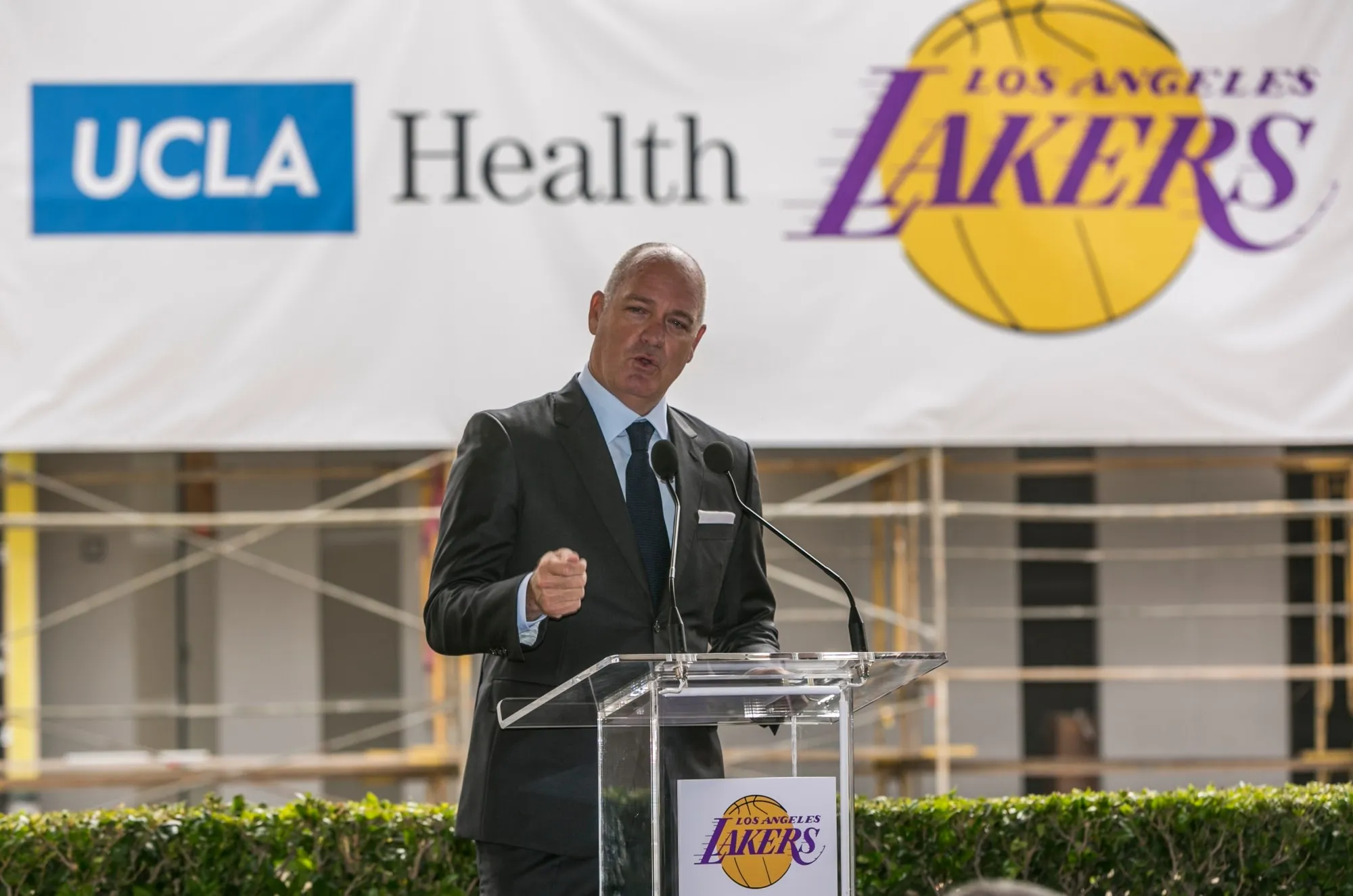
UCLA’s goalkeeper from 1980-1983 and team captain is leading the university from a new post as it rivals those new opponents. After a 35-year tenure in a front-office role with the Los Angeles Lakers, Harris was appointed UCLA’s CEO and athletic director on Aug. 31, succeeding fired AD Martin Jarmond.
‘A unifying voice’
Well before Tim Harris earned a sociology degree and ascended the ranks of the NBA’s premier franchise, he showed up at Grant Clark’s dorm in Dykstra Hall, motorcycle helmet in hand, and introduced himself as “Harry.”
Harris had been commuting from his parents’ home in the South Bay for a term, before moving in with Clark. The two had met over the summer when Harris and his family hosted Clark during preseason practices after he transferred from a community college in Northern California.
“He didn’t have to do that,” Clark told the Southern California News Group. “That was very generous of him. It made a big impression on me.”
Harris arrived at UCLA amid a defining tension point in the men’s soccer program. Steve Gay had been fired as head coach the season prior and replaced with assistant Sigi Schmid – then 28 years old, quiet, carrying interim status, hoping to make a name for himself alongside esteemed Bruins coaches like John Wooden, Terry Donahue and Al Scates.
Schmid had brought in two freshman goalkeepers: the presumed starter, Martin Lemon, and Harris, an underrated recruit from South Torrance High, as former teammate Tibor Pelle described it.
When it became clear Lemon wasn’t ready, Schmid had no choice but to throw Harris between the sticks, banking his job security on a backup freshman goalkeeper.
“He had nowhere near the résumé, nowhere near the experience, nowhere near the psychological preparation,” Pelle said.
But Harris carried the work ethic necessary to improve at the position. He and Pelle, also a roommate in Dykstra, would grab a bag of balls and head to Spaulding Field, where Pelle, a forward, would challenge Harris with shots from all angles for hours on end.
“I always looked forward to training with him because he made me better, and I think I made him better,” Pelle said.
While Harris was the “underdog” starter, still gaining confidence, he remained soft-spoken. As his role grew in importance, his social status and leadership elevated.
As juniors, Harris and Clark, a center back, were named co-captains. Harris commanded the defense. He guided Paul Krumpe, whom Schmid had recruited as a right back despite playing midfield throughout high school.
“He was a really good communicator,” Krumpe said. “He was a unifying voice that did a really good job of tying the upperclassmen and the younger players together.”
Read more Yemen risks a return to civil war as Iran-backed rebels target a vital oil shipping route
Throughout the summer, Schmid held weeks of two-a-day practices, concluding with final roster cuts. After surviving that stretch, Harris and his roommates hosted the team at their off-campus Brentwood apartment for team-bonding competitions. They made a point of including everyone, even those who hadn’t made the roster.
Harris’ teammates describe him as a “a vocal leader,” a “big personality” and “the life of the party.” Without his instant impact as a freshman goalkeeper, and rise to team captain, Schmid might not have gone on to win three national championships and be known as a legendary coach in Westwood and beyond, Pelle believes.
A South Bay native, Harris was attending his “dream school,” Krumpe said. In four years there, he lived out his dream experience.
“UCLA gave him the academic, intellectual, and athletic résumé that enabled him to launch his career,” Pelle said.
‘Leading the charge’
Harris pursued professional soccer. On the day he graduated from UCLA, he represented the U.S. in a friendly against England in the Los Angeles Coliseum. He played for the L.A. Lazers, an indoor soccer team owned by the Buss family’s California Sports Inc., in the 1980s.
When his athletic career ended, he began overseeing events at the Forum in Inglewood. By 1990, he had moved up to the arena’s vice president of marketing. In 1999, he advised the Buss family’s Forum sale and move to Staples Center in downtown Los Angeles. He continued to grow within the Lakers’ organization, managing sales, marketing, sponsorships and ticketing, until earning the position of president of business operations.
While Harris’ expertise resided in logistics, “he understood that those things could not operate in a vacuum from basketball operations, players and agents,” Blain Skinner, a former Lakers corporate executive who worked 38 years for the team, told the SCNG.
“One of his strengths,” Skinner said, “was his very broad view of the organization.”
Before Skinner retired in 2019, he and Harris collaborated to land the Lakers’ first jersey patch sponsor. Harris’ initial pitch to former Wish CEO Piotr Szulczewski led to an immediate offer. After brief negotiations, Harris and Szulczewski shook hands to mark “a three-year partnership worth what was, at the time, by far the largest sponsorship deal in Lakers history and one of the NBA’s top jersey patch deals,” Skinner said.
After the NBA approved the inclusion of jersey patch advertisements in 2016, Harris and the Lakers moved swiftly, yet meticulously. Rather than sprinting to the forefront, they sought the best deal on their timeline.
Jersey patches have recently entered college sports, with Notre Dame and Ohio State reaching multi-year deals north of $10 million annually, per Front Office Sports. Other Big Ten schools, like Illinois, Michigan State and Wisconsin, struck multi-million dollar agreements to sport brand symbols adjacent to their historical logos.
UCLA is seeking a jersey patch deal, a university source confirmed to the SCNG. Harris is “leading the charge,” in partnership with the broader university, the source explained, to secure a deal competitive in the Big Ten market.
As college sports continue to breach the line into professional sports, Skinner described how Harris’ experiences with the Lakers can translate to conversations with agents and general managers, driving revenue at Pauley Pavilion and the Rose Bowl, and maximizing UCLA’s historic brand in the L.A. and global sports markets.
“UCLA now has to compete not only on the field and court, but also for players, partners, revenue and attention,” Skinner said. “Tim understands that environment.”
Harris’ title of CEO is intentional. And for the time being – at a moment when the university carries a significant financial deficit – Harris is taking on everything that role entails, along with athletic director, in a pro-bono nature.
It’s a responsibility only an alum might accept.
“Tim has UCLA in his heart,” chancellor Julio Frenk wrote to the SCNG. “He brings a clear commitment to our student-athletes, as well as a deep understanding of our university and how to create a program that sustains itself for generations to come.”
Read more Hong Kong court convicts Wall Street Journal publisher of deterring reporter from taking union role
Said Pelle: “UCLA made him who he is. Now he’s giving back.”