
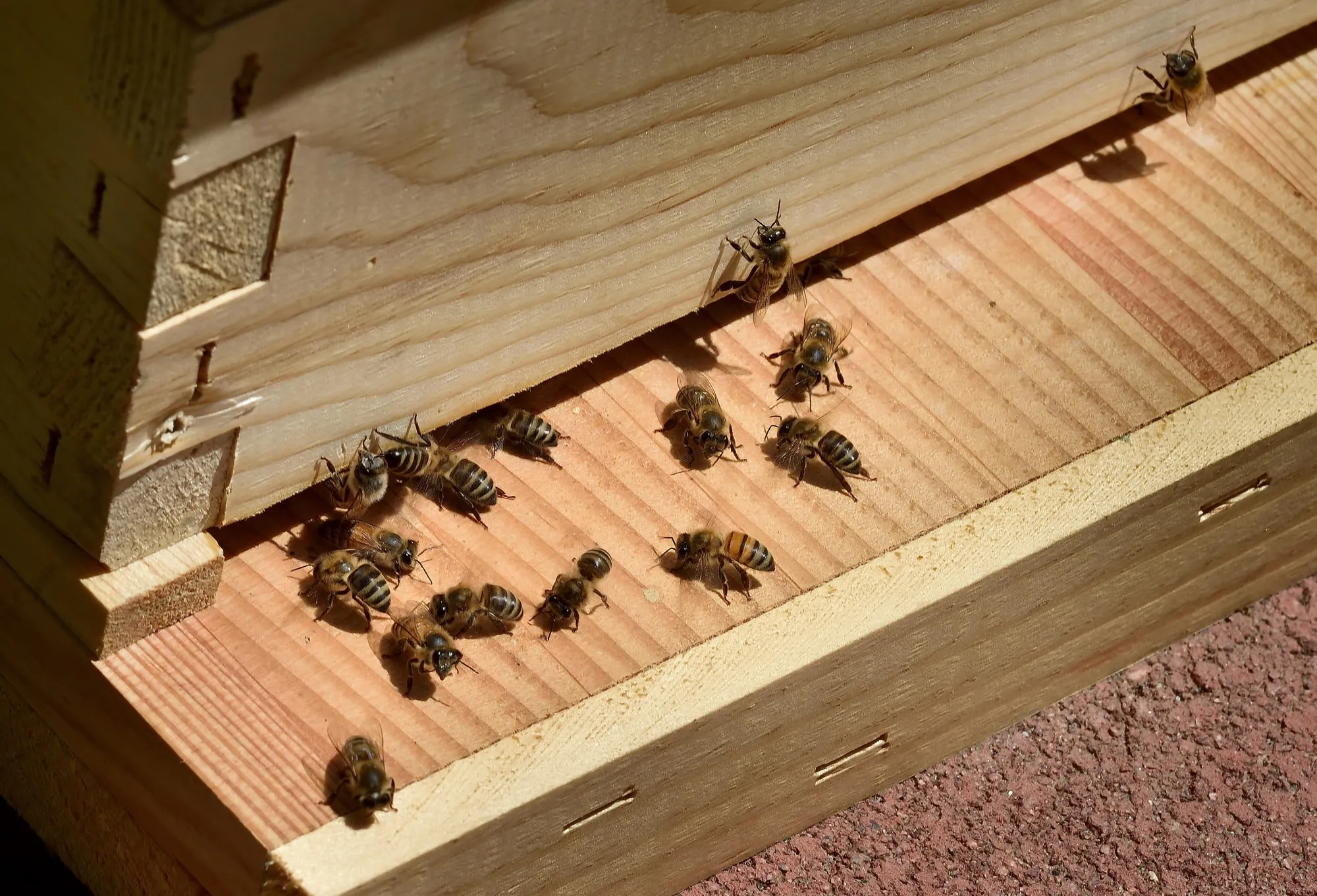
Temple Beth Tikvah in Fullerton was abuzz last week when beekeeper Ray (he prefers that I use only his first name) arrived with a frame of live bees and a wealth of knowledge about honey production – a fitting subject, since honey is the iconic food of Rosh Hashanah, the coming Jewish New Year.
Read more Anaheim briefs: Show-and-tell with the Anaheim Historical Society
Honey, it turns out, has staying power. It never spoils, and pots of honey found in 3,000-year-old Egyptian tombs are reportedly still edible.
Ray is often called to remove beehives from private homes. Once, he was called to a woman’s shed, where he discovered a hive.
“I took the bees, and then she said, ‘Could you take all those buckets too?’” Ray said. Her father had been dead for 40 years, she explained, but he had left behind 54 five-gallon buckets of honey. “It was still good.”
The children had plenty of questions — and Ray had plenty of answers. Many were concerned about getting stung.
“Bees love to be looked at, but they don’t like to be touched,” he told them. “They don’t want to sting you unless they have to.”
And one surprising warning: “Even dead bees can sting.”
We tend to picture bees pollinating vast fields of crops in the countryside, but Ray says bees actually may do better in urban areas. Commercial farms can be hard on them because of pesticides and the limited diet they are fed.
“Bees need a variety of food,” he explained. “And I don’t feed my bees chemicals.”
That variety is reflected in the honey itself. Its flavor, color, aroma and texture depend on the flowers from which the bees collect their nectar. Different blossoms contribute their own combination of sugars, minerals and organic acids, creating honey with remarkably different personalities.
Read more Little Mercury may be shrinking faster than scientists expected
Commercial supermarket honey, however, is heated and filtered, which can strip away some of those distinctive compounds — and with them, some of the honey’s natural character.
Ray, who keeps 150 hives and produces gallons of honey, offered one delicious irony: “I’m a diabetic!”
Of course, no Rosh Hashanah celebration would be complete without apples and honey. At the event, attendees sampled six varieties of honey with five varieties of apple, along with challah and chips.
As we tasted, Ray explained a fascinating member of the hive: the queen. “The queen’s job is having babies. She doesn’t do any work,” he said. During peak seasons, she can lay between 1,500 and 2,000 eggs a day, so laden with eggs, in fact, that she is too heavy to fly.
Worker bees surround the queen and tend to her every need. And if she dies or disappears, the colony gets to work choosing young larvae — usually about three days old — and feeding them a special diet of royal jelly.
The result: a new queen.
Ray’s visit was sponsored by PJ Library, the brainchild of Harold Grinspoon. Inspired by Dolly Parton’s Imagination Library, Grinspoon envisioned a similar program that would put engaging Jewish books into the hands of Jewish children each month. Today, PJ Library serves Jewish communities in 30 countries.
There are almost as many ways to use honey in the kitchen as there are varieties of honey to taste.
Fullerton’s Judy Bart Kancigor is the author of “Cooking Jewish” and “The Perfect Passover Cookbook.” Her website is cookingjewish.com.
Read more The push to remove lead pipes is on. Thousands of water systems still don’t know where theirs are