
To explain why Southern California News Group sent a reporting team cross-country for the 25th anniversary of the Sept. 11 attacks, we’ll repeat only a little of what you already know, probably by heart.
Read more What to expect from commercial real estate for the rest of 2026
On Sept. 11, 2001, a group of 19 terrorists directed by the late Osama bin Laden killed 2,977 people by causing four passenger jets to crash into the Twin Towers in New York, the Pentagon in Washington, D.C., and a field/strip mine in an otherwise peaceful stretch of Pennsylvania.
The attack was so important that within days the Orange County Register dispatched reporter Andre Mouchard – one of the authors of this article – and photographer Bruce Strong on a cross-country drive, from New York to Southern California.
We talked with cops and funeral directors and grieving spouses and little kids and a guy with a python around his neck.
They all told us a lot of stuff, but it boiled down to this:
Our collective loss was more than anybody could possibly imagine, much less explain.
But we noticed something else back then, too, even as we drove.
The post-attack America of late 2001, just 10 months removed from a razor-close election, wasn’t in a mood to squabble.
Democrats, Republicans, tweeners, people who don’t vote, people who can’t vote, people of all cultural and economic leanings; everybody agreed on a few things – America is a cool country, we really hate that bin Laden guy, and we love firefighters, cops and everybody else willing to risk their lives for others.
Flags weren’t political. Politics wasn’t tribal. Decency felt normal.
That America didn’t last, of course, but it was real at the time. We saw it.
So, what happened?
That question is part of what prompted our bosses – now with the Southern California News Group – to send a new(ish) team out of town to update the 2001 story.
Photographer Jeff Gritchen and reporter Sierra van der Brug joined Mouchard this time. We spent nine days driving from Southern California to Newark, New Jersey (we took a clueless Uber into Manhattan), stopping at Sept. 11 memorials along the way. We logged more than 65 hours and 45 minutes in our vehicle (a rented Jeep) and covered 3,593 miles. We didn’t fight, though the return traveler whined semi-frequently.
We missed pythons, but we did catch up with librarians and Steelers fans and an Indian-American guy who lifts a lot of weight, among others. We shot video, took photos and wrote stories about every day of the trip.
And before we flew home Saturday, we learned this: A lot of the Americans we talked with think common ground is still possible, maybe. Others do not.
But all of them – of all political stripes – want the “United” part of our nation’s name to make a comeback.
“I’d love to live in that country,” said Kamir Badal, a 48-year-old restaurant owner from Cheyenne, Wyoming.
“I’d love to show that country to my kids.”
Here are some of the trip’s greatest hits:
Day 1: Las Vegas
We’re staring at the fake flame held by the fake Statue of Liberty in front of the New York-New York Hotel & Casino, a gloriously fake version of New York City.
We’re clocking that the blue-ish rubber turf that stands in for New York Harbor is wearing thin, and that even guys dressed as cartoon characters (Donald Duck and Mickey Mouse) make U-turns to avoid this place.
Which stinks.
We’re here because this place is sacred, kind of. It’s the spot where thousands of people – tourists and locals alike, sober and otherwise – once created what was in the running to be the world’s biggest spontaneous memorial.
Starting minutes after the attacks and carrying on for a couple years, people brought all manner of nonsense to lay down at faux Lady Liberty; plastic flowers, shot glasses, T-shirts, at least one pair of barbecue tongs. They did it as a way to pay real tribute to real people who really died.
And as it grew, the small mountain of tchotchkes became the most authentic thing in a pretend town.
But it’s gone. The only reminder that it was ever here is a solid, seriously gray plaque. It’s on a fence, but set low enough that unless you’re a little kid you need to bend down to read it.
But part of the message is interesting, maybe as cool as the plastic baby feet somebody once tossed on the pile.
“Our World Changed Forever on September 11, 2001. The people of our nation demonstrated strength and resilience, as well as love and compassion for our fellow man…”
Think about that. We honored people who died trying to rescue others as “heroes,” and that was apt. But love? That’s apt, too. Heroes often risk their lives – or lose them – simply because they love others enough to do it.
“Love” isn’t the word most people link to Sept. 11. Leave it to gamblers and drunks and waitresses and cabbies to break the mold.
Day 2: Murray, Utah
Whoops.
We’ve driven several hundred miles to Murray, a pretty town about 15 miles south of Salt Lake City. But we’re learning that the people who supposedly oversee Murray’s Sept. 11 memorial can’t find it.
A nice, capable guy who works at the amphitheater in Murray Park, Robert Wyss, expresses a bit of guilt about this.
“I probably should know where it is.”
So he makes some calls. And, soon, the mystery is solved: They used to have one, but it’s gone.
Why?
The words.
The message on the plaque that’s no longer around began like this:
“On September 11, 2001, a handful of men put their beliefs on the line in a stand for terrorism. As a result, the discarding of their lives cost the lives of thousands of world citizens… “
Those words were not intended to be pro-terror – c’mon, it was part of a Sept. 11 memorial. But they are less than clear. And if you squint hard, you can read them as not quite anti-terror enough.
Anyway, some vandals in town did, in fact, read it that way. And they were so persistent in desecrating the memorial that, eventually, an exasperated park supervisor hauled the whole thing off. The de-installation, we were told, happened in “the dead of night.”
For us, the Murray bench incident hints at something sad:
The unity that America felt after Sept. 11 was driven by a lot of shared feelings, including anger. But over the years, as some of those feelings faded – things like sympathy and solidarity – the anger stuck around.
For a time, anyway.
Day 3: Cheyenne, Wyoming
Badal, the restaurant owner, wears a turban in public, always, even when he lifts weights. And, right now, as the sun rises and the inside of this shockingly clean Planet Fitness heats up, the headwear is getting a little moist.
No matter. Badal pushes more than 300 pounds off his chest. He does this silently, not even breathing hard. He’s a beast.
As I ask him about the turban and about people’s responses to it, and about the prospect for unity in post-Sept. 11 America, Badal nods a little and stacks weights for his next exercise, apparently a leg press.
“I moved to the United States a few years after (Sept. 11). And some people gave me (grief) about the turban,” he said.
“I didn’t live here before that, so I don’t know how it would have been, but I’ve always thought that was because they thought I’m one of the terrorists.
“I’m brown. I have a turban. To some people, it makes sense.
“But you should know that was never most people. Or even a lot,” he added.
“Just some.”
He moved to Cheyenne, from Texas, about four years ago, and since then he’s noticed two things about what he hopes is his forever home.
“This is a super conservative place, politically. And I kind of thought the turban would be a thing, you know?. But it’s not. I can’t recall a single incident. And I don’t think twice about my kids going to school, either. People here are very kind.”
And the other thing?
“Maybe it’s not just Cheyenne,” he said.
“Maybe it’s just time. Maybe people are letting it go.”
Day 3: Morrison, Colorado
Red Rocks Amphitheatre, this high-altitude music venue with 70 rows of seats that climb more than 100 feet straight up, hosts an annual Sept. 11, 110-story “stair” (it’s actually the seats) climb. It’s a tribute to the firefighters who died in the Twin Towers.
But, until then, Red Rocks is a very public workout zone.
Dozens of lycra-clad men and women run, skip and crawl up and down the 70 rows, huffing in the thin air (we’re at 6,450 feet). Non-exercisers stand around and watch, sometimes clapping. Exercisers stand around, too, between sets, gawking at each other. And, clearly, some want to be gawked at.
Enter Emmy Agustin, a first-timer to Red Rocks who, since getting here just after breakfast, has gone native.
Read more OCVarsity’s football wrap-up: Stories, scores, photos from Friday’s games
She might be the most popular person here. She schmoozes new friends, moving from group to group. She grins. She listens. She lets her easy laugh rise over the sweaty hum.
But she’s not always this festive. At 41, the Hawaii native who now lives in Aurora, Colorado, holds a job, flight attendant, that’s linked, probably forever, to Sept. 11.
Three years ago this week, she was one of four people chosen to represent her union, the Association of Flight Attendants, at a ceremony in Washington, D.C., to honor the 25 flight attendants who died in the attacks.
It was a somber event, and Agustin doesn’t seem to do somber.
But she is smart, and she has some thoughts about what she did.
“It was just a flower that we each put down on the tarmac, but it really meant something. It was important.”
When asked about Sept. 11 and whether we can get back to the unity that came after, she offers what she concedes is an unusual opinion.
“We should be grateful. Obviously, not about what happened on Sept. 11; it was a terrible thing,” she said. “And I’m not talking about the victims’ families or anything. That’s different.
“But most of us should be grateful because of what it did later. The terror didn’t make us break apart. It did the opposite.
“And I totally think that’s still possible again,” she added.
“Actually, I know it is.”
Day 4: Anthony, Kansas
Twenty-five years ago, as they watched TV and saw big planes crash over and over into a big city, leaders of this tiny, wheat-farming town had the same thought that millions of other Americans were having:
How can we help?
In the end, Anthony, Kansas, population 2,108, went micro, channeling all of the town’s effort to help the family of a single fallen firefighter, Joe Spor. The son of a firefighter, Spor, 35, was a member of an elite rescue squad when he died. He left a wife and four kids.
It’s unclear if Anthony’s bake sales and other fundraisers brought in big money. It apparently was enough to help the kids.
But the town’s kindness was sincere and powerful.
It was powerful enough, in fact, that New York-area fire officials have come out to Anthony several times over the years. And, if history is a guide, some people from town are likely to be in touch – yet again – with FDNY sometime this week.
But nobody around here brags about it.
As we sit in our new favorite bar, Idle Hour, in downtown Anthony, the bartenders and patrons talk about how the new Kansas weather pattern (it’s more than 100 degrees today, same as it’s been for the past several weeks) might be grim for this year’s crops. They talk about schools and real estate. They talk about how almost everybody in town who isn’t in this air-conditioned bar is at a nearby lake.
But they don’t talk – without prompting – about the help they provided to Spor’s family, or about the town’s artful Sept. 11 memorial, which stands, unvisited today, in a sun-baked park a few blocks away.
“We’re all just friends now,” said Earl Ratliff, an Anthony resident of an indeterminate age, referencing the town’s connection to New York.
“That’s just how it worked out.”
Day 6: Oxford, Ohio
“I was eating Cap’n Crunch.”
That’s Chad Bennett’s answer to the inevitable “what were you doing when” question about Sept. 11.
The firefighter from Los Angeles was 7 that day. Now, at 32, he’s part of a huge cohort – more than 1 in 3 Americans – who either weren’t born or were young children when Sept. 11 supposedly changed everything forever.
Bennett was in New York City when he talked cereal, not here, at the campus of Miami University of Ohio. But if he had been here, he would have fit in.
Sept. 11 isn’t a top issue around for these (or, probably, any) students, even as the 25th anniversary draws close. It’s not disrespect. It just reflects growing up in a post-Sept. 11 world. Most Baby Boomers don’t have an emotional connection to Pearl Harbor.
We interviewed a half-dozen students, asking them to sit on a Sept. 11 memorial bench near the school’s fitness center. There’s a plaque on the bench recalling Kelly Booms, a Miami of Ohio grad who died in the attacks, but none of the students knew that before we told them. (To be fair, the plaque is tiny.)
We asked, among other things, how they think their lives are different than they might have been if the attacks hadn’t happened.
They’re less free, they told us; more surveilled. They say their views on politics and culture and religion have been shaped, to some degree, by something that happened just before they were born. But they can’t really say how.
Can anybody?
Day 7: Shanksville, Pennsylvania
The park worker here, at the Flight 93 National Memorial, shares the scoop, anonymously, that he stops dancing every time he blows his leaf blower anywhere near the stone that serves as the memorial to the exact spot where Flight 93 crashed on Sept. 11. It’s in a field, about a half-mile away from the visitor center, so it’s unclear why it needs protection from leaves, but whatever.
He still wears the headphones, he says, but he doesn’t listen, at least not when he’s near the stone.
“It’s sacred.”
When we check the stone, it does, in fact, look sacred.
Maybe it’s a theme.
The chalk artist who is at this memorial for a special day of chalk artistry – using photos to paint the faces of two of the 40 people who died when the plane went down (other artists are drawing the other 38) – picks the same word.
“When you do this, and you look at every detail of a person’s face, and you really focus for as long as you have to do to do this, it’s sacred,” said Erika Thurkins, who lives in Pennsylvania.
She picked today’s subjects after reading their profiles, and noted that the woman she’s drawing, Hilda Marcin, was about to move in with a daughter in California when she was killed.
“There was something about that decision, which wasn’t acted on, that moved me.”
Thurkins noted that recreating the faces, even temporarily, is a step short of keeping them alive. But it’s a small step.
Of her subjects, she said this:
“I listen to them.”
Even the Steelers fans at this site, on this day, are talking spirituality.
“We have a choice, kind of a sacred one. We can either let this country be as divided as it is, or we can choose to be united again,” said Patti Fitzpatrick, who lives near the site.
“We don’t have to be subject to this division.”
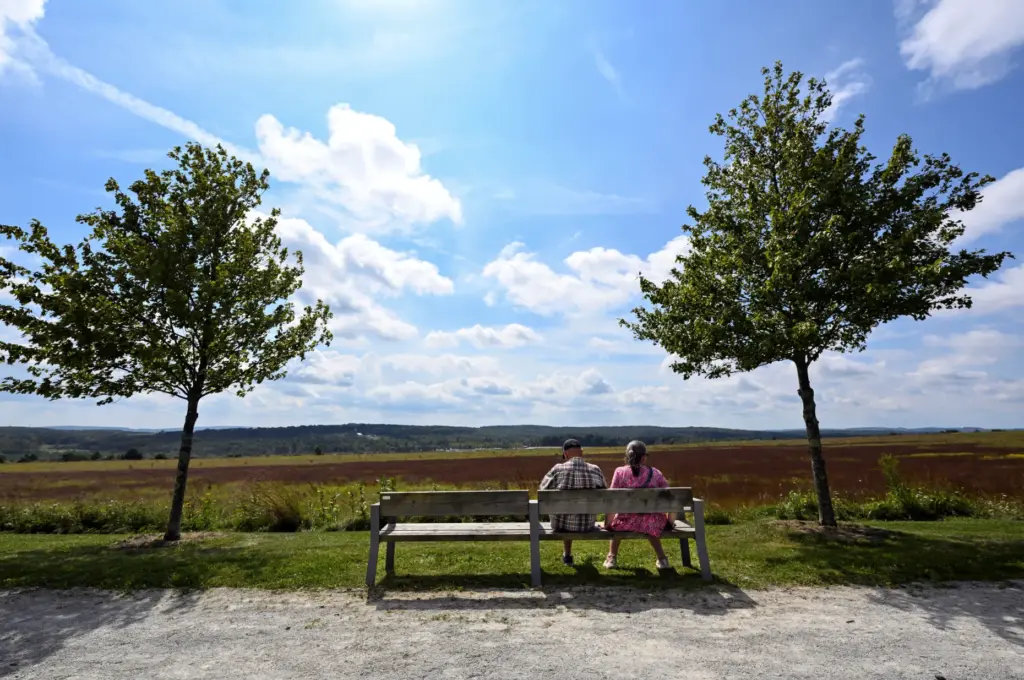 Hal Mante, and his wife, Joyce Mante, sit on a bench as they look toward the crash site at the Flight 93 National Memorial in Shanksville, PA, on Wednesday, September 9, 2026. Hal Mante, in comparing this memorial to Ground Zero, said New York is more graphic while Shanksville is more peaceful. (Photo by Jeff Gritchen, Orange County Register/SCNG)
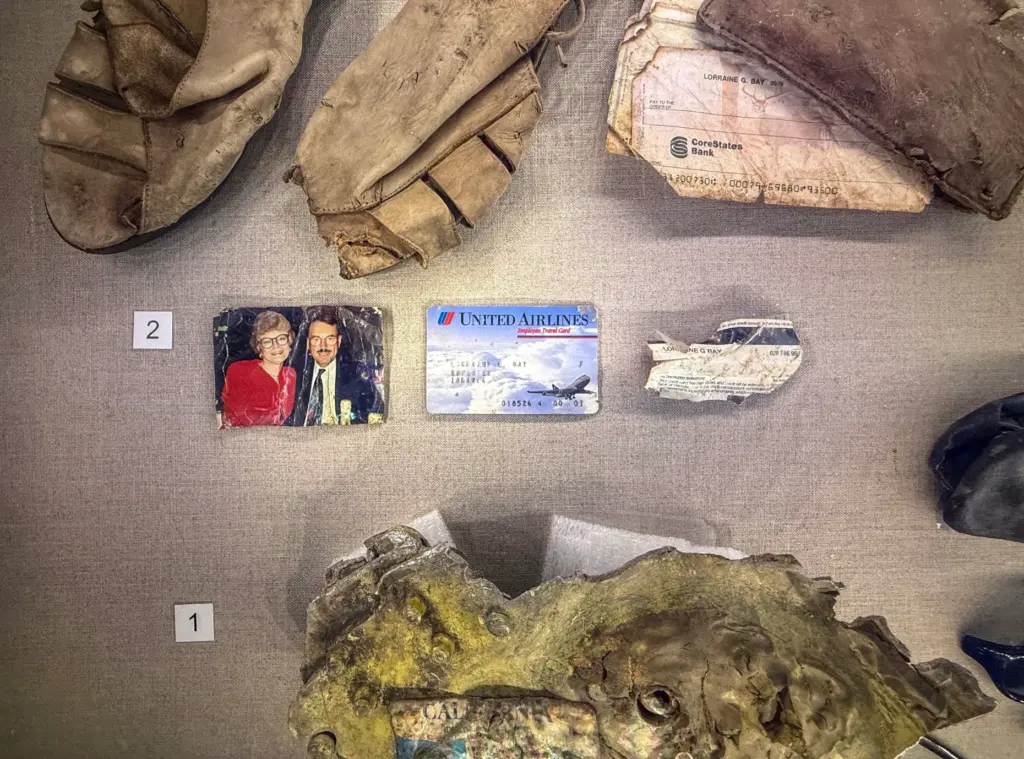 Items from passengers recovered at the crash site are displayed at the Flight 93 National Memorial in Shanksville, PA, on Wednesday, September 9, 2026. During the Sept. 11 terrorist, American Airlines Flight 93, from Newark to San Francisco, was hijacked. The passengers, hearing about the other attacks, took over the plane and caused the crash in Pennsylvania. (Photo by Jeff Gritchen, Orange County Register/SCNG)
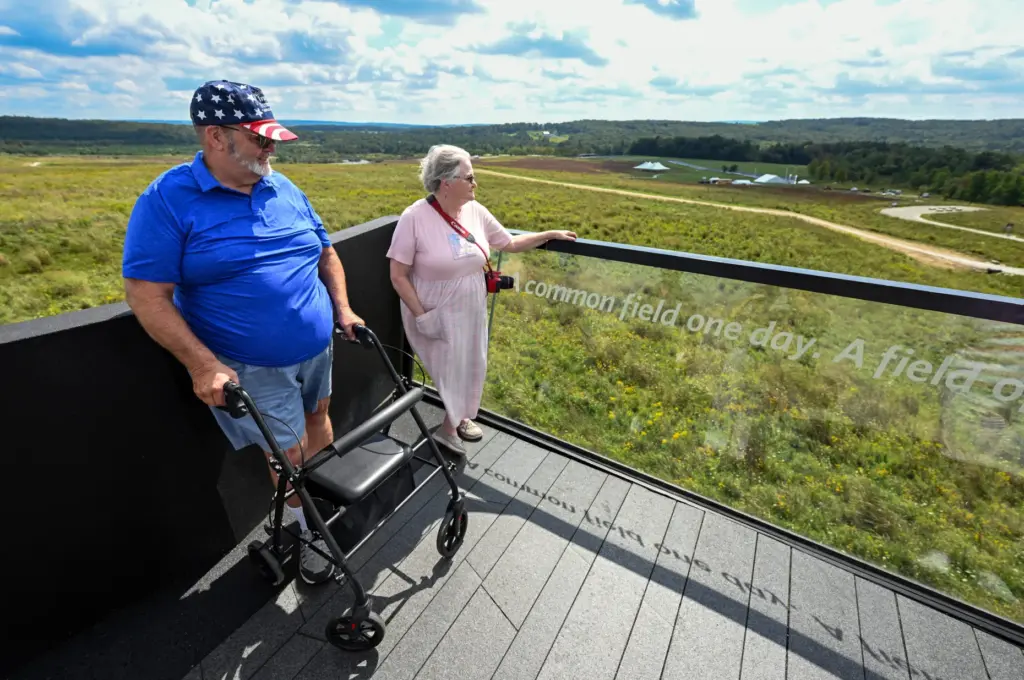 Rick Fitzpatrick, left, and his wife, Patti Fitzpatrick, at the Flight Path Overlook at the Flight 93 National Memorial in Shanksville, PA, on Wednesday, September 9, 2026. During the Sept. 11 terrorist, American Airlines Flight 93, from Newark to San Francisco, was hijacked. The passengers, hearing about the other attacks, took over the plane and caused the crash in Pennsylvania. (Photo by Jeff Gritchen, Orange County Register/SCNG)
Day 9: Manhattan
We’ve smelled a lot of weird smells on this trip.
Cheyenne, Wyoming, Dodge City, Kansas, Newark, New Jersey – the impossibly big cloud of weed we inadvertently ran into in Las Vegas; different cities offered unique and, in several cases, less-than-excellent odors.
And 25 years ago, this place, lower Manhattan, put out its own weird smell.
It was the world’s biggest blown fuse.
The air was powerfully metallic, with a dash of sulphur. Two of the world’s biggest buildings, with all the wiring and piping and insulation that modern buildings employ, had just gone down in flames, so a lingering smell made sense. There was white powder everywhere. It probably added to the smell.
That visit came fewer than 10 days after the attacks, but even then workers cleaning up the rubble weren’t noticing the smell anymore. Or, at least they said they weren’t.
One guy even thought we were being rude when we asked about it.
“Exactly what smell are you talking about?”
He said this while wearing a mask that you’d see later, during COVID, but whatever.
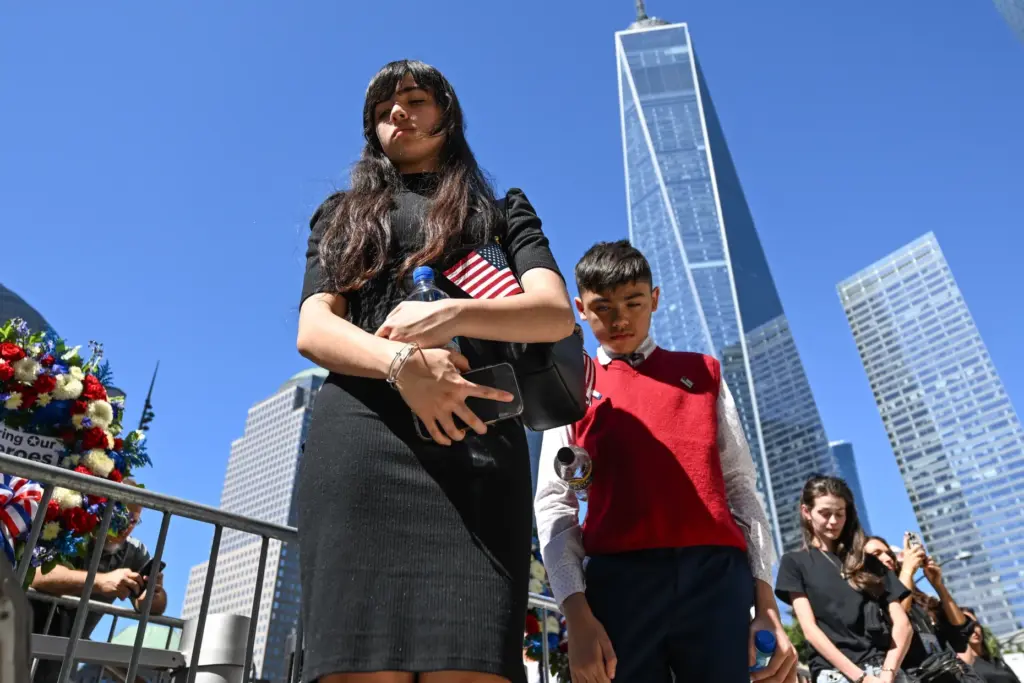 Aerias Pinto and her brother, David Pinto, pause during a moment of silence outside FDNY Ladder Company 10 and Engine Company in New York, NY, on September 11, 2026. Their father lost his great grand aunt Susan Pinto during the Sept. 11 terrorist attacks. This was the 25th anniversary of the terrorist attack at the World Trade Center, Pentagon and Shanksville, Pennsylvania. (Photo by Jeff Gritchen, Orange County Register/SCNG)
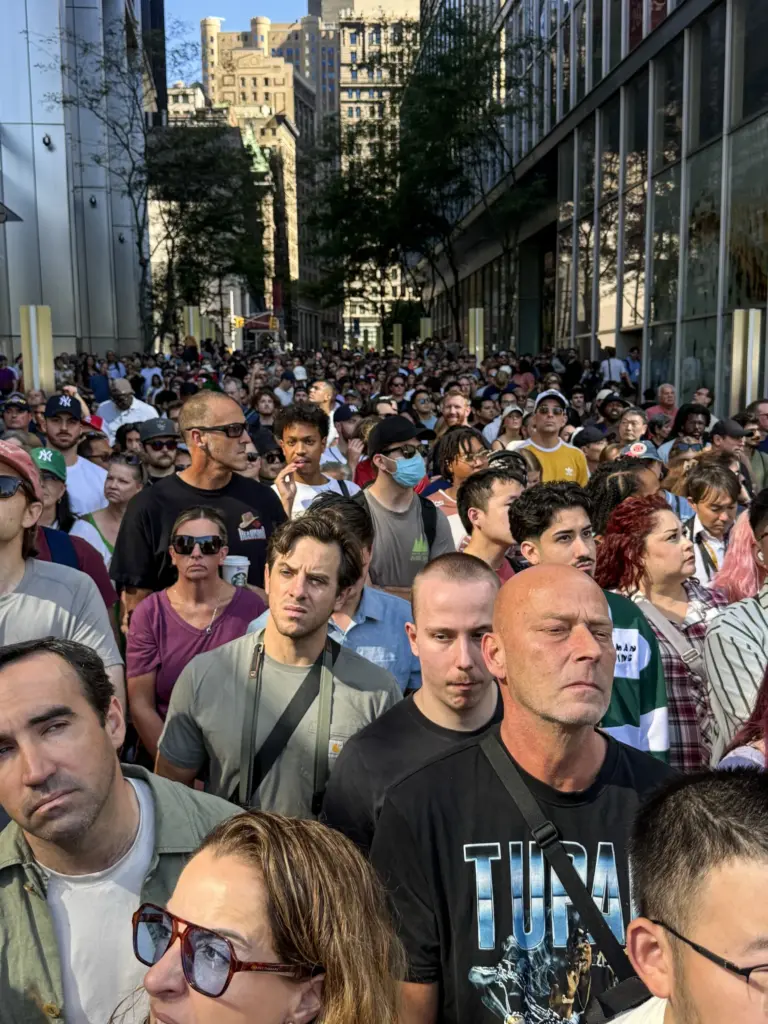 People wait in line to enter the 9/11 Memorial Pools at Ground Zero in New York, NY, on September 11, 2026. This was the 25th anniversary of the terrorist attack at the World Trade Center, Pentagon and Shanksville, Pennsylvania. (Photo by Jeff Gritchen, Orange County Register/SCNG)
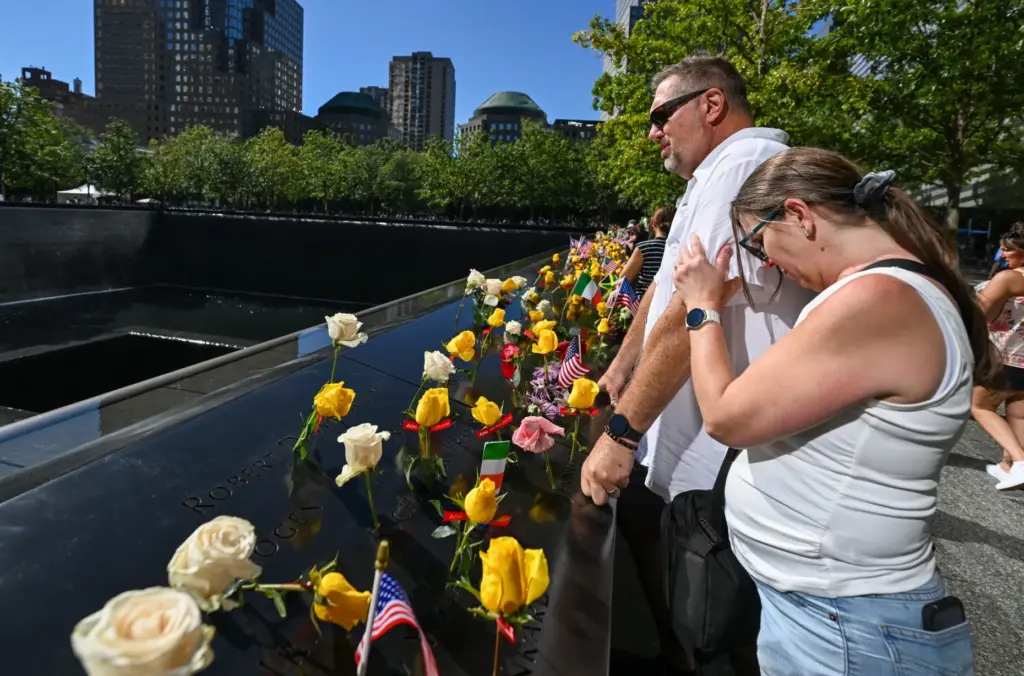 Paul Gasser and his wife, Barbara Gasser, stand at the 9/11 Memorial Pools in New York, NY, on September 11, 2026. Paul teared up as he remembered his escape from the 51st floor of tower two during the Sept. 1a terrorist attacks. This was the first time he returned to the site since the attacks. (Photo by Jeff Gritchen, Orange County Register/SCNG)
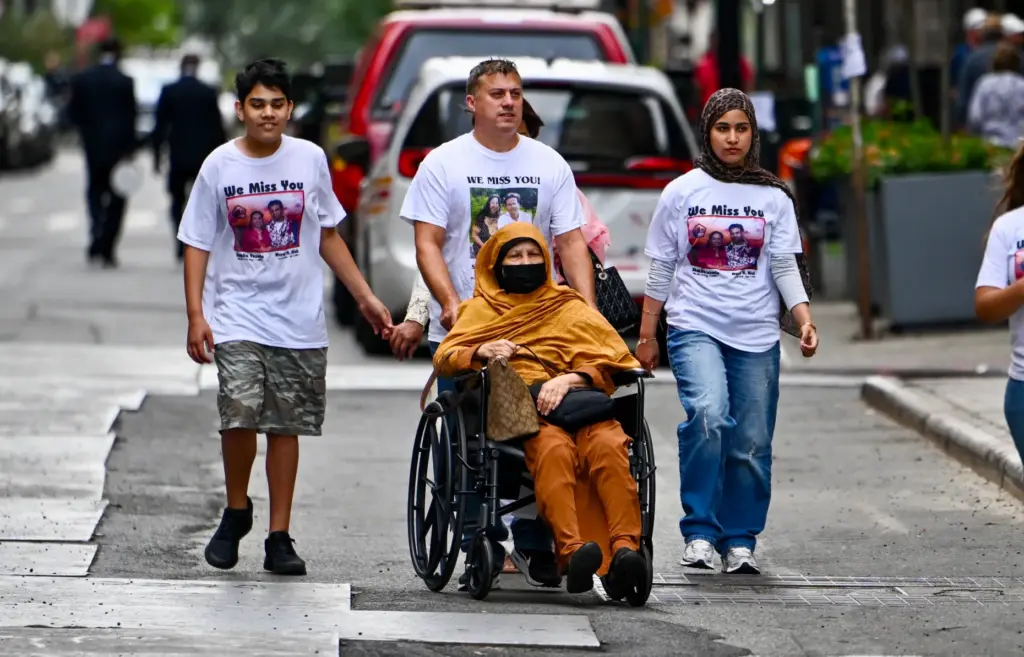 Family members arrive at the annual 9/11 memorial event at Ground Zero in New York, NY, on September 11, 2026. The was the 25th anniversary of the terrorist attack at the World Trade Center, Pentagon and Shanksville, Pennsylvania. (Photo by Jeff Gritchen, Orange County Register/SCNG)
Today, that’s gone.
As thousands of people gather near the buildings and the museum and the reflection pools that have replaced the towers, as a way to commemorate the 25th anniversary of the Sept. 11 attacks, there are normal, even pleasing, city smells.
There’s coffee, somewhere. And saltwater. And pizza. And, if you walk up to where the food carts are, a couple blocks away, there’s a mix of grilled hot dogs, fried chicken, falafel and some kind of fried mozzarella nonsense.
It’s the smell of Sept. 12.
“That’s the best day ever, in the whole world,” said Jared Bennett, a captain in the Los Angeles Fire Department.
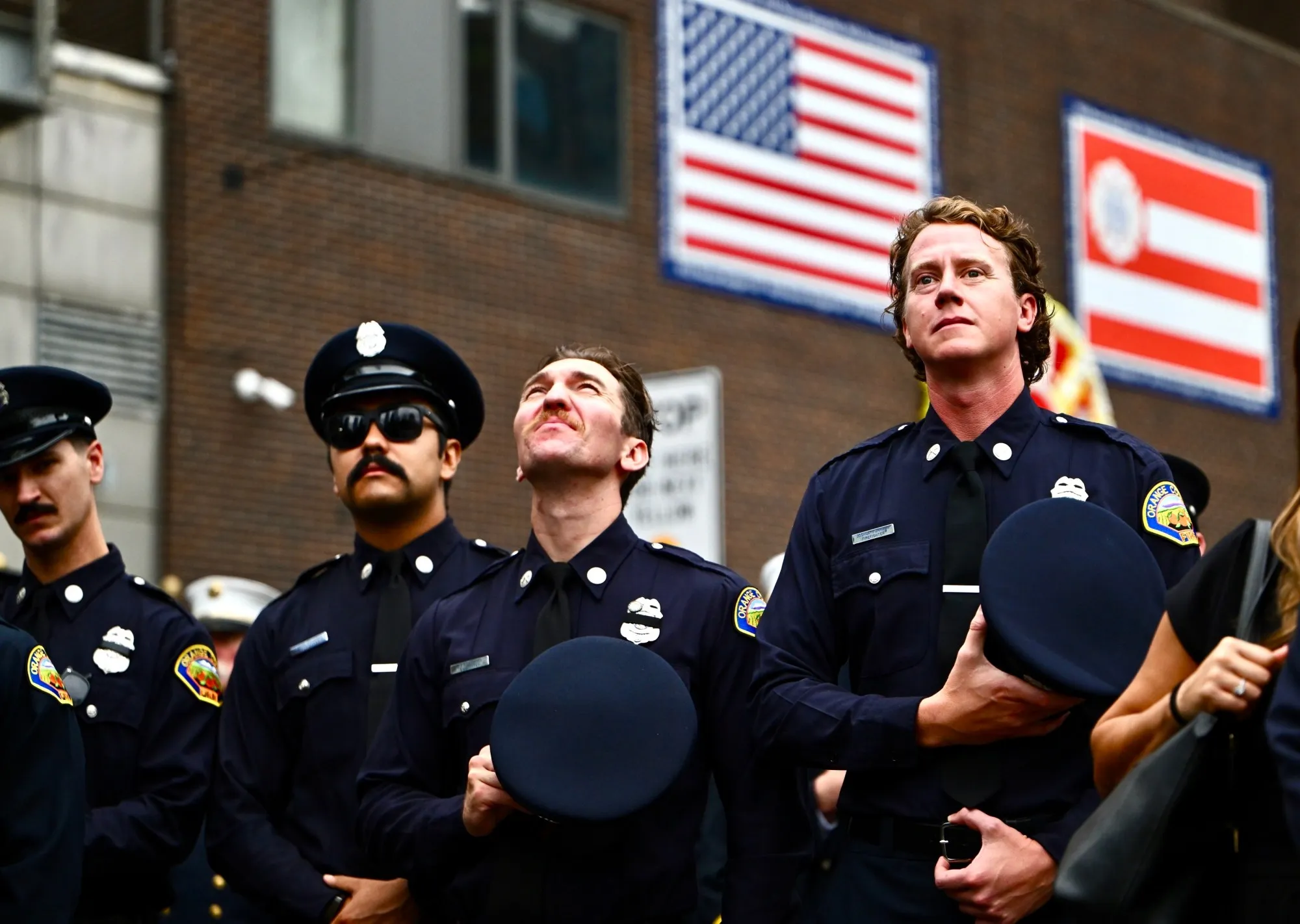
Bennett and his family, and many other LAFD fire folk, are in town today, gathering in uniform near the memorial to pay homage to lost co-workers.
To be clear, most didn’t work directly with FDNY firefighters. But firefighting seems to run deeper than most work situations. And when 343 firefighters died in the towers, 25 years ago, trying to save others, the loss was powerful enough to bring guys like Bennett and a couple thousand other firefighters here, on their own dime, to pay respect.
Bennett, like a lot of people we’ve met over the past few days, seems to be looking forward.
Read more Mission Viejo football bounces back with resounding win over Lincoln
He says Sept. 12 – shorthand for unity – isn’t far off.
“To change it, we just have to do well. That’s all. It can happen.”