
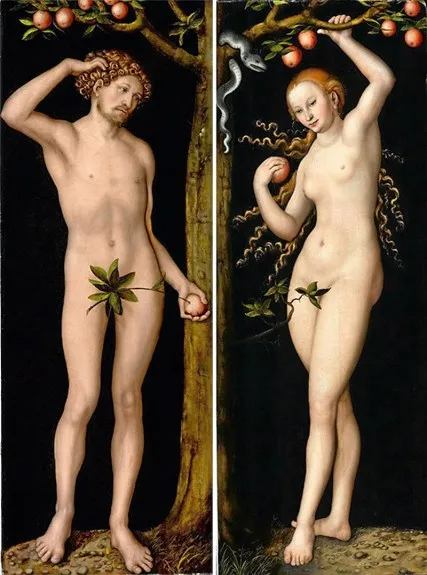
The Norton Simon Museum in Pasadena once again faces a lawsuit challenging its ownership of iconic masterpieces seized by the Nazis during World War II.
Read more Russia’s wartime parliamentary election is set to secure the Kremlin’s power
The heirs of Jewish art dealer Jacques Goudstikker, whose dealership was looted by the Nazis in 1940, have tried unsuccessfully to recover the paintings of “Adam” and “Eve” by Lucas Cranach the Elder for decades, but courts have repeatedly ruled in the museum foundation’s favor.
Now, the Jewish Federation of Greater Los Angeles is trying again under a 2024 law giving claimants another shot at a court challenge. The latest attempt is one of two cases filed this week under that law and it could set the precedent for many more.
Marei von Saher, the sole surviving heir of Goudstikker, assigned her claim to the Cranachs to JFEDLA on Monday, Sept. 14, the same day the lawsuit was filed in Los Angeles County Superior Court.
If successful, the proceeds will be used to support Holocaust survivors, according to a press release.
“By pursuing the recovery of the Cranachs, we are seeking to reverse a great injustice perpetrated by the Nazi theft of a Jewish family’s property, and securing the resources that will enable us to provide for the many acute needs of thousands of impoverished Holocaust survivors in the greater Los Angeles area so they can live in dignity for the remainder of their lives,” said Rabbi Noah Farkas, president and CEO of JFEDLA, in a statement.
In a statement, the Norton Simon Art Foundation pointed to a 2016 judgment issued in federal court — and reaffirmed by an appellate court two years later — that established the foundation as the “sole owner of the title” to the oil paintings.
“After decades of litigation, court after court including the United States Supreme Court has confirmed that the Norton Simon Art Foundation has proper title to Adam and Eve by Lucas Cranach the Elder,” the statement reads. “We will continue to make these important artworks accessible to the public, as we have since 1971.”
Nazi Reichsmarschall Hermann Göring, Adolf Hitler’s right-hand, stole the diptych of “Adam” and “Eve” in 1940 following Germany’s invasion of the Netherlands. The United States took the artwork back upon the defeat of Germans and turned over the Cranachs, among other looted artwork, to the Dutch government.
U.S. District Court Judge John Walter dismissed the previous case in 2016 after determining the Goudstikker estate lost its rights when it failed to meet a 1951 deadline to request the return of the art from the Dutch government. This allowed the painting to become the legal property of the Netherlands, which made the eventual sale to the Norton Simon Museum lawful, according to the ruling.
Goudstikker originally purchased the Cranachs in 1931 from the Soviet Union. The work was part of the “Stroganoff Collection,” a hodgepodge of art taken from the Stroganoff family by the Soviets and some, such as the Cranachs, that were seized from churches and other institutions.
George Stroganoff, who received the Cranach as part of a settlement with the Dutch government in the 1960s, sold the depictions of “Adam” and “Eve” to the Norton Simon for $800,000 in 1971.
In 2000, an art historian alerted von Saher that he saw the Cranachs while visiting the museum. For six years, von Saher tried to informally reclaim the artworks before she sued the museum for the first time in 2007,
Read more Buckingham Palace hits back at claims in a book by Princess Diana’s brother
The paintings were appraised at $24 million at the time.
AB 2867, signed into law by the governor in September 2024, gave past claimants two years to file new lawsuits. It requires courts to rely on California law over others when there is a conflict. Under California law, a thief cannot give a “good title” to anyone who purchases stolen items.
The law was created in response to a Ninth Circuit Court of Appeals decision that allowed a Spanish museum to retain an impressionist masterpiece stolen by the Nazis because the court applied Spanish law, rather than California law, when making its decision.
The Holocaust Expropriated Art Recovery Act, or HEAR Act, first passed in 2016 and expanded in April this year, allows claimants to bring lawsuits against foreign governments or museums with ties to the United States and blocks certain technical legal defenses.
The second lawsuit, filed by the daughters of Dina Gottliebova Babbitt, seeks a series of watercolors Babbitt was forced to paint by Nazi physician Josef Mengele while she was imprisoned at the Auschwitz concentration camp. Mengele ordered Babbitt to paint portraits of Roma prisoners as part of his pseudo-scientific experiments. She did so on the condition that Mengele spare her mother from the gas chambers.
The watercolors are now in the possession of the Auschwitz-Birkenau Museum and Memorial in Poland. Babbitt, who moved to California after the liberation of Auschwitz, was invited by the the museum to authenticate the watercolors in 1973, but the museum refused to return the artwork, according to the lawsuit.
Pawel Sawicki, a spokesperson for the memorial, said the drawings of Roma victims made in the camp “must remain in the Memorial as part of the documentation of the crimes of Mengele.”
“We fully understand the emotional approach of Dina Gottliebova’s family to the works she made on the orders of Josef Mengele in circumstances that certainly affected her life, but in carrying out our statutory responsibility, we express the deep conviction that the watercolors should remain at the Memorial,” Sawicki stated. “The portraits of Roma victims are the few remaining fragments of the documentation made by Mengele as part of his criminal experiments. Therefore, they should be treated as unique documents related to the history of Auschwitz.”
Under AB 2867, the daughters of Babbitt can not only sue for the return of the watercolors, but for monetary damages for the refusal to return the paintings for decades.
Art Ashes, the nonprofit that pushed for the HEAR Act, stated the potential precedent set by the lawsuits could help the rightful owners in more than 100,000 cases of Nazi-looted art.
“Museums’ insistence on keeping artworks taken in the Holocaust perpetuates the crimes of the Nazi regime, and demeans the memory of six million Jewish souls,” said Joel Greenberg, Art Ashes’ founder, in a statement.
The new lawsuits came on the same day that a judge in Argentina determined an 18th century portrait stolen by Nazis and missing for 80 years must be returned to its rightful heirs.
Read more Tens of thousands flee as Iran-backed rebels draw Yemen into the wider war