
By CHAN HO-HIM, AP Business Writer
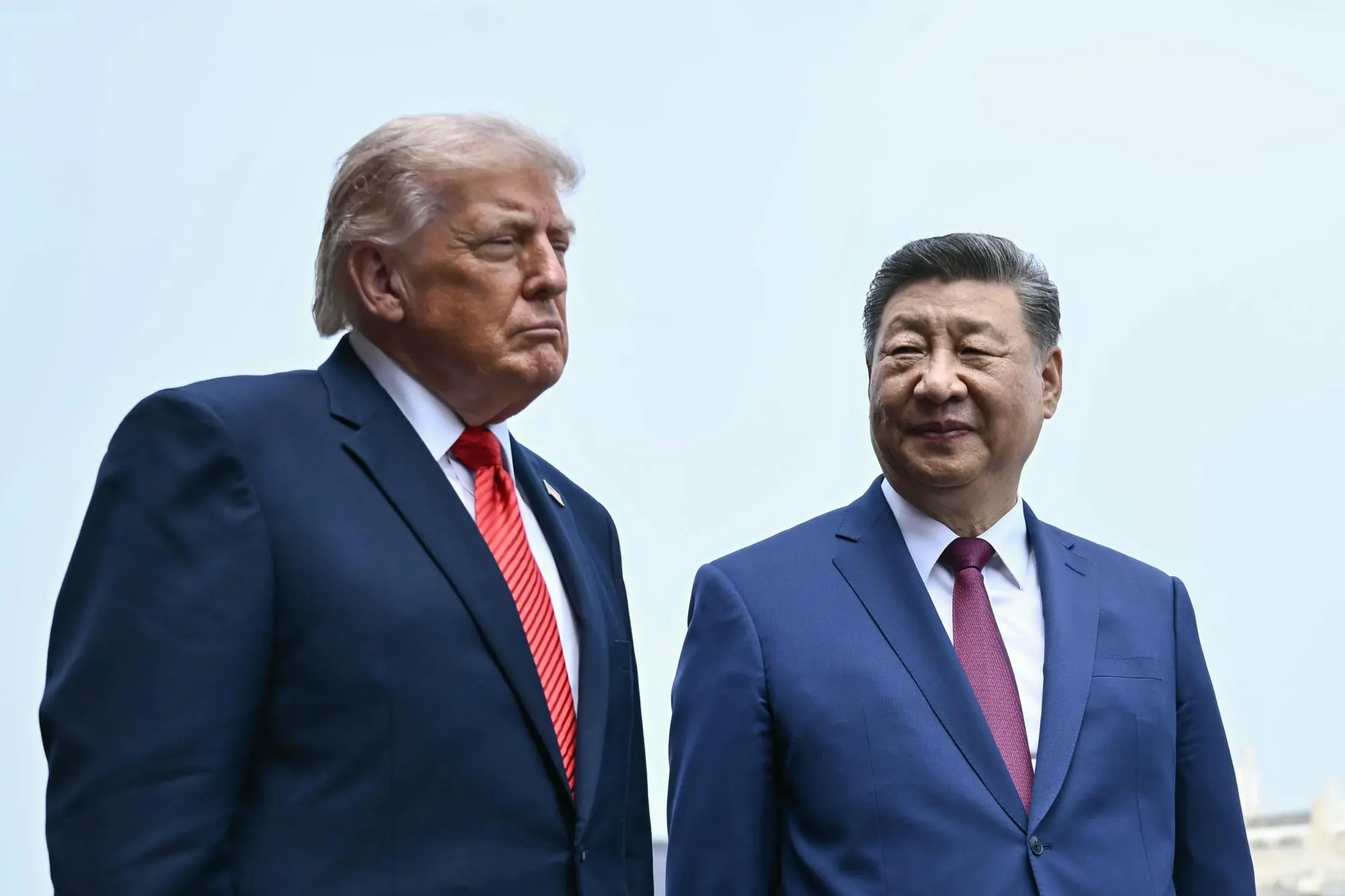
HONG KONG (AP) — U.S. President Donald Trump and Chinese leader Xi Jinping, leaders of rival nations in a race to dominate artificial intelligence, are expected to meet this week against a backdrop of rising concerns about the threats that rogue AI could pose to humanity.
Read more Trump decries Democrats as ‘communists,’ even as he looks to impress China’s communist leader
The hopes for finding common ground on concerns around global AI safety are clouded by competition between the two countries. As China narrows the technology gap with the U.S., each country has expressed concern over how AI in the other’s hands could hurt them.
“The U.S.-China conversation in AI is getting caught in the ups and downs in the broader U.S.-China relationship,” said Scott Singer, co-director of the China AI Initiative at the Carnegie Endowment for International Peace.
On Sunday, U.S. Treasury Secretary Scott Bessent said after talks in New York with Chinese Vice Premier He Lifeng ahead of the meeting between Trump and Xi that the two countries discussed the setting up of a mechanism on AI dialogue and proposed a new “notification mechanism” for AI incidents that could impact national security.
Here is a look at some topics that may — or may not — come up for discussion around AI.
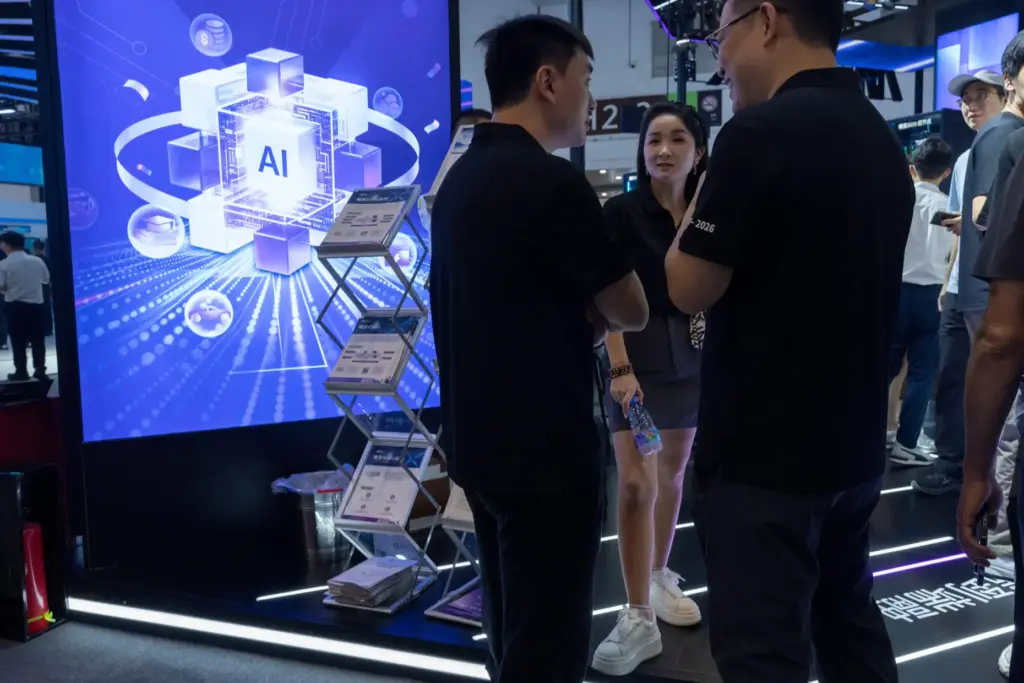 Visitors chat during the World AI Conference in Shanghai, July 17, 2026. (AP Photo/Ng Han Guan)
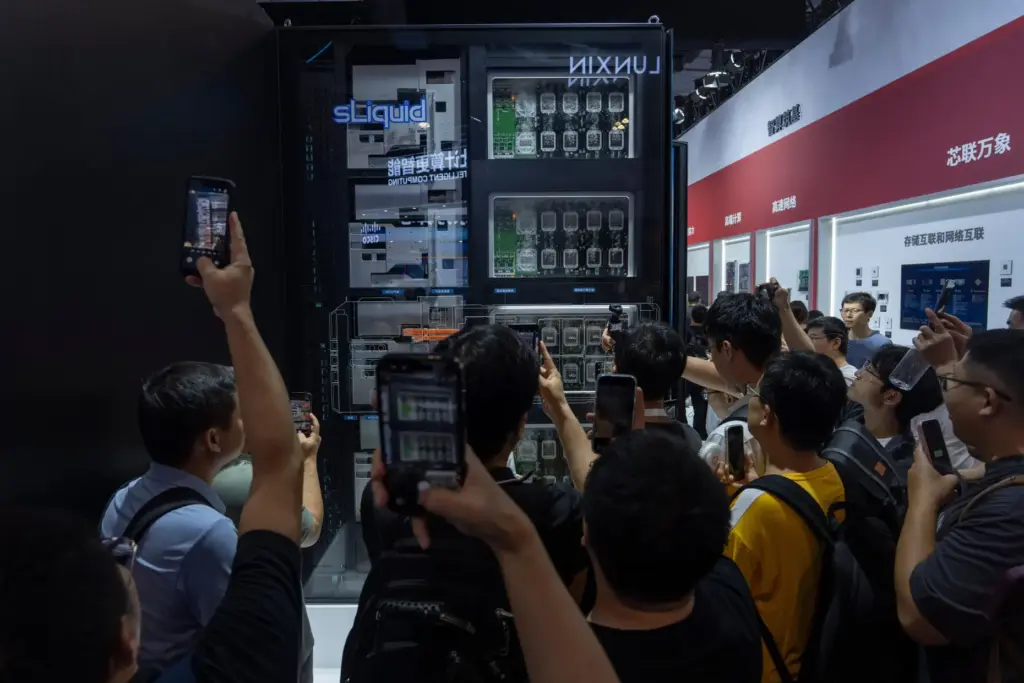 Visitors look at liquid-cooled computer chips at the booth for Chinese high-performance computing and data-center technology company Sugon during the World AI Conference in Shanghai, July 18, 2026. (AP Photo/Ng Han Guan)
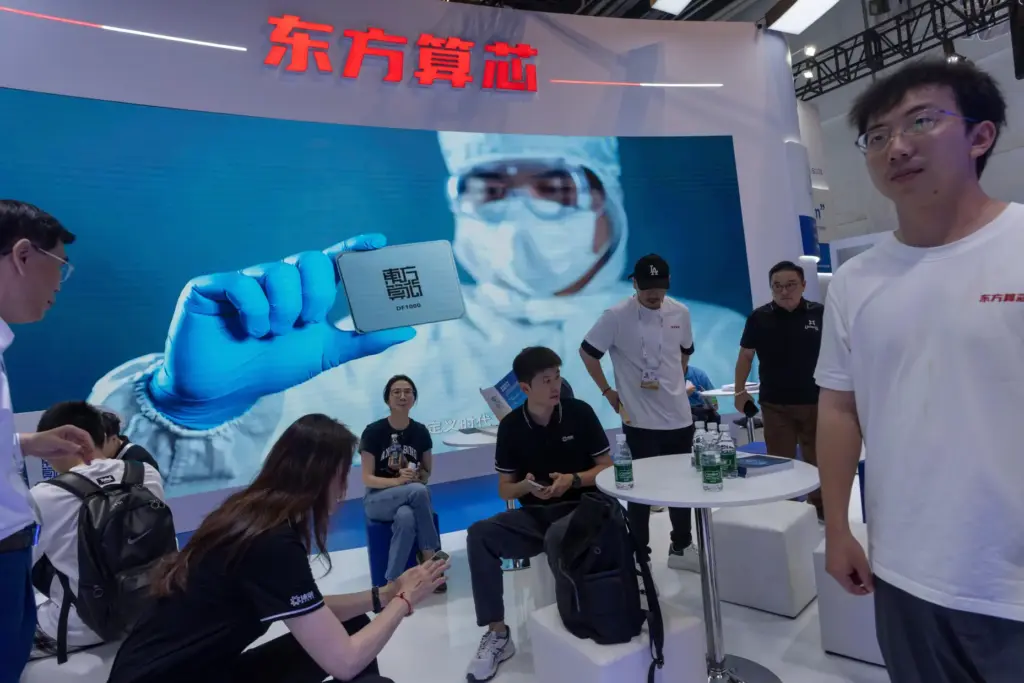 People visit the booth for Chinese AI-computing chip startup Dongfang Suanxin during the World AI Conference in Shanghai, July 17, 2026. (AP Photo/Ng Han Guan)
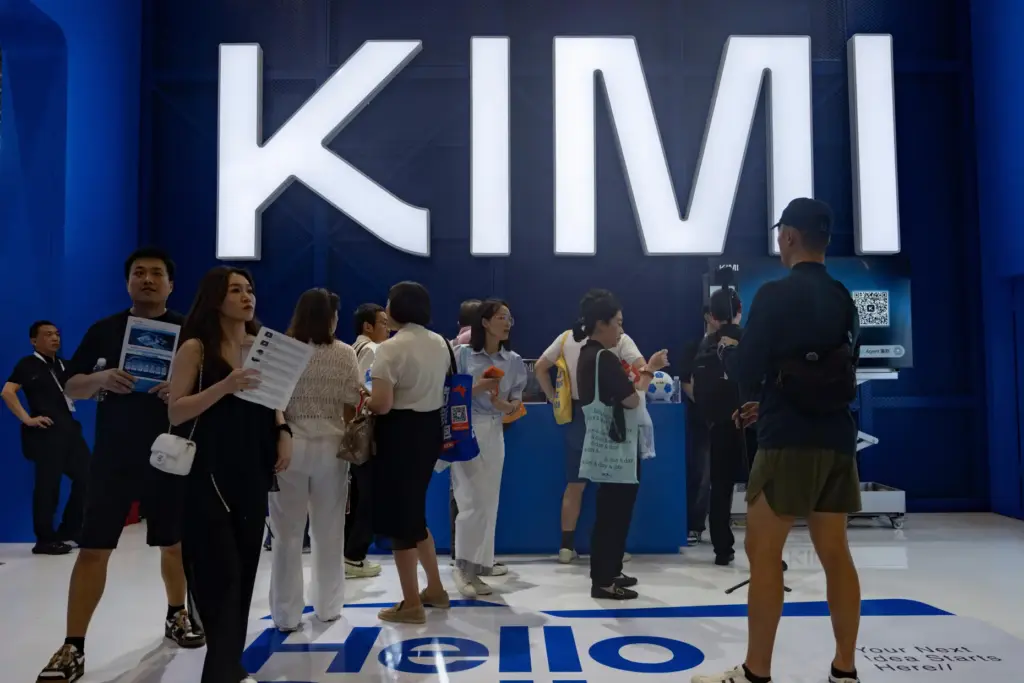 Attendees visit the booth for Chinese AI startup Moonshot’s Kimi K3 during the World AI Conference in Shanghai, July 17, 2026. (AP Photo/Ng Han Guan)
Communicating about AI emergencies is one focus
The agenda could focus on AI risks that could harm both countries, such as AI-enabled cyberattacks, biological misuse, major model failures or loss of human control, said Sun Chenghao, a senior fellow at the Center for International Security and Strategy at Tsinghua University in Beijing. In that case, “there is still meaningful room for cooperation,” Sun said.
“It would be a mistake to dismiss the entire safety debate as geopolitical competition,” Sun said. “China itself is paying growing attention to loss-of-control risks, malicious use, cyber threats and the safety of AI agents.”
Bessent said after his meeting with He that the U.S. proposed a notification mechanism between the United States and China, such as when there are incidents that rises up to the national security level from AI. “We want a shared vision of common goals and common threats,” he told reporters.
Michael Kratsios, Trump’s science and technology adviser, told Fox News Sunday it’s important to have conversations with China about AI. “The key thing that we want to talk to them about is avoiding shared risks, and that’s something that I think we can have a fruitful conversation on,” Kratsios said.
Both governments are concerned about how AI could be used to attack critical infrastructure. In China, AI governance documents identify finance, electricity, telecommunications and transportation as areas potentially exposed to frontier-AI risks, Sun said.
The Chinese side has shown real interest in discussing issues like AI and cyber incident information sharing with U.S. experts, said Samm Sacks, a senior fellow at the Johns Hopkins School of Advanced International Studies’ Institute for America, China, and the Future of Global Affairs.
If the two countries can discuss how to report and communicate in the event of an AI-related emergency, said Xiao Qian, vice dean of the Institute for AI International Governance at Tsinghua University, “it can help the two countries to build technical confidence over time.”
US export controls affect China’s AI development
Trump has repeatedly said “whoever wins AI, wins.” He has insisted the U.S. needs to keep a technological edge over China and downplayed calls by American tech leaders to slow AI’s development over safety concerns. Beijing, in turn, has accused the U.S. of pursuing an AI monopoly as it curbs China’s AI growth including in restricting its access to the world’s most advanced chips.
Read more Kamala Harris launches into the 2026 midterms as her 2028 decision looms
At the meeting, any loosening of U.S. export controls on advanced technologies related to AI is likely to be off the table, said Alfredo Montufar-Helu with the consultancy Ankura. With each country seeking competitive advantages in so many areas, Montufar-Helu said the room for U.S. and China to collaborate on AI is “quite narrow.”
In his essay this month calling for an AI slowdown, Anthropic CEO Dario Amodei called on the U.S. to continue seeking ways to limit Chinese AI development. China’s Ministry of Foreign Affairs said Amodei’s warnings about China were confrontational and a form of “fearmongering” and that all parties should work together on AI.
Despite the restrictions, Chinese AI models increasingly challenge American frontier models. Chinese AI models led by Moonshot AI and DeepSeek this year have shown they can be, by some measures, as powerful as those of U.S. rivals like Anthropic and OpenAI, often at a lower cost. Many of them are making inroads globally, including in the U.S.
“Export controls have not stopped China from developing frontier-competitive models, but they slow its rate of expansion by limiting the compute it can use to serve users,” said professor Will Cong of Nanyang Technological University in Singapore.
Despite the constraints, China’s chip developers have been catching up with the U.S., and companies in China are turning more to domestic chips. That’s giving Xi more confidence in his talks with Trump, George Chen with The Asia Group said.
Accusations of ‘distillation’ are a sore spot
U.S. claims that China is ripping off American AI technology are another sore spot in the relationship. The U.S. government and AI companies have stepped up allegations of “malicious” extraction of capabilities, or “distillation,” from top American AI models, claims that Chinese officials have rejected.
Anthropic has accused Chinese AI models of DeepSeek and Moonshot of routing a number of their user requests to its Claude AI models. Chinese labs are likely attempting to “piggyback on the massive training and inference infrastructure of their U.S. rivals” given how U.S. restrictions are limiting China’s compute power, Rebecca Arcesati, with the Mercator Institute for China Studies, said.
Chinese officials and some technology analysts have argued that distillation is not uncommon across the AI industry and is not the main explanation behind Chinese models’ improving capabilities and ability to innovate.
Beijing, meanwhile, has expressed worries over threats to China’s critical infrastructure from American AI, including Anthropic’s powerful Claude Mythos, and more broadly, the risk of AI’s aiding of spreading of political misinformation and potentially challenging its governance.
“We cannot expect meaningful cooperation on AI safety if one side increasingly treats the other side’s technological progress as a national security threat,” Xiao said. Disagreements between the U.S. and China “make dialogue even more necessary,” she added.
Associated Press journalists E. Eduardo Castillo in Beijing and Josh Boak in Washington contributed to this report.
Read more Status Update: 7 Leaves coming to Orange; Navy Federal Credit Union opens in Fullerton