
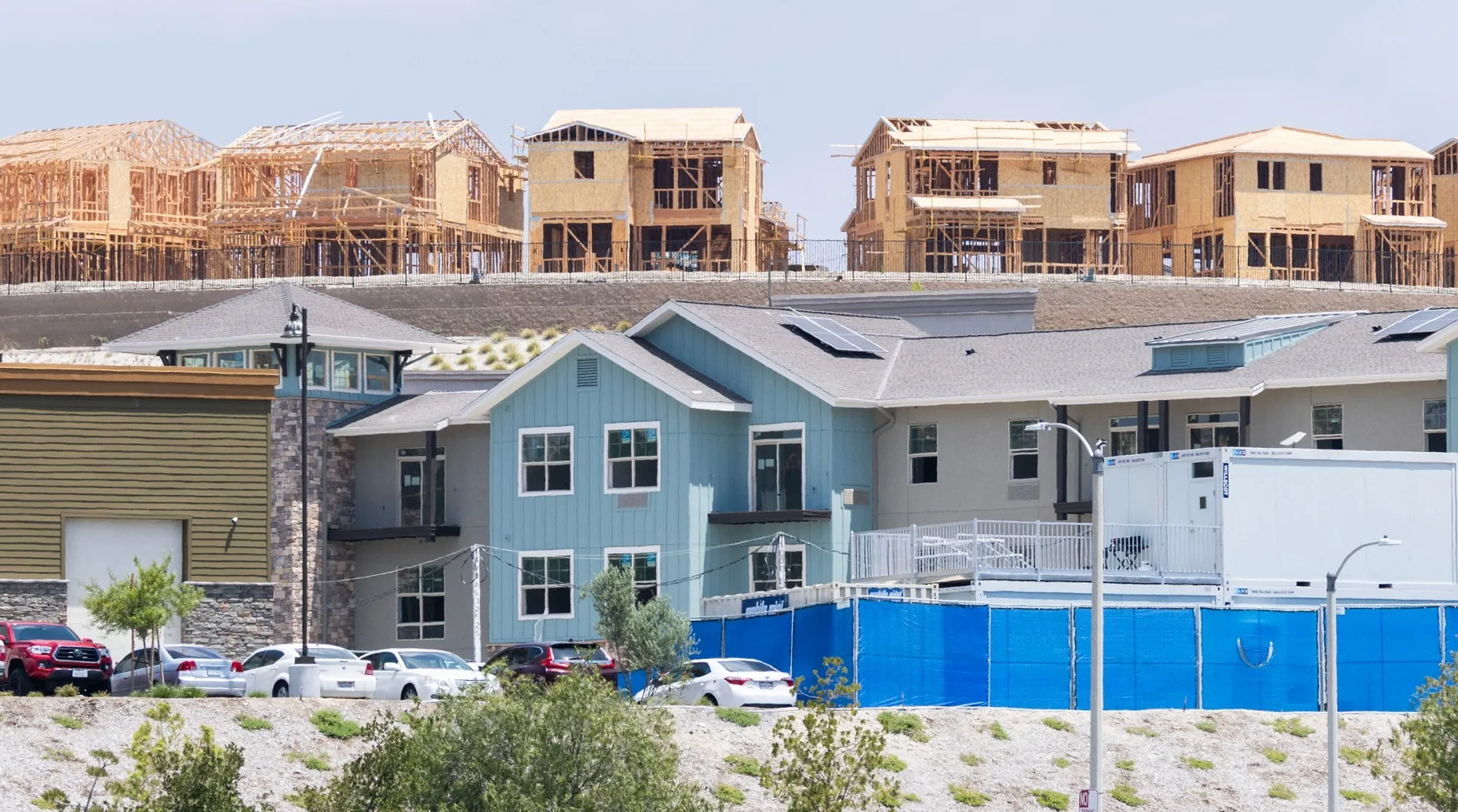
California voters will decide in November whether to authorize two multibillion-dollar housing bonds — one to help fund new affordable homes and another to help buyers afford down payments on newly constructed properties.
Read more Felony vandalism charges against Stanford protesters dismissed in agreement with attorney general
One measure, Proposition 1, would let the state borrow $11.25 billion for a variety of housing efforts, including financing low-income apartments and providing low-interest home loans to veterans and first-time homebuyers.
The other, Proposition 37, would allow a state agency to sell up to $25 billion in bonds to lend money to homebuyers for down payments on newly constructed properties.
David Garcia, policy director at UC Berkeley’s Terner Center for Housing Innovation, which does not take positions on ballot measures, said Prop. 1 would replenish crucial state programs to “continue building affordable housing throughout California.” He said Prop. 37, meanwhile, could help many residents who qualify for a mortgage but lack savings for a traditional 20% down payment, while also “creating demand for builders to build new housing.”
Opponents of Prop. 1, however, argue that while jumpstarting housing construction may be a worthy goal, it would be reckless for the state to take on billions in new debt while facing a long-term budget deficit. And although Prop. 37 is designed to pay for itself through buyers’ home loan payments, opponents fault it for not specifying how much borrowers would pay in interest and not prioritizing first-time buyers.
Neither measure would directly raise taxes, but Prop. 1 would need to be paid from the state’s general fund, potentially reducing money available for other services.
According to a recent poll by the Public Policy Institute of California, 55% of likely voters support Prop. 1, while 61% support Prop. 37. Each requires a simple majority to pass.
Prop. 1
The largest chunk of Prop. 1 funding, $7.2 billion, would go toward state programs that provide grants and low-interest loans to developers to build affordable apartments and townhomes. Just over $1 billion would fund mortgage assistance for first-time homebuyers and other programs to encourage homeownership. Most of the remaining roughly $3 billion would support affordable housing programs for farmworkers, students and tribal members.
The bond funds would help subsidize up to 40,000 multifamily rental units, and provide as many as 40,000 households with mortgage assistance, home repairs and other homeowner support, according to the state’s nonpartisan Legislative Analyst’s Office.
Chione Flegal, executive director of Housing California, a pro-housing group backing the measure, said tens of thousands of affordable units are now “shovel-ready” thanks to recent state laws that have rolled back development regulations. But with state housing programs running low on money, she said many of those projects need an additional funding source like Prop. 1 to break ground.
“You have both an incredible need and the conditions to actually get building quickly,” Flegal said.
In San Jose, a city-backed, 500-plus affordable housing development at 71 Vista Montana has faced years of delays after multiple attempts to develop it fell apart over funding issues, according to city officials. The City Council approved a new developer this month to move the project forward. Officials endorsed a plan for the developer to submit a financing proposal within three months, secure all funding within two years, and start construction within three years.
California voters last passed a dedicated state affordable housing bond in 2018, totaling $4 billion. In 2024, voters also approved $2 billion for homeless housing as part of a $6.4 billion mental health bond pushed by Gov. Gavin Newsom. Newsom, along with Democratic mayors and state lawmakers, has also backed Prop. 1.
The Howard Jarvis Taxpayers Association, which opposes the measure, argues it would be foolish for the state to take on new debt when it in the years ahead. If the state wants to support housing, it should find money already in its budget, which tops $350 billion this fiscal year, said spokesperson Susan Shelley.
“The more you pile this debt on, the more difficult the budget process is,” she said.
Prop. 1 would cost the state between $500 million and $600 million annually for around 25 years — about a quarter-percent of the state’s general fund budget, according to the Legislative Analyst’s Office. The bond would cost about 15% more than paying upfront with money the state already has, the office said.
Read more Lindsay Clancy’s attorney asks judge to investigate the lone juror who wanted to convict her
The Prop. 1 campaign has raised at least $8 million from donors including affordable housing developers, civic foundations and construction unions. There is no registered opposition campaign.
Prop. 37
Prop. 37 would create a new state program to lend middle-income homebuyers up to 17% of the price of a newly constructed house, condo, townhome or manufactured home. Buyers would pay the remaining 3% to cover the full down payment.
Buyers would make two monthly payments: one on their conventional mortgage and one on the down payment loan. If approved, the state may adopt a rule allowing down payment loans to cover closing costs, though a final decision would not come until later.
To qualify for a loan, a household would need to earn no more than double the area median income in the county where the home is located, adjusted for family size. That means in Santa Clara County, which has among the highest median incomes in the state, a family of four would need to earn less than $411,000 a year to qualify. The maximum home sale price would range from roughly $1 million to $1.5 million depending on location.
Bob Hertzberg, the former Los Angeles state assemblymember behind the measure, said the goal is “to create generational wealth” and provide more Californians “the opportunity to move from being renters to being homeowners.”
Unlike traditional down payment assistance programs, Hertzberg’s proposal would only apply to newly constructed homes. He said that would incentivize developers to build new housing, particularly condos and townhomes in denser neighborhoods.
Under the measure, developers who build specifically for the program would benefit from updated construction defect liability rules, which housing advocates have blamed for stalling condo construction in recent years. The new rules would allow developers to ask courts to dismiss lawsuits brought by homeowners over needed repairs if property owners fail to respond within 120 days to developers’ attempts to fix the issues. In most cases, the rules would also cap attorneys’ fees at 30% of a final settlement, judgment, or other legal resolution.
Proponents say Prop. 37 would spur more than 190,000 new homes statewide. The Legislative Analyst’s Office, however, said it’s unclear whether the measure would increase construction and homebuying. It noted that homeowner borrowing costs and repayment terms are still unknown, which could affect demand for the program.
While the measure instructs the state to ensure interest rates are “below-market,” rate setting would need to account for demand from investors buying the bonds to fund the program, among other factors. If a homeowner defaults, the bond investors would be on the hook for the loan, not taxpayers.
The League of Women Voters of California, which opposes the measure, criticized the lack of clarity on rates and the fact that, unlike most other mortgage assistance programs, it does not prioritize first-time homebuyers.
“California needs homeownership programs that lower families’ total costs, confront racial barriers to building wealth, and support strong communities,” the policy advocacy nonprofit wrote in its ballot recommendation. “Prop. 37 does not meet that test.”
The California Housing Finance Agency, which runs other homebuying assistance efforts, would be in charge of the new program. The measure would authorize the agency to issue up to $25 billion in bonds, potentially dwarfing other state mortgage programs.
In large part because the state would repay the bonds using revenue collected from borrowers’ home loan repayments, the measure would not impose any direct costs on the state, according to the Legislative Analyst’s Office.
The Prop. 37 campaign has raised more than $22 million from donors including the California Association of Realtors and construction unions. There is no registered opposition campaign.
Read more 10 things to know about famed TV host, evangelist Fulton Sheen ahead of beatification