
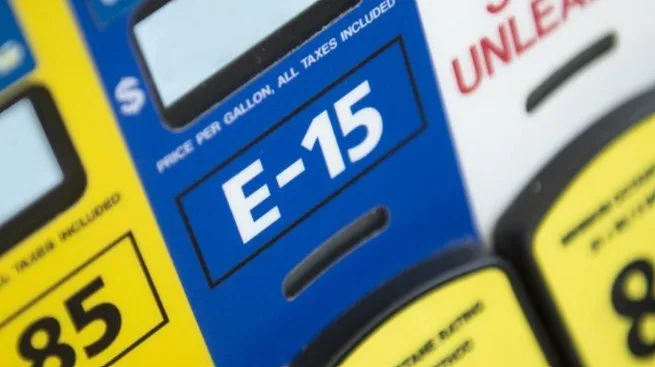
Legislation signed into law by Gov. Gavin Newsom will allow a greater amount of ethanol blend into gasoline sold in California, which fuel analysts say will reduce costs — although drivers may not notice much overall change, given the continued spike in prices at the pump.
Read more Xi heads into Trump visit after making China into a global force since 2015
Newsom on Saturday signed Senate Bill 795 that is designed to remove the final regulatory hurdles for E15, a gasoline mix that contains 15% ethanol. California had been the last remaining state that limited ethanol blended into gasoline to 10%, or E10.
“This common-sense bill cuts unnecessary red tape while maintaining our environmental and safety standards,” Newsom said in a statement. “We’re helping make E15 a real option for California drivers.”
Conventional vehicles of model year 2001 and newer are approved to use E15.
Boosting the ethanol mix should offer some financial relief.
Fuel analysts point out that as of Friday, the spot price for petroleum in Los Angeles stood at $4.27 per gallon while the spot price for ethanol came to $2.49 — a difference of almost $2.
So if the amount of ethanol blended into gasoline increases from 10% to 15%, the cost of gasoline will decline.
Two years ago, a estimated that California drivers could save 20 cents per gallon by switching from E10 to E15 fuel. The study was sponsored by the Renewable Fuels Association, which promotes the ethanol industry.
How long will it take for drivers to see E15 at the pump?
David Hackett, president of Stillwater Associates, a transportation energy consulting company in Irvine, estimated it would take “weeks, not months.”
In all probability, “independent retailers are likely to go with E15 before the major brands do,” Hackett said. “That’s been the history of this kind of thing.”
Hackett said his firm expects “the whole market (in California) will transition to E15, but that will take a while, months at least.”
E15 is not only expected to reduce costs, but the governor’s office pointed to a recent study from UC Riverside that found increasing ethanol blending in gasoline would not affect nitrogen oxides, or NOx, emissions that are components of air pollution, as well as reduce particulate emissions.
Gas prices have soared in the wake of the war with Iran, which started nearly seven months ago.
Read more Video: Week 5 football predictions from OCVarsity’s Steve Fryer and Dan Albano
According to AAA, the average price for a gallon of regular in California on Monday came to $6.17 — the highest of any state. The national average was $4.48, or $1.69 lower than the Golden State.
The average in the San Diego area Monday was $6.23. That’s an increase of $1.49 compared to the price when the war started on Feb. 28, 15 cents higher than a week ago and 53 cents higher than one month ago.
At such a rate, the eventual switch to E15 and its accompanying cost benefits may not make a notable difference to everyday drivers — unless things change for the better with regard to traffic in the Strait of Hormuz.
The widening conflict in the Middle East has clogged the passage of fuel tankers through the waterway that under normal circumstances accounts for 20% of the world’s petroleum products.
The Institute on Taxation and Economic Policy, a left-leaning think tank based in Washington, D.C., estimated that as of Monday, U.S. households have paid $410 more at the pump since the start of the war.
The churn has left analysts at major global investment houses at a loss.
On Thursday, the head of commodities strategy for JP Morgan wrote in a note to clients, “For the first time since the start of the Iran conflict, we don’t have a baseline view,” as reported by Yahoo Finance. “We simply don’t know how to model the endgame.”
The price of diesel fuel has skyrocketed even higher than gasoline.
The average price in the U.S. cracked the $6-per-gallon mark for the first time ever earlier this month. In California, the price is even steeper — hitting $8.42 on Monday. That’s the highest of any state and an increase of $1.34 compared to one month ago.
When asked by the Union-Tribune if he’s ever seen diesel prices soar to such an extent, California Trucking Association CEO Eric Sauer said, “Absolutely not … There’s been fluctuations in my (25-year tenure with the organization) and some pretty sizable increases for diesel fuel, but nothing of this magnitude.”
In a bit of good news, crude oil prices dropped for the fourth straight session on Monday.
The price of Brent — the international benchmark for crude oil futures — closed the trading day at $100.34 per barrel, a drop of 3.4%. And the price of West Texas Intermediate — the benchmark for crude in the U.S. — fell 4.5% to $95.78 a barrel.
Read more Hilary Duff extends The Lucky Me Tour with Honda Center stop