
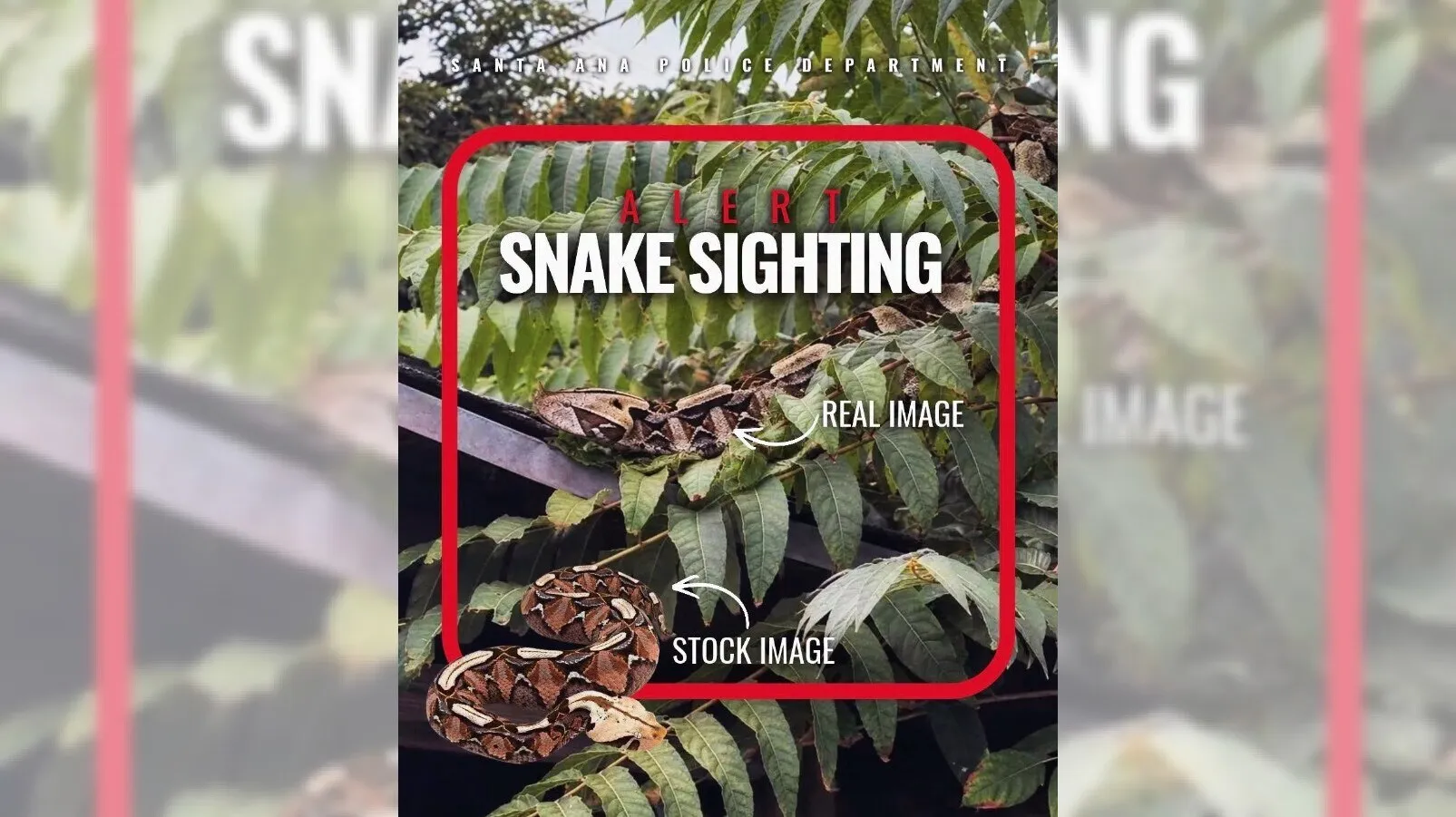
For about 24 hours, it was believed that a highly venomous snake might be slithering about a Santa Ana neighborhood after police announced a sighting on Monday, Sept. 28. But on Tuesday, Sept. 29, the police revealed the sighting was a hoax concocted with an AI-generated image of a snake in a tree.
Read more Orange County elections chief expects faster vote counting this year
Santa Ana police had doubts about the image even as officers and reptile experts canvassed the neighborhood Monday looking for the reported Gaboon viper, officials said.
The department attempted to verify whether the image was generated by artificial intelligence, while reptile experts also pointed out apparent problems with the image, police spokesperson Natalie Garcia said. Among them were the snake’s positioning in the tree and what appeared to be an ear on the animal, even though snakes do not have external ears.
But police still could not definitively establish Monday that the report was false, according to Garcia.
With residents continuing to express concern Tuesday including many suspecting the photo was fake, detectives went to the workplace of the man who reported the snake to ask him for additional information, Garcia said. During that interview, the man admitted he had fabricated the report and image.
Garcia declined to detail the explanation the man gave detectives for the hoax. She said he attempted to justify what he had done and appeared remorseful, but investigators were no longer certain which of his statements they could trust.
The man’s initial account included details that appeared to lend credibility to the sighting, she said. He told police that his dogs’ barking prompted him to go outside and investigate, and his son claimed to have seen the snake as well, Garcia said. Neighbors also told police the man came to their homes after the purported sighting and appeared pale as he described what had happened.
Police initially did not plan to seek charges, Garcia said. After the man admitted the report had been fabricated, however, detectives decided to seek a charge of making a false report of an emergency.
On Wednesday, Garcia declined to say what tool the department used to try and verify if the snake image was real or generated by AI. Prior to confirming the image was a hoax, Santa Ana police said they had run the image through AI generators and had not been able to confirm that it was produced by AI.
OpenAI’s photo verification tool did show that the photo was either generated or enhanced by AI when submitted for verification by this publication.
So how reliable are generative AI verification tools?
The tools currently available are not entirely accurate, said Dr. Karen North, professor of digital social media at USC’s Annenberg School.
Read more Video: Week 6 football predictions from OCVarsity’s Dan Albano and Steve Fryer
In the past few years, some major AI players, including Google and OpenAI, have released photo verification tools based on SynthID watermarks. SynthID embeds “digital watermarks” into content produced by generative AI. These watermarks are designed to be imperceptible to humans but detectable by SynthID technology, according to Google.
But North said these watermarks are not always reliable and are not detecting AI, but rather the likelihood of AI, using algorithmic mechanisms.
“The way that AI works is that it generates sort of the most obvious, the most mundane, the most likely content,” North said. “And the AI detectors do that in reverse. They look to see whether or not what was created, whether it’s a picture or words, was created in a way that sort of looks like a buildout of the most likely version.”
Verification tools can produce both false negatives and false positives when flagging AI content. North herself has tested AI detection in essays and found that some content is detected at 100% AI, even when written fully by a human. These inaccurate readings can happen when AI detects an algorithmic pattern that is similar to that of AI in text or photos, even if AI was not used.
But OpenAI claimed that false positives in their AI photo detection software are rare, though the company acknowledged that there are limitations to its SynthID watermark. Stripping metadata or degrading the watermark could lead to a false negative read in an AI verification tool, and OpenAI claimed that its verification tool only works with content created with OpenAI products.
North described an AI detector as a tool that “will give us a pretty good heads up that something looks like the kind of content that was generated by AI.”
But people should also rely on the uncanny valley theory, she says — the idea that people will get an eerie feeling when something they see simply feels off. Often, there are small elements in the background or context of AI-generated photos that feel unnatural or make viewers uncomfortable.
“On some level, we should trust that eerie feeling that there’s something wrong, that there’s something that doesn’t look quite right,” North said. “That’s also a heads up that you should take a breath before trusting what you’re seeing.”
In the case of the snake in Santa Ana, OpenAI’s photo verification tool did show that the photo was either generated or enhanced by AI when submitted for verification by this publication.
Read more Works by van Gogh and Cézanne up for sale in Sotheby’s $450 million auction