
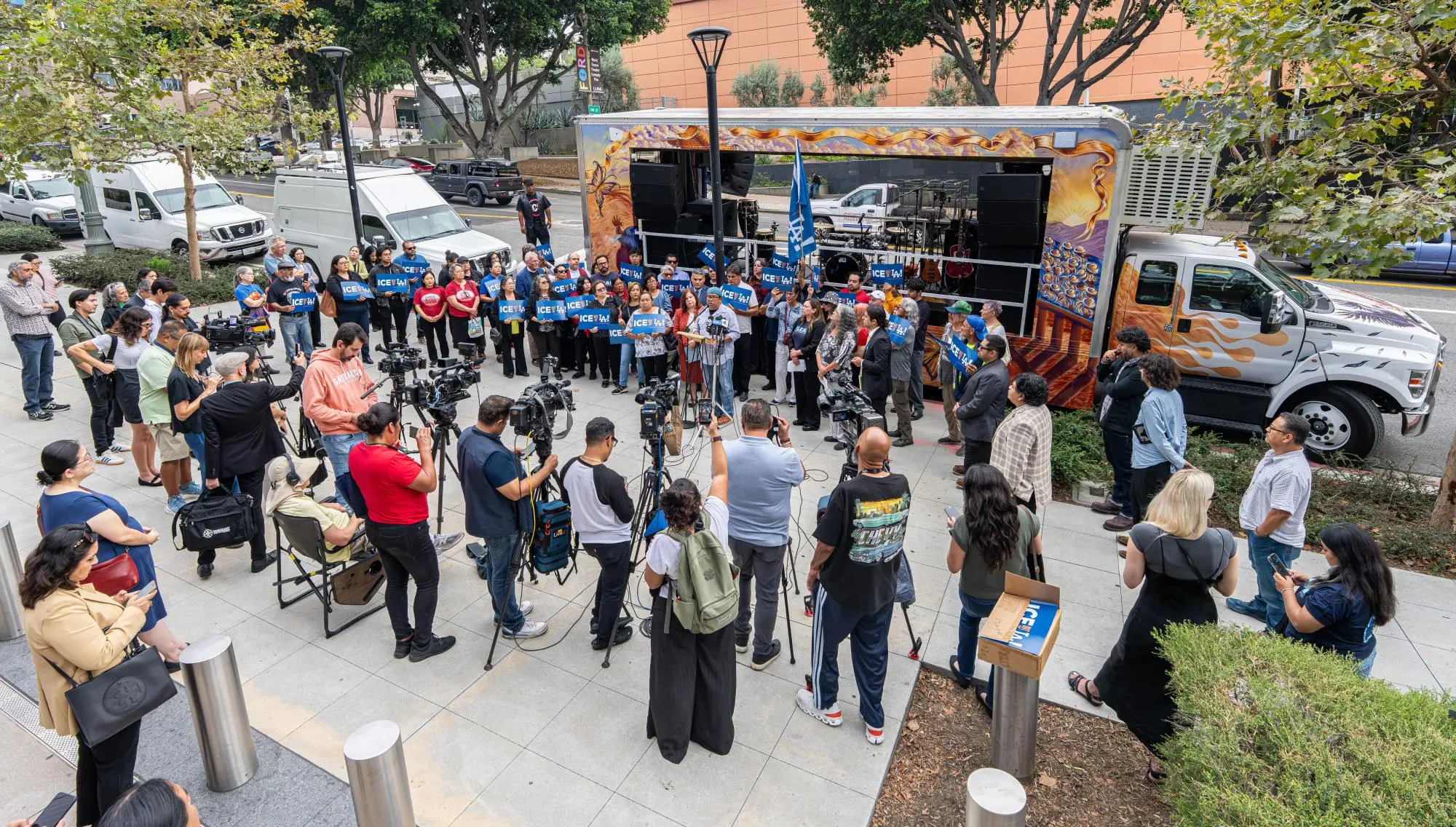
Nearly 15,000 people arrested by U.S. Immigration and Customs Enforcement in Southern California in 2025 and 2026 were eventually deported, according to a study published Thursday, Oct. 8 by UCLA and the UC Berkeley School of Law.
Read more ALDS: Rays finish sweep of Yankees behind Mesa homer, fan interference call
At the height of the agency’s surge in June and July 2025, 75% of those arrested were deported, researchers said.
The study looked at arrests, detentions and deportations of non-citizens within the Los Angeles ICE field office’s area of responsibility, which covers the counties of Los Angeles, Orange, Riverside, San Bernardino, San Luis Obispo, Santa Barbara and Ventura.
The findings also show that the city of Los Angeles had by far the most apprehensions, with 33% of all “at-large” arrests in the region occurring there.
“The extraordinary impact of the surge is now clear,” Graeme Blair, co-director of the project and a political science professor at UCLA, said in a statement. “Nearly 15,000 people have been deported from the region. Now, we can also quantify what immigrant communities here have felt since the surge began in the summer of 2025: that enforcement never stopped. Over 1,000 non-citizens were arrested just in July 2026.
“Increasingly, non-citizens across the country who had no reason to expect they could be deported have been targeted, and it was folks in the Los Angeles region who bore the brunt of these new enforcement priorities first,” Blair said. “These are people immigration judges have not ordered removed, many with legitimate grounds to challenge their removals.”
While ICE, an agency of the Department of Homeland Security, had previously relied heavily on taking custody of people already held in jails and prisons, a defining feature of immigration enforcement since 2025 has been a sharp increase in at-large arrests — those carried out in neighborhoods and communities and at ICE check-ins rather than custodial settings.
“DHS leaders made Los Angeles a testing ground in June 2025 for the new at-large arrest strategy, sending immigration agents out into communities, Home Depot parking lots and immigration courthouses, and to make arrests at regular ICE check-ins,” Blair said. “Those patterns continued throughout fall 2025. Again, this summer, we saw that the numbers increased as ICE continues to try to hit daily arrest targets.”
Read more Ducks take off for two games in Canada after first loss
Key takeaways from the study by the UCLA-based Deportation Data Project and UC Berkeley:
— 15,000 deported. ICE arrests across a seven-county region in 2025 and 2026 have led to nearly 15,000 deportations;
— Arrests move into communities. At-large arrests surged, increasingly targeting people without criminal convictions or final deportation orders; and
— Swift deportations, few releases. Of those arrested from January 2025 through May 2026, 62% were deported within 60 days, while just 7% were released from detention within 60 days.
The status of people arrested during the surge changed as well. At the surge’s peak, in June 2025, arrests of people who had no final order of removal from an immigration court were nearly 1,400% higher than 2024 levels, while arrests of non-citizens with no criminal conviction increased by more than 3,400%. Neither group had been targeted by previous administrations, the study determined.
Suicidal ICE detainees are routinely put in solitary confinement. Experts say that’s inhumane
Adelanto ICE medical staff repeatedly failed detainee who died, internal report says
Read more Salad bar buffet Souplantation plans a comeback in Orange County
‘A culture of fear:’ The lingering trauma after ICE detains a loved one