
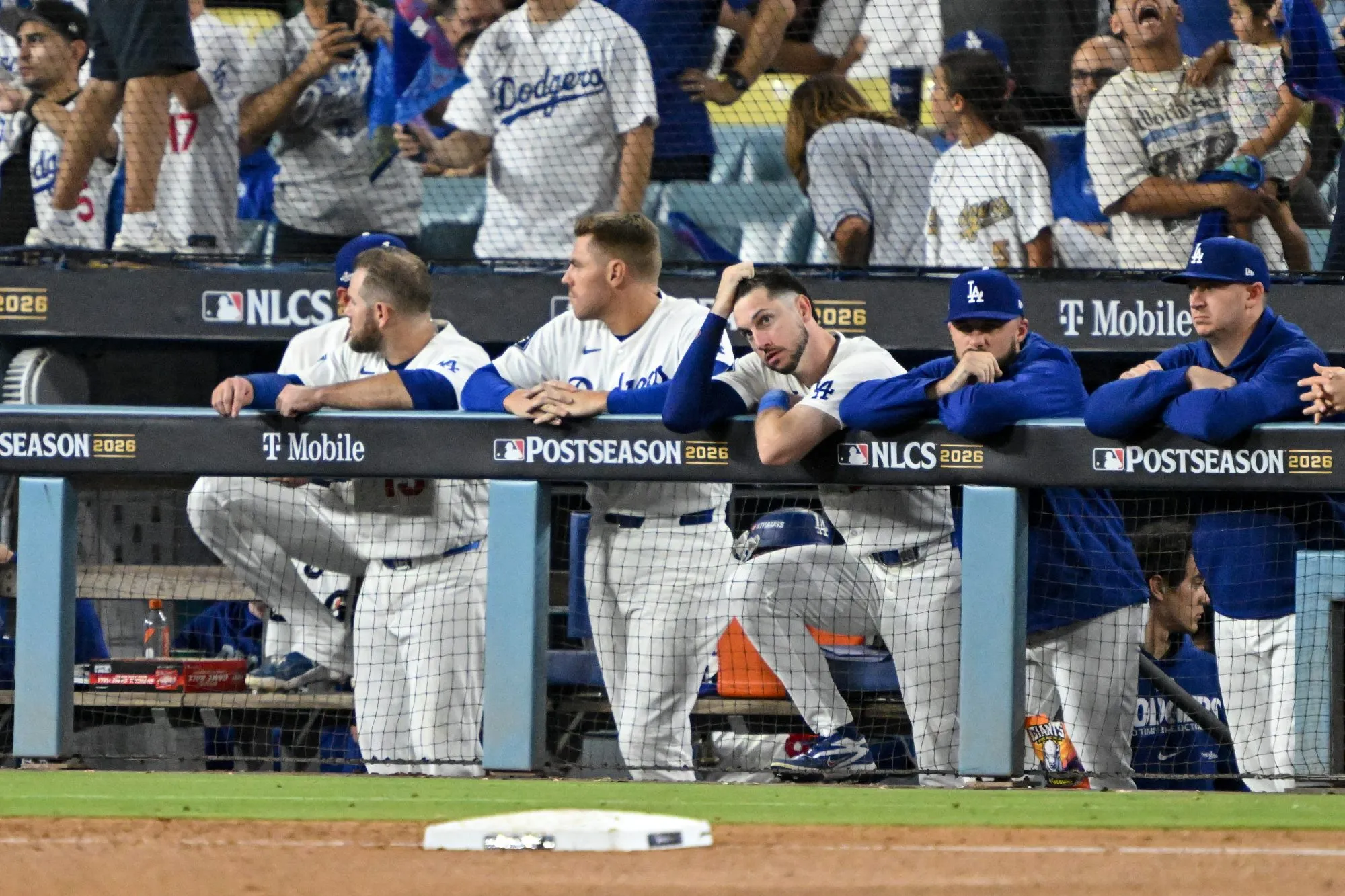
LOS ANGELES — Maybe we should have anticipated this.
Maybe we were fooled by the Dodgers’ 100 victories during the regular season and their 18-7 final month, achieved as it was primarily against under-.500 opposition. Who had the cushier September schedule, the Dodgers or USC football? Hard to tell.
Read more Horse racing: ‘World class’ Jamie Spencer riding at Santa Anita, Del Mar
Hidden in the numbers: Against teams that finished with records above .500, the Dodgers were 36-36 for the season. After the Fourth of July, they were 10-22 against those clubs. They held a 14-game division lead on our nation’s 250th birthday, and subsequently had 6½ games chopped off that lead in little more than a month while being swept by Boston, Atlanta, the Chicago Cubs and Arizona. The cracks seemed to be forming then.
If we were fooled in September by six victories in seven games over Cincinnati or series sweeps over San Francisco (6-0 against the Giants in September) and Washington … well, that’s on us. These were a very fluffy 100 victories, and those cracks – mainly a difficulty in generating offense beyond the home run – became evident in September (50 for 234 with runners in scoring position) and were glaring in October (5 for 43 in the postseason, including 2 for 11 in Thursday night’s season-ending 6-4 loss to Milwaukee).
The eighth inning of Game 4 was a proper illustration of the Dodgers’ problem. Will Smith lined one into the right field corner with one out and took third when the Brewers’ Sal Frelick misplayed the ball. With one out and the infield in – the alignment that Dusty Baker used to refer to as “hitters’ delight” the opportunity to smack a line drive past a drawn-in infielder – Kyle Tucker instead lofted a fly ball to center fielder Garrett Mitchell that was shallow enough to force Smith to stay at third.
And then Teoscar Hernández struck out on a half swing. Thus, the Dodgers stranded a runner at third for the third straight inning, after doubles by Tucker in the sixth and Andy Pages in the seventh were wasted.
Let there be no doubt: Milwaukee was the better team this week. A year ago, when the Dodgers swept the Brewers en route to their second straight World Series championship, those Brewers were ascendent, a young team that found its footing this year.
These Dodgers? They’re an aging group that was chasing history but, as it turns out, might be history.
Is this the Last Dance for Mookie Betts, Freddie Freeman and Max Muncy? That’s just one of a number of questions facing the Dodgers in what will almost certainly be an unsettling winter, given that management’s insatiable thirst for a salary cap will – barring a negotiating miracle – lead to a Dec. 1 lockout. That will almost certainly result in a shortened 2027 spring training and maybe a shortened season, and it could also result in revised salary rules that at the very least will force the Dodgers to reevaluate their method of team building.
The Dodgers will still be all right, especially compared to those clubs who don’t have as robust a player development system, or an ownership as hungry to win. But the dynasty, if that’s what you want to call a two-year reign, ended in The Ravine on Thursday night.
Will they still be Japan’s team once MLB’s murky future becomes clearer? Probably.
Read more Santa Anita consensus picks for Friday, Oct. 16, 2026
Shohei Ohtani, physically compromised and thus a shadow of himself for more than a month, received some criticism from the masses here for insisting that he could play through his injuries, and that criticism itself was a new experience. But his booming three-run home run in the second inning on Thursday – with a 113 mph exit velocity, only the fourth ball he’s hit over 100 mph in 28 postseason at-bats – gave the Dodgers an early lead, and gave them hope as well.
Ohtani’s not going anywhere. Neither is Yoshinobu Yamamoto. And the Dodgers have cultivated marketing and fan engagement initiatives in Japan. Expect those to continue.
What is different about this season, different even from the 2022 and ’23 seasons that ended with losses in the Division Series, is the uncertainty of the future, largely because a lockout will basically freeze all offseason activity until there’s a settlement.
In the meantime, ignore those who have taken up the owners’ argument that competitive balance is the main reason a salary cap is necessary. The presence of the Brewers in the World Series, and the reality that their American League opponent will be either Tampa Bay or Cleveland, puts the lie to that argument. The motivation for a salary cap is to raise franchise valuations, which is peculiarly a billionaires’ problem, and why should fans support that fight?
In the meantime, it’s worth pausing to appreciate what these Dodgers have accomplished: Fourteen straight postseason appearances, 13 division titles in 14 years, five World Series appearances and three championships in a decade.
The bottom line: Ownership and management care as much about winning as do the fans and those in uniform, and that’s not the case in every city.
And when the quest falls short, it does sting.
Asked how proud he was of this group’s fight, Manager Dave Roberts said: “Extremely proud. It never feels good to lose and not accomplish a goal to win the World Series. It started back in the early part of February. I love this team and what we had to go through. It’s one of those things that every night we take the field, people are bringing their best to beat us.
“I think for me it never feels good to lose, but when you get beat, you can handle it a little bit better,” he added, tipping his cap to the Brewers. “I had a good conversation with the guys in there and just told them how proud I was. I’m not used to those speeches, those consolation speeches.
“But it was a long season. It was still a good season. The thing about sports that we all love is no matter how much you prepare (and) you want it, there’s no guarantees. That’s the great thing about sport is the unknown.”
Read more ALCS: Guardians beat Rays on Halpin’s home run for 2-1 series lead
It usually is, anyway. This baseball winter could be an exception.