

Part 1 of a series on the deaths of children in Southern California.
It was normal for Baby Boy W. to sleep in bed with his father, the death files say.
Read more Trump and Vance to announce a $25M whistleblower program to encourage public to report alleged fraud
On this particular night — the wee hours of April 25, 2024 — the queen bed was strewn with pillows and clutter. “(T)here were empty jewelry boxes and what appeared to be a broken pearl necklace, with pearls spread throughout the bed, along with Gerber Snack Crunchies,” the coroner’s report said. “W. was known to put random items in his mouth and (father) would normally catch him and have to take it out.”
Baby Boy W. was 1 year old. He hadn’t seen a pediatrician since the day he was born. His mother used alcohol and illegal drugs while pregnant, and his parents had recent, and well-documented, tangles with the child protection and criminal court systems in San Bernardino County. Those included allegations of child neglect in March and April 2023, an added allegation of emotional abuse in August 2023, a domestic violence call in 2024, suspicions of drug use, probation violations, thoughts of suicide — plus, his mother’s three older children were in a relative’s care, according to documents.
“Possible drug use by the father and the mother and father screaming, slamming doors and mocking the baby’s crying,” said a child welfare worker’s report after the August 2023 incident. “The department is worried that the substance use may interfere with the parents’ ability to parent.”
But the larger system was perhaps not worried enough. The state of California — and the whole nation, thanks to federal policy growing out of the “crack baby” era — places a premium on keeping families together, sometimes even when alarm bells screech and red flags fly. Baby Boy W.’s troubled mom was heading to jail on a parole violation. His dad was center stage.
At about 2 a.m. on that April morning, Baby Boy W. was awake and exploring as his father slumbered. Baby Boy W. got into the jewelry box on the shelf above the bed; its treasures included that pearl necklace, and apparently something far more treacherous.
“Cause of death: Effects of fentanyl,” the coroner’s report on Baby Boy W. said. “Father woke up after hearing a noise and found W. next to him in bed face down in a praying position unresponsive and not breathing.”
Distraught, Baby Boy W.’s father committed suicide just months later.
As horrifying as this tragedy is, Baby Boy W.’s death is not exactly unique. The Southern California News Group has documented at least 46 children — likely just a fraction of the true total — dying in 2024 and 2025 in Southern California after exposure to illegal drugs and/or neglect related to substance use. Officials left many of these children in the care of troubled families and relatives despite documented red flags.
Addiction is not grounds to remove a child from a parent’s care in California. There must be another documented layer of menace — demonstrated proof of actual harm, severe neglect, substantial risk of physical or emotional danger — before a child can be taken into protective custody.
That may shock the general public, but it’s a widely known and vexing reality for many professionals on the front lines of child welfare.
Overall, as a system, we leave vulnerable children in very high-risk situations in order to preserve families, said a social workers’ representative who, because of the harsh spotlight on child welfare workers when tragedy strikes, asked to remain anonymous.
That’s been the push with federal regulation, in the media and in society at large, she said. The federal policy called “Families First” measures success on how many reunifications there have been; as long as the child goes home, it’s a positive number for the state.
The “Families First” philosophy has surely spared an untold number of families the trauma of separation. But it can result in tragedy, especially for the youngest, most vulnerable babies. There’s too often a deadly abyss between good intentions and real results.
The Southern California News Group reviewed thousands of pages of child abuse and neglect fatality case files, and two things come disturbingly, hauntingly clear:
• Drug and alcohol use played an outsized role in these tragic deaths;
• And the overwhelming majority were no strangers to the child welfare system. With few exceptions, the dead children’s families were repeatedly scrutinized by the child welfare, law enforcement, family court and/or criminal justice systems, but the children remained with troubled families nonetheless.
We examined confirmed child abuse and neglect fatalities in Los Angeles, Orange, Riverside and San Bernardino counties for 2024 and 2025. We have basic data on 177 of them, and detailed files released under Senate Bill 39, meant to help us deconstruct and learn from these tragedies, for 110. We found that:
• Seven of the deaths happened in foster care, but the overwhelming majority happened on the watch of a parent or legal guardian;
• The overwhelming majority — 92 of 110 — had histories of involvement with the child welfare system;
• Many families had recent allegations lodged against them that were under investigation — or had been deemed “unsubstantiated” or “inconclusive” — when the children died;
• Many of the parents were victims of alleged neglect and abuse when they were children themselves, underscoring the cyclical nature of the problem;
• And nearly half the cases involved substance use in some way. While many child welfare documents officially said “unknown” for substance use, or had blank check boxes for “substance use” on standardized risk and safety assessment forms, substances were specifically called out as a factor elsewhere in police, sheriff’s and coroner’s reports.
“In the United States of America, in the 21st century, how can so many preventable deaths happen every day to the most defenseless, helpless babies and young children?” asked a that could have been written yesterday. “The ripples of each life cut short extend to us all.”
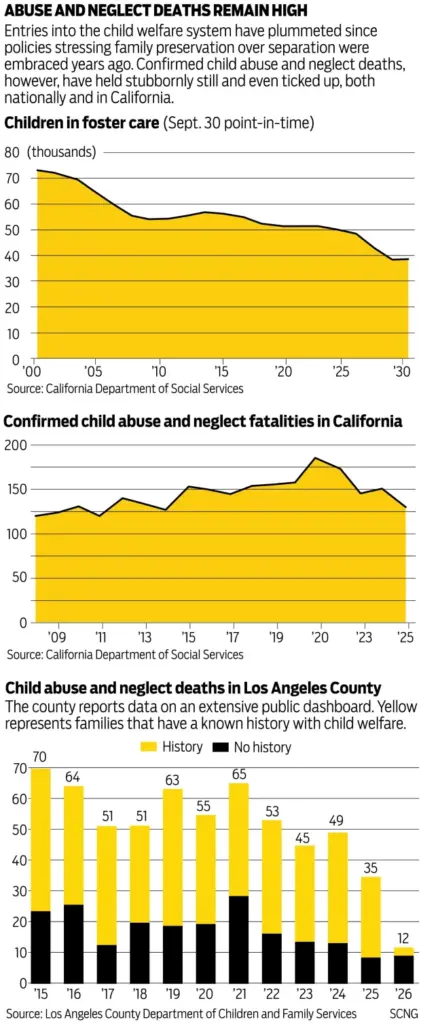
Entries into the child welfare system have plummeted since Families First, stressing preservation over separation, was embraced decades ago. Confirmed child abuse and neglect deaths, however, have held stubbornly still and even ticked up, both nationally and in California. Blame — and even criminal charges — have been heaped on social workers when things go awry, but they’re often scapegoats in a much broader system that can be tragically myopic.
It’s a pretty messed-up system, said a blunt Dr. Jeoffry Gordon, a retired physician who volunteers on the (only he said it more strongly). “The problem is, people pay attention when there is a fatality or an embarrassing case, and then it wafts away.
“The other dynamic is the not-so-benign neglect of state authorities. When you talk about a child fatality due to abuse and neglect, you’re getting an early warning sign of social and court and medical system failure. Every one of them is the result of a system failure. We have political failures, government failures, medical profession failures, training failures, resource deficiencies. … Blaming it on the lowest person in the system — the social worker — is way off base. The problems are majorly systemic ones, rather than the failures of social workers who have such a hard job that it’s scary.”
For those front-line workers, it can be damned-if-you-do, damned-if-you-don’t. Sometimes, social workers said, we should remove to be on the safe side. We cannot keep pushing the system to reunify at all costs.
‘Often struggling’
“We can’t identify who the next victim will be, but we know a remarkable amount about the characteristics of the children who die and their families,” said the report to Congress a decade ago.
“The parents … are often struggling and have backgrounds of trauma themselves. They may have drug addictions, mental illness, cognitive disabilities or previous criminal histories. They may face domestic violence at home or live in unsafe, crime-ridden communities. Many suffer from a lack of financial resources, inconsistent employment and housing instability. Often these parents are young; some have had prior experience with foster care or the juvenile justice system. Some have recently returned from deployment in the military and may be suffering from post-traumatic stress syndrome. These conditions, as dysfunctional as they may be, are not meant to excuse harmful behaviors toward children, but they do help explain them.”
According to the most recent statewide data from the California Department of Social Services:
• More than half the children who died, or nearly died, from maltreatment in California came from families that had been on the child welfare system’s radar within five years of the “critical incident”;
• More than a quarter of these children — 28% — had quite recent contact with the child welfare system, within a year of their deaths or injuries;
• Many of these children — 17% — had contact with the child welfare system when the “critical incidents” happened;
• Among that last group — families in the system when the tragedy occurred — 41% had an open referral at the time, 21% were receiving out-of-home services and 24% were receiving in-home services.
Exactly how the state and counties tally these deaths appears to vary, however. The state Department of Social Services did not respond to a detailed list of questions submitted, in writing, more than a month before publication.
How big a role does addiction play in these deaths? That’s hard to say.
California does not track addiction’s role in child fatalities. The Golden State officially says substance use factors into just about 12% of entries into the child welfare system — far below the national average of about 40%, which is dragged down by California itself.
Many experts and front-line workers find these figures laughable and put the true figure at 80% or even higher — a deliberate head-in-the-sand approach that ignores reality and can have disastrous consequences.
“We need to be honest about the fact that addiction is often chronic, and we have a short window in which we can intensively treat parents and do everything we can to help them get into treatment,” said Emily Putnam-Hornstein, distinguished professor at the University of North Carolina at Chapel Hill, co-director of the Children’s Data Network at USC, and research specialist with the California Child Welfare Indicators Project at UC Berkeley.
“But we probably need to recognize that a lot of these kids cannot, and should not, be reunified,” said Putnam-Hornstein. “I do think there’s a difference when there’s a strong parent-child bond to be considered: If a parent develops an opioid addiction when a child is 8, that’s different than if that addiction occurs when the child is 1 month old. If the child is older, we adjust the risk assessment differently.
“For these very young babies …” her voice trailed off.
“If I could wave my magic wand, we would be much more honest about what the trajectory of that substance use disorder risk is going to look like in the foreseeable future.”
Read more Are child welfare workers expected to be miracle workers?
‘Accident’
Baby Boy G. was just 1 month old on Sept. 21, 2025. His family had a history of troubles — allegations of physical and emotional abuse, general neglect and “caretaker absence/incapacity” — stretching back decades.
The night before his death, Baby Boy G.’s mother left him in the care of her own mother.
“The maternal grandmother admitted to having a few drinks throughout the night and being intoxicated,” the files say. “Her teenage son stated she was ‘put to bed’ by her friend; she went to bed on the couch in the living room. (Baby Boy G.) was lying on the couch with the grandmother. There is video footage from a Ring camera … the grandmother was observed speaking to her teenage son while lying with (Baby G.) on the couch; she then gets up, stumbles, and hits her teenage son on the side of the head.
“At this time, (Baby Boy G.) was observed to be alive and heard making noises. The grandmother’s son is heard telling her, ‘You’re laying on him.’ Another video … shows the maternal grandmother partially falling off the couch and then adjusting her position. (Baby Boy G.) was seen as lying ‘behind’ his grandmother and his feet were viewable; he was heard whining. The maternal grandmother was then observed to roll over and lay on top of (Baby Boy G. who) was observed to kick his legs and cry, at which time the video ends.”
The next morning, video footage showed the grandmother waking up at 8:17 a.m. and realizing she was on top of Baby Boy G. He was lying prone with his face in the couch cushion and his body between the cushions, a police report says. The grandmother picked him up. He was pale, purple and unresponsive. Paramedics from the Los Angeles County Fire Department responded to the 911 call. Death was pronounced on scene.
Cause of death A: Asphyxia. Cause of Death B: Smothering. Manner: Accident, the county medical examiner concluded.
‘No number is an acceptable number’
The tension in the system has always been a push-and-pull between the rights of parents and the safety of children. The pendulum swings.
During the crack epidemic decades ago, a parent’s drug involvement meant children were swiftly swept into protective custody. This “knee-jerk” approach sowed a great deal of trauma and was denounced as racist overreach.
Today, the pendulum has arguably swung in the opposite direction. Even as opioid addiction and overdose deaths soared over the past several decades, the number of children entering California’s child welfare system plunged by almost half — 48%.
The number of confirmed child abuse and neglect deaths, however, has ticked up, according to state data.
Since 2008 — the earliest year for which there are comparable statistics — 2,609 children have died in California from confirmed abuse or neglect, according to the state Department of Social Services’ count.
Deaths hit an official high of 185 during pandemic lockdowns, the state’s accounting says, when there were fewer eyes on children and families. It settled down to 130 last year, but it is still higher than in 2008.
These are not enormous numbers, experts point out: 2,609 children in a state the size of California, which is home to more than 8 million children at any one time?
Still, other horrified experts point out: That’s at least 2,609 dead children. Many of whom might have lived, if only. If only.
“It is really appalling to limit our concern or investment because of a number that people consider small,” said Jessica Heldman, executive director of the Children’s Advocacy Institute at the University of San Diego School of Law.
“Every one of these children is completely innocent, likely to be depending on our government agencies, which are charged with protecting them,” she said. “When you look at the statistics and recognize that the majority of children who die due to abuse or neglect are very young — under the age of 3, and most under the age of 1 — there are absolutely no more vulnerable people in our society.
“No number is an acceptable number.”
County social services agencies — which run the child welfare departments that man the front lines — would agree. Confidentiality rules prohibit them from commenting on particular cases, they said, but they carry the heavy weight of this responsibility and take it very seriously.
The said it works closely with community organizations and professionals to support and strengthen families, as well as raise awareness of child abuse and neglect prevention.
The has seen abuse and neglect fatalities drop over recent years. It prioritizes child safety in all assessments of child abuse or neglect, it said in a statement outlining how the system works. “With rare exception, the law affords every parent the right to reunify with their child. The system’s goal of reunifying children with their family is delicately balanced with the child’s need for permanence. Federal and state laws impose strict reunification timelines,” it said.
Where substance use is an issue, policies align with law and medical recommendations, L.A. County DCFS said. Workers assess the impact on children’s safety in partnership with several agencies. While child fatalities are rare, “when they do occur, they highlight the complex dynamics experienced within some families and the high-stakes, nuanced and sometimes unpredictable nature of child safety work,” it said. “DCFS continues to implement changes based on insights gleaned from these tragedies, strengthening its practices to better protect children and support families.
“Experience and data affirm that preventing abuse, neglect and child fatalities is a shared responsibility best approached with investments from all of those who care about the safety of children and well-being of families. Every community member can actively protect children.”
Needles in the haystack?
Richard Wexler is a fierce critic of America’s approach to child protection. The “family policing system,” he calls it, which confuses poverty with abuse, targets people of color and inflicts its own legacy of trauma on vulnerable children and families.
“The only acceptable goal for child abuse fatalities is zero,” said Wexler, the executive director of the National Coalition for Child Protection Reform. “We seek that goal knowing our reach will exceed our grasp, but we can do better.”
It’s important to acknowledge that the overwhelming majority of children “known to the system” do not die, he said. Abuse and neglect deaths are extremely rare — needles in a haystack — and for decades, we’ve responded by making the haystack larger.
“We’re now at the point where, nationwide, more than one-third of all children and more than half of Black children will endure the trauma of a child abuse investigation before they turn 18, and make no mistake, even when it doesn’t result in foster care, the investigation is traumatic,” he said. “And yet, that hasn’t stopped child abuse deaths.”
With hundreds of thousands of children “known to the system,” how can we find more of the 130 before it’s too late? “Shrinking, not further expanding, the system does not guarantee you will find more of those 130, but it’s the essential prerequisite to finding more of those 130,” he said.
Others disagree with the needles-in-a-haystack analogy. It may be more like the elephant-in-the-room.
“I don’t think these deaths should be viewed as needles in a haystack,” said Putnam-Hornstein. “We can do a much better job figuring out which families have children at higher risk. We have underinvested in that really critical area.”
Putnam-Hornstein spearheaded a study of maltreatment allegations and deaths in California over an eight-year period. After adjusting for risk factors at birth, children with a prior allegation of maltreatment, even if that allegation was “unsubstantiated”:
• Died from intentional injuries at a rate that was 5.8 times greater than unreported children;
• Died from sleep-related issues at a rate that was 3.5 times greater than unreported children;
• Died from any injury at a rate that was 2.5 times greater than unreported children;
• And died from unintentional injuries at a rate that was 2 times greater than unreported children.
“A prior allegation to (child protective services) proved to be the strongest independent risk factor for injury mortality before the age of five,” concluded the study out of the Center for Social Services Research at UC Berkeley.
The lack of standardization about what counts as an abuse or neglect death means these tragedies are severely undercounted. “All told, estimates suggest that well over 50% of fatalities due to maltreatment may be incorrectly coded as deaths due to accidents, natural causes or other factors on the death record,” the study found.
It’s a sobering thought, the federal commission said: Many of the children who will die today, tomorrow, or later this year have already been reported to authorities as possible victims of abuse or neglect.
This project was produced in partnership with the USC Center for Health Journalism through its Data Fellowship.
Next: Drug and alcohol often factor into deaths of children whose families were repeatedly scrutinized by child welfare, police and/or criminal justice systems, but children remained with troubled families nonetheless.
Read more Plans to address cracks, compromised cliff along PCH at Crystal Cove outlined