
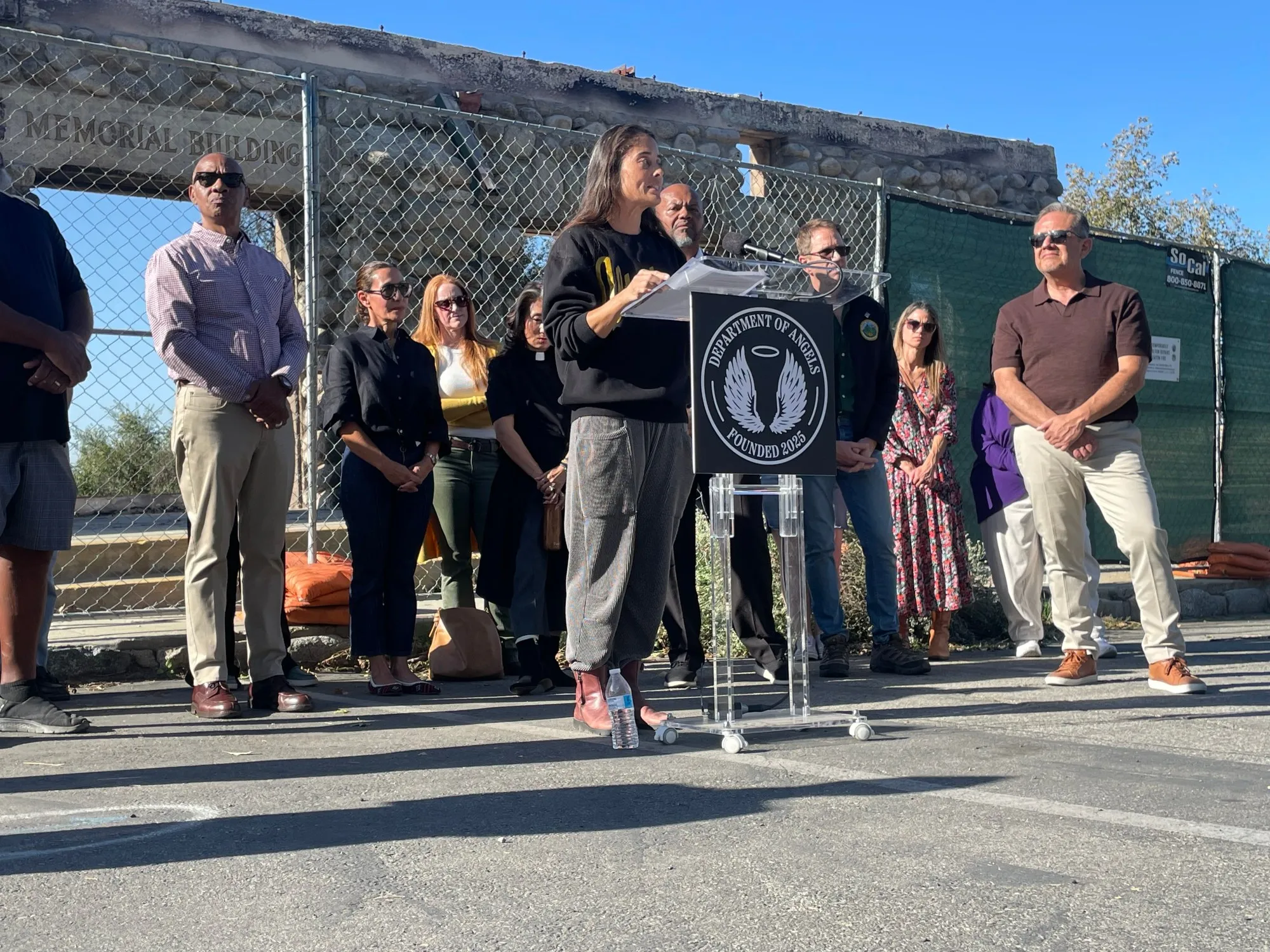
On Tuesday, the same day a fresh survey revealed that only 1% of those who experienced total loss during the deadly 2025 Los Angeles County wildfires had been able to return home, the din of work trucks and tractors echoed at the corner of Lake Avenue and Mt. Curve Avenue.
Read more Jessie Rees Foundation keeps delivering joy, and new movie could help with grief
That’s where Alyson Granaderos stepped up to a microphone, and remembered that a completely different sound and landscape once existed here: It’s here, outside the remnants of Altadena’s Farnsworth Park and the torched facade of its vintage clubhouse, where before Jan. 7, 2025, the sound of Little League baseball was a weekend treat. The smell of barbecue hung in the summer air. Where you could stand and see Downtown L.A., from the foothills of the San Gabriels.
Now, it’s an everyday construction zone.
“I look forward to the day when this fencing comes down, when we can sit on the front porch and we can hear once again families cheering on that home run hit,” she said, a tremble in her voice as she spoke outside a cordoned-off park clubhouse.
Granaderos was one of a dozen or so survivors, clergy leaders, frontline nonprofit representatives and business owners and leaders from Altadena, Pacific Palisades and Malibu who renewed a call for the federal government to step up and provide long-term disaster recovery funding.
It’s not the first time such a call has been made. It’s refrain can be heard all the way back to the days when President Donald Trump visited the Palisades back in January 2025, touring the fire that had just torn through the area. Thousands of homes and businesses gone. Twelve lives. Gone. “Unbelievable. It’s not really believable,” Trump said at one point, of the destruction around him.
Local leaders, too, gathered, and pledged to keep pressing the government for aid in what would be a massive reconstruction effort. Altadena itself lost 19 lives, with more than 9,000 structures consumed.
But Tuesday, the call had a new layer of context. The midterm elections are looming in November, and new quarterly data points to a still frustratingly slow reconstruction that, despite the optics of new homes going up in the Palisades and Altadena, has left thousands of people still displaced.
The data was released Tuesday by the Department of Angels, a nonprofit founded in the wake of the fires that has been studying community patterns and the human stories behind those patterns. The seventh such survey pointed to two fire footprints where the infrastructure need for the communities to fully recover were sorely lacking.
Among an array of fresh findings, only 1% of those who have experienced total loss in the burn zones have returned home.
The survey found that Altadena residents were “far more likely” than Pacific Palisades residents to return in the months just after the fires. That is, of Altadena residents who are home now, 36% were back by March 2025, compared to only 7% of Palisades returnees.
“A significant number of those who returned home in those early months have not completed remediation of their homes even now, suggesting that some survivors returned to contaminated homes.
And the majority of those with household incomes below $50,000, and more than 4 in 10 of those with incomes between $50,000 and $99,999, say that they have no way to cover their financial shortfalls, or that they aren’t sure how they’ll cover them.
The findings went on: The share of survivors who sold, are in the process of selling, or plan to sell their homes, spiked upward to 11%, up from 7% in June.
About 1 in 4 in Altadena, Palisades, Malibu have permanently moved.
The latest survey comes as rebuilding is pushing forward. Even as the coalition held a news conference outside Farnsworth, work crews were busy building — a scene that was unfolding from east to west in Altadena on Tuesday.
But underlying the building was a concern — bolstered by Tuesday’s survey results — that a truly robust recovery can’t happen without a vibrant business community, along with a healthy church and school community, that will support the housing and households that would return. Survivors worry that the infrastructure for such revived towns can’t happen without the kind of federal support, which disaster-ridden cities and towns have relied on for generations in the United States.
Leaving it for fire-scorched communities to do themselves can only go so far.
Maryam Zar, CEO at the Malibu Pacific Palisade Chamber of Commerce, touted her group’s work to tap low-cost loans and attract investment to revive the area’s business scene. “But we cannot do it alone,” she said.
“Local determination cannot overcome the financial scale of this disaster,” she added. “We can’t expect a devastated community to finance its own recovery while the economic foundation that sustained it remains fractured.”
The midterm election on Nov. 3 was another backdrop to the renewed call this week for federal support.
It’s support that leaders say has eluded disaster-ridden towns across the nation over the past two years, with the L.A. wildfire footprint being the largest economically devastated among them all.
Read more Celebrity exorcist priest to take one-year ‘media fast’ after meeting with Denver archbishop
Congress has not passed disaster supplemental appropriations for long-term recovery in the communities devastated by the Eaton and Palisades fires. Such support would include funding for affordable housing reconstruction and economic recovery programs. This year, Gov. Gavin Newsom presented a revised request, building off the $30 billion he’d submitted for.
But no dollars have come through that request, according to Newsom’s office.
A request for comment from the White House had not been returned by deadline.
Survivors have been calling for a California Disaster Investment Fund and a federal Disaster Opportunity Zone while pursuing community development block grant recovery funds, and FEMA dollars.
Lately, President Donald Trump has turned emergency relief into a campaign talking point in the final sprint to the midterm elections, approving disaster declarations in consequential states and coupling endorsements with funding announcements.
The latest example came Wednesday, when Trump voiced support for Republican Rep. Tom Tiffany in Wisconsin’s governor race while pledging millions to help with recent storms.
In addition, the president recently joked that he would cut off money to North Carolina, which is still healing from Hurricane Helene two years ago, if Republican Senate candidate Michael Whatley lost. And the day before an Ohio campaign rally with Sen. Jon Husted last Saturday, Trump approved a disaster declaration for the state while leaving 15 other requests pending.
The White House rejected the idea that it’s injecting politics into disaster recovery. “There is no politicization to the president’s decisions on disaster relief,” spokesperson Lauren Bis said last week, reported the Associated Press.
A FEMA spokesperson also told the Associated Press that “any suggestion that disaster decisions are politically motivated does not reflect how this process works or how FEMA carries out its mission.”
Since taking office last year, Trump has approved about 65 requests for major disaster declarations and denied more than two dozen others from states, tribes or territories seeking federal financial assistance following hurricanes, tornadoes, storms, floods and fires.
Trump has taken longer on average to approve disaster requests than any other president, according to an Associated Press analysis of data dating back to 1989, when a federal law setting new parameters for disaster determinations was implemented. And no other president has such a disparity in denials between states that supported him politically and those that did not.
The delays and denials come as Trump’s administration contemplates a makeover of the Federal Emergency Management Agency, which administers disaster aid. Major disaster declarations are intended for events that are beyond the resources of state and local governments.
Rep. Brad Sherman, D-Sherman Oaks, who represents the Palisades area in Congress, said he has some hope that a good showing by his party in the midterms could help the chances of federal funding. But it’s not a slam dunk, he said.
“Even if there’s a majority, nothing becomes law that he vetoes,” he said, referring to Trump.
Still, Sherman said he was “determined to vote” on the matter and has been working to build alliances with other states for the supplemental aide package.
“We have to see what he is willing to do,” Sherman said, referencing Trump while acknowledging that this session’s Congress “has done nothing.”
“It only gets better next year,’ he said.
Locally, groups are hoping the midterm moment resonates to get their message out.
“What we are urging is that in this highly partisan environment that there be one thing that both the Republicans and Democrats agree on is that ‘we are for Americans when they most need us,” said Miguel Santana, co-founder of the Department of Angels, and president and CEO of the California Community Foundation. “This should be a time when Americans should be very intentional about voting, because they may one day be one of these survivors.”
In the meantime, you can hear the concern in the voice of Altadena Pastor Keith Kenebrew, of Hillside Tabernacle City of Faith Church. He’s celebrating a rebuilt church, torched by the Eaton fire. But he laments the lack of people attending. They are scattered, displaced, gone from Altadena, unable to attend like they once did.
“People are already leaving,” he said. “There is a fear and there is a danger that they will never return.”
The Associated Press contributed to this report.