
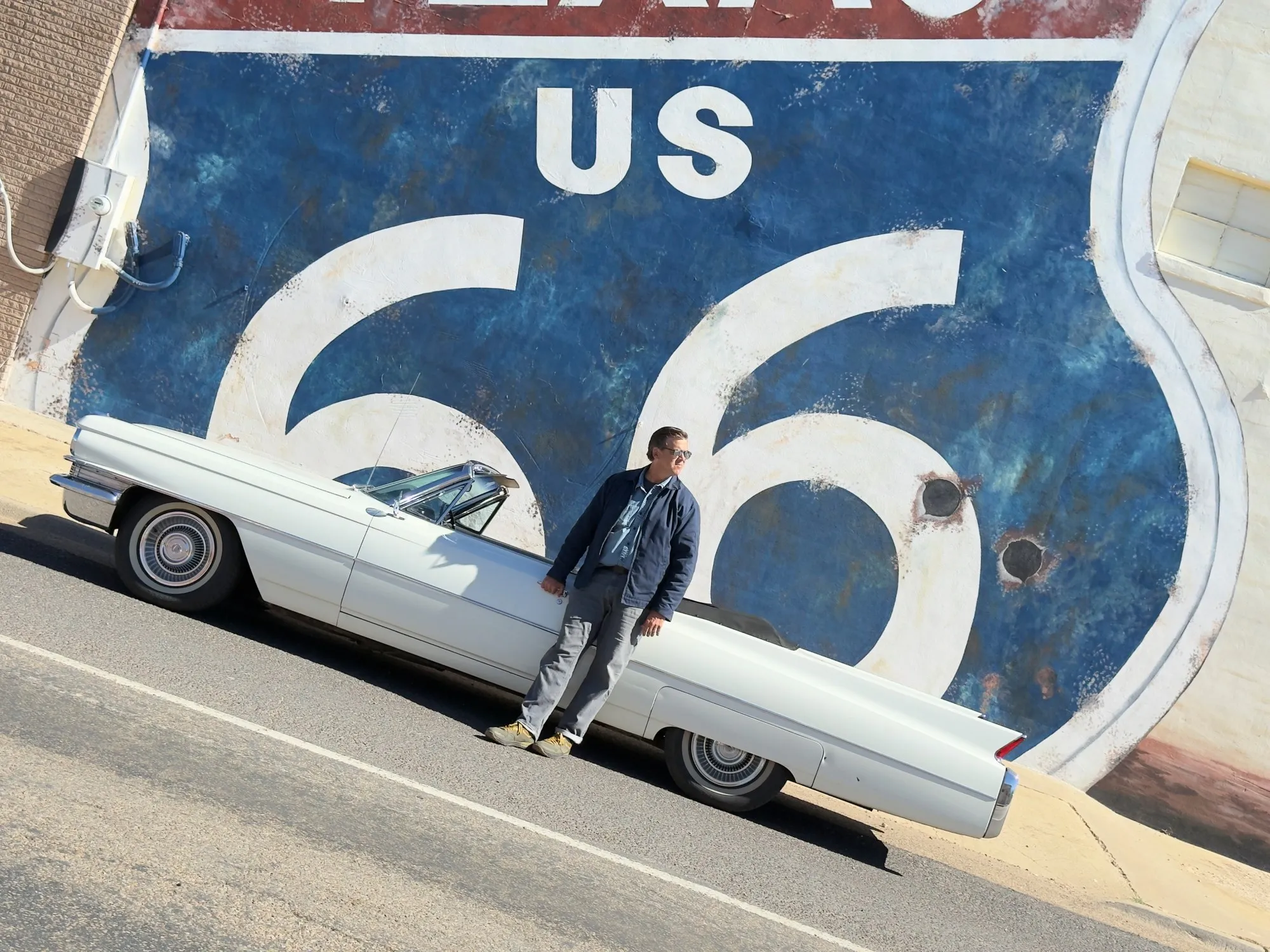
John Paget was fresh out of college when he first developed a passion for Route 66, but it wasn’t the road’s nostalgia that piqued his interest.
Read more 7 Orange County bars and restaurants going all out for Halloween
At 24, he was too young for that to resonate, but he knew more lay beneath the surface of the towns along the route.
He set out to make his first documentary film and project, famously using a TV camera mounted on the hood of a 1969 white Cadillac convertible to capture ground-level footage of the highway. The result was 1994’s “Route 66: An American Odyssey,” which chronicled how hundreds of small towns were affected by the development of the interstate freeways.
“When they built the interstate freeways, their towns died,” Paget said in a phone interview. “They went from 1,000 cars an hour coming through their downtown to absolutely nothing. That kind of dramatic impact on those towns — how some withered on the vine, became ghost towns, and how others fought back with determination to revive them — is what captured my interest.”
Now more than 30 years later, Paget is on the road screening his follow-up documentary, “Route 66: The Main Street of America,” in conjunction with the route’s 100th anniversary. The film will premiere in California at the California Theater in San Bernardino on Oct. 23, followed by screenings at the Grand Ritz Theater in Escondido on Oct. 25, the Lido Theater in Newport Beach on Nov. 2 and the Los Angeles Theater in Los Angeles on Nov. 7, where Paget will answer questions from the audience.
“I was curious to go back and see what became of all these places because back then a lot of them were old gas stations, motels, motor courts, all run by kind of these older mom-and-pop proprietors who had doggedly fought it out and survived being bypassed by the interstate,” Paget said. “I also wanted to create a film that would inspire Americans to go discover this road or rediscover it.”
When Paget traveled the country 30 years ago, he noticed how much of the United States landscape had become covered in large fast-food and hotel corporations. Those chains were drawing customers away from local businesses that make Route 66 so unique and causing them to struggle.
“The whole appeal of Route 66 is that it’s not homogenized,” he said. “I came back and did it again because America still doesn’t seem to get the message. By default, people still go to all these boring, homogenized places. I’m trying to inspire Americans to be a little more adventurous and sleep in a Wigwam Motel, and eat at Delgadillo’s Snow Cap Drive-In or the Mitla Cafe in San Bernardino.”
Some of the places featured in the documentary include a desert oasis with deep-sea diver explorers, a family in Luther, Okla., restoring one of America’s earliest Black-owned gas stations, a couple who realized nobody in their town called Bourbon was producing any bourbon, so they did it themselves.
Paget also said that there are plenty of unique foods and drinks along the highway, including a guy who started making sake in Holbrook, Arizona. He said the man, originally from Japan, lives in a town of 5,000 people, entered his sake in a major competition in Tokyo, and won an award for the best sake made outside of Japan.
When it comes to food on Route 66, the first thing that comes to mind for Paget is the fried onion burger at the Hamburger Inn in El Reno, Okla. The Western Oklahoma town invented the burger during the Great Depression when meat was expensive and scarce. Burger chef Ross Davis and his father began stretching hamburger patties by adding clumps of onion to make the meat go further and discovered culinary gold.
Read more ‘Disrespected’ man gets 27 to life for fatal shooting in Santa Ana
“It turns out to be the best burger I’ve ever had is the El Reno fried onion burger,” Paget said. “It’s incredible. To this day, my wife and I look on about every week on Zillow for real estate in El Reno just because it’d be so worth it to eat those daily, but I’m not sure if it’d be good for you.”
Now Adam Hall of Sid’s Diner continues the fried onion burger tradition as a third-generation owner on Route 66. Paget said he has regularly met younger people on the route who value generational tradition in their hometowns over chasing big-city promises.
He said taking on the family business used to carry a negative connotation. However, in an increasingly digital world, built on social media algorithms that have led to more loneliness, purposelessness and disconnection among, but not limited to the youth, there seems to be promise in the fulfillment found in revitalizing Route 66.
“Younger generations are looking for something authentic, and we all want to feel like we’re part of a story,” Paget said. “When we’re disconnected from history and living in a homogenized landscape, we lose touch with how we’re part of that and how we’re connected to our ancestors.
It feels like we’re increasingly living a digital existence, and Route 66 is a great answer to that because it’s full of authentic places where you feel that and can connect to history, things that are tangible. We’ve met many people who left corporate life to buy an old motel in Tucumcari, New Mexico: the Blue Swallow Motel. If their job was once working in tech or IT, now they’re fixing old vintage neon signs and washing the bedding and welcoming guests, and I’ll tell you, they’re happy.”
Paget also said the people he’s met along Route 66 share a passion for preserving a historic place that some view as a lost cause, destined for demolition. He said many of these people will pick up the labor as love and sometimes pour their own money into reviving something when banks won’t finance their projects and friends and family think they’ve lost their sense of reality.
“Then they become these celebrated places that, in a lot of cases, do end up successful and making money, but that was never the point,” Paget said. “These people all took tremendous risks to save these important pieces of history, and I again just wanted to spotlight and celebrate them in the film. I’m grateful for what they did, and they make for great stories.”
Paget also added that he’s learned a lot from screening the film with an audience and has been surprised by some of the reactions he’s received, including people moved to tears by the featured stories.
“This is a film about a highway, but it’s obviously about something deeper,” he said. “It really is about something bigger, with themes of a story, history and connection to generations. I’ve had a lot of people tell me it restores their faith in America and rekindles their love for it. Part of that, too, is that it brings us together for a Route 66 movie, but it’s also a powerful reminder of what we have in common and what it means to be an American.”
Route 66: The Main Street of America
When: 6 p.m. Friday, Oct. 23.
Where: California Theatre, 562 W 4th Street, San Bernardino.
Also: 2 p.m. and 7 p.m. on Sunday, Oct. 25, at The Grand Ritz Theater, 301 E Grand Ave., Escondido; and 8 p.m. on Saturday, Oct. 26, at the Los Angeles Theatre, 615 S. Broadway, Los Angeles.
Read more New Mexico sues Epstein attorney and accountant, accuses them of hiding sex trafficking operation
Information: Admission is $15-$28 at mainstreetofamerica.com.