
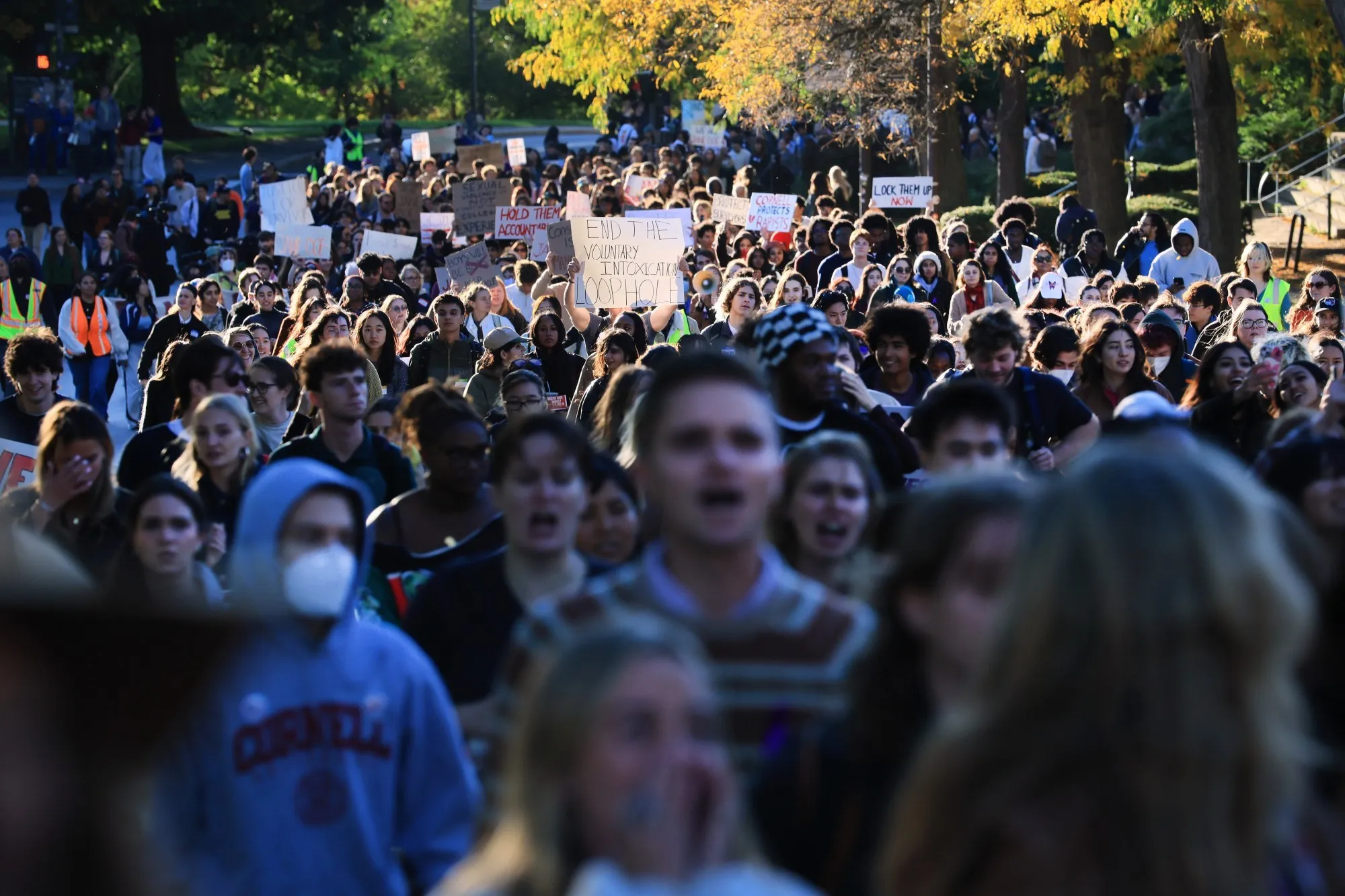
A former Cornell University student’s allegation that seven members of a campus fraternity drugged and sexually assaulted her in 2024 has sparked national outrage, recalling a high-profile incident at Stanford University more than a decade ago.
Read more ‘Picasso of Pumpkin Carvers’ brings artistry to a Halloween tradition
Stanford Law professor emerita Michele Dauber said little has changed since former college swimmer Brock Turner sexually assaulted Chanel Miller, who was unconscious and intoxicated, behind a fraternity dumpster in January 2015.
Dauber led the recall of Santa Clara County Judge Aaron Persky, who sparked outrage when he sentenced Turner to six months in county jail after a jury convicted him of three felony sexual assault counts. Turner spent three months in the Santa Clara County Main Jail — he was released in September 2016 for good behavior and is required to register as a sex offender for life.
Persky was the first California judge recalled in 86 years. The case also led to significant changes to California law regarding sexual assault sentencing.
Now, a decade later, a former Cornell student’s civil lawsuit filed last month against that university has sparked familiar outrage over a lack of criminal prosecution and accountability. The case, dubbed the “Cornell 7,” centers around the student’s claims that seven men coerced her into taking ketamine and raped her in October 2024 at a fraternity house. The student, Jane Doe, also alleges the university and law enforcement agencies did not do enough to punish or pursue prosecution of the men. The men involved have denied the allegations, while Cornell University has said it responded appropriately given the information available.
At the time, prosecutors decided not to charge the men involved, and the female student dropped out of the university. Prosecutors briefly reopened the criminal probe last month before New York Gov. Kathy Hochul appointed a special prosecutor, State Attorney General Letitia James, to lead the case earlier this month.
Stanford’s Dauber said the Cornell case is another example of the legal system and universities’ failure to treat sexual violence seriously.
Dauber said if anything, student faith in university’s sexual assault policies has only gotten worse since Miller’s assault on Stanford’s campus in 2015. Stanford’s data shows that a third of female undergraduate students experience sexual violence during their four years on campus.
“Only a third of female undergrads said that it was very or extremely likely the university would take a report seriously,” Dauber said, citing a 2024 campus survey. “Less than a quarter of female undergraduate students said that it was very or extremely likely that the university would conduct a fair investigation. These together point to very low levels of trust in the University Title IX process.”
In a statement Wednesday, the university said it is “committed to building a culture of care and accountability and to preventing sexual violence,” through student education, mandatory training for residential leaders on the federal civil rights law prohibiting sex-based discrimination and harassment, Title IX, and outreach at fraternities and sororities.
The university also said this week it is reinstating a sexual assault prevention program, Flip the Script, after pausing the program earlier this year due to low student enrollment, along with a companion program for male students. Repeated randomized controlled trials have shown Flip the Script significantly reduces rates of sexual assault, in some cases as much as 50%.
The university said Title IX reports — which include all forms of sexual misconduct — at the university are “fairly consistent” year to year, with cases hovering around 220 in the past three years. Stanford said of the total number of Title IX reports since 2022, 31 cases have proceeded to the hearing process, two students have been expelled and four suspended for sexual assault.
Stanford said independent officers, not the university, conduct Title IX hearings and impose sanctions and Stanford is “bound by their decisions under its procedure.” The university said it adopted this process in 2020 after extensive community input.
Dauber chatted with the Bay Area News Group to discuss the Cornell case, its relation to Stanford’s 2015 Turner case and whether anything has changed over the last decade in the handling of sexual assault allegations on college campuses.
Read more Letter implicating Meghan Markle dad in alleged child porn was penned by ex-wife
Q: How is the Cornell 7 case similar to Chanel Miller’s assault on Stanford’s campus?
A: The most obvious similarity is that both incidents occurred at a frat party. . One federal study found that for an undergraduate female student. Stanford’s own data show that sorority members have far higher rates of sexual assault than their non-Greek classmates, likely due to their proximity to fraternity members. Another similarity is that both victims took the highly unusual step of reporting to the police and requested their cases be prosecuted. Then, both women experienced the failure of the legal system to treat sexual violence seriously. Turner was convicted of three felony sex crimes, and the failure point in the legal system occurred at sentencing, when Judge Persky gave him just a few months in county jail. For Jane Doe, the failure point occurred with the prosecutor, who failed to sufficiently investigate or give serious consideration to any criminal charges.
Q: How does the Cornell case differ from Turner?
A: The real point of divergence between the two cases, to me, is the handling by the universities. Cornell, for all its many failures, took some actions that resulted in expulsions and suspensions for some of the involved students — though Cornell failed in its most important task, which was to protect the victim’s educational rights and she left school.
By contrast, at Stanford, students found responsible for sexual assault are virtually never expelled. Stanford’s record on this is egregious. Even Turner was not expelled — he was allowed to withdraw voluntarily.
As for fraternities, Cornell’s Chi Phi was banned and de-chartered. At Stanford, the Turner assault occurred at Kappa Alpha house behind a dumpster, among a sea of red cups, during a fraternity rager. Kappa Alpha was put on “social probation” and continued operating. Kappa Alpha did not lose their charter and did not even lose their house — which still boggles my mind today. Stanford has long been among the least friendly, if not the worst, college campuses for survivors.
Q: What are some of your biggest concerns following the handling of the Cornell case?
A: I find it startling that Cornell and Stanford and the rest of the academic world have not abolished Greek life.
Interestingly, at Stanford, men are also sexually assaulted in frats at a very high rate compared to those not in frats. In addition to rape, there are repeated instances of hazing and drug-related deaths, such as what occurred at Stanford when a student who happened to be the son of a faculty member died of a fentanyl overdose at Theta Delta Chi in 2020.
That fraternity wasn’t even permanently banned — it was suspended for six years. It was rechartered two years early in 2025, following alumni pressure. What do you have to do to get permanently banned as a fraternity at Stanford? Is there anything bad enough? Quite apart from the moral failure these light sanctions represent, the educational lesson is clear: fraternities are very powerful indeed if they can get away with quite serious offenses with minimal accountability.
Q: What policies still need to be improved?
A: We need evidence-based prevention programs that are actually proven to reduce rates of sexual violence. There is only one such program, Flip the Script, with a strong research foundation. It has been shown to reduce the rate of campus rape by 50%, and attempted rape by between 30% and 60% — an unheard-of success rate. It is an empowerment program for women students that dispels victim-blaming rape myths and gives participants the verbal and physical tools to protect themselves. In fact, in the aftermath of the alleged fraternity gang rape two years ago, Cornell instituted it for sorority women … I have been trying for more than 10 years to get it widely adopted at Stanford. So far, this has not happened.
Q: Culturally, has anything changed around the way society reacts to these cases? Have you noticed a difference in the public’s response to the Cornell assault?
A: The recall of Judge Persky had a substantial impact because it showed that women could rise up and hold elected officials and members of the justice system accountable for failing to take campus sexual violence seriously. I think that exercise of democratic power on this issue was something we have not seen much before, so it had an impact. I would wager that the DA in New York who failed to do a thorough investigation in the Cornell 7 case will be voted out if he decides to run for reelection.
Q: Anything else you think the public should know about this topic?
A: Colleges like Stanford and Cornell often mouth platitudes that they “take sexual assault very seriously.” They don’t, and we can tell that because rates of campus sexual violence have never significantly declined . Colleges have the ability to institute a few changes that would quickly and dramatically reduce the rate of campus assault: abolish Greek life, expel students found responsible for rape and widely institute the evidence-based prevention programming Flip the Script. They know what to do; they just won’t do it … What we can see is an epidemic of rape on our campuses that never abates and that periodically bursts into view, like Brock Turner and the Cornell 7, then fades away. I have become increasingly convinced that the only way to stop it is at the ballot box.
Read more 15-year-old arrested in Florida A&M shooting that wounded 11 after homecoming game