
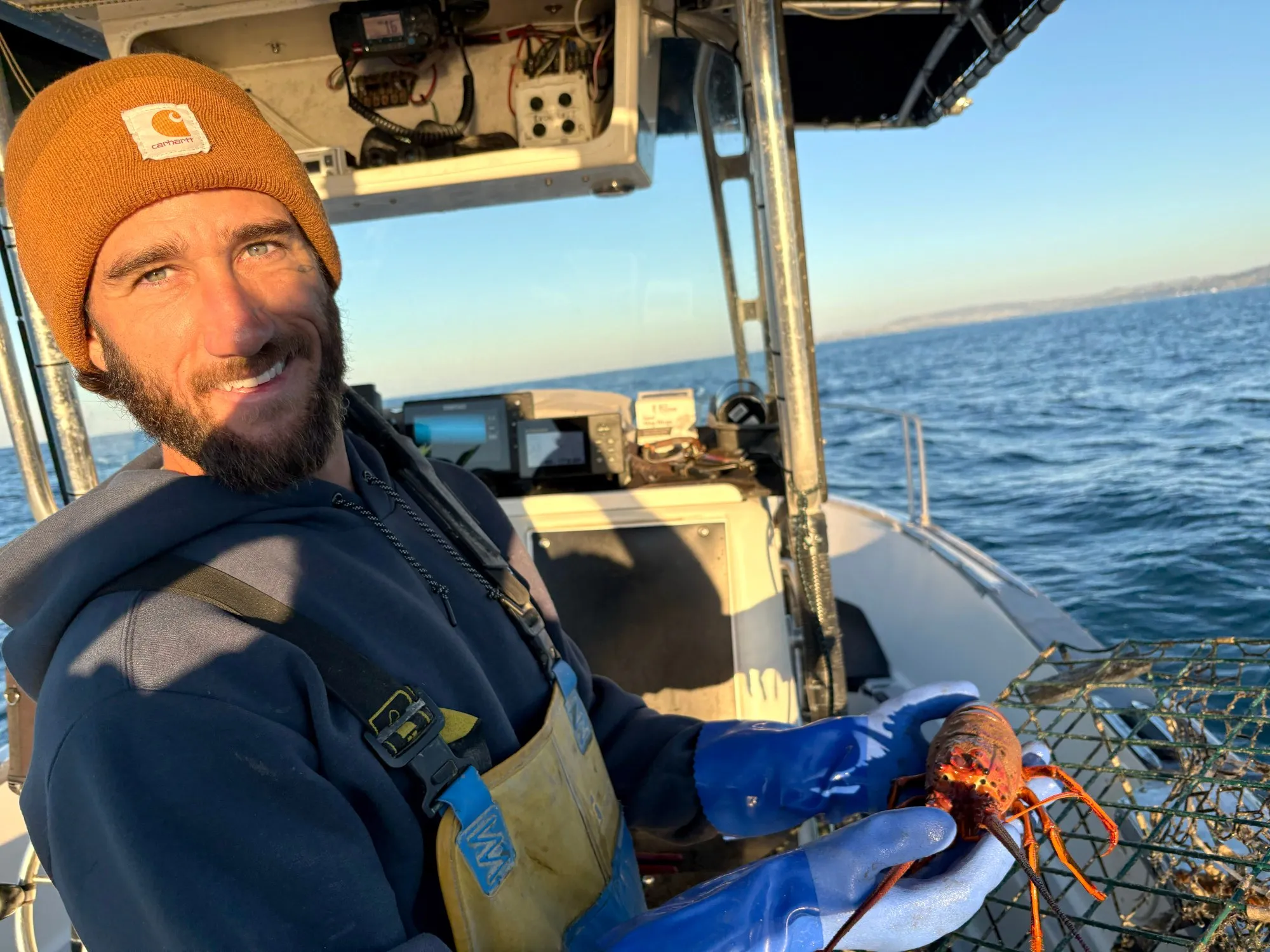
Let’s not romanticize it: Mackerel stinks.
I learned this the hard way, on Wednesday, Nov. 11, when I spent a day lobster fishing with Zach Greenfield, one of a dozen or so commercial lobstermen who use Dana Point Harbor as their base of operations.
Read more Southern California rent bargains are hard to find
I went lobstering to learn if the job is dying. A lot of people – including some who lobby for the industry and others who are long-time lobstermen – think it might be. If so, that’s sad. People have been hauling lobsters out of the local waters since long before Orange County existed as a political and cultural entity. And if the job goes away – if the lifestyle that goes with the job dies out – it’ll take something from us all. We’ll be less connected to history and nature, a little less interesting.
And, big-picture, the discovery I took away is this: Lobstering might, indeed, go away. Just not yet.
But in my day with Greenfield, I learned a lot of other stuff, too.
For one thing, lobstering is physically hard. Even an empty lobster trap weighs 40-or-so pounds. And commercial lobstermen – who run up to 300 traps during a six-month lobster season – manhandle traps all day. Hands, arms, necks, backs; all get used – and sometimes strained or worse – as a routine part of the job.
Also, lobstering is complex. Anybody who believes they can “take it up,” without a genuinely deep understanding of marine science, or lobster behavior, or market economics, or how to repair the $500 engine that powers a device known on at least some lobster boats as “the thing that hauls the (bad word) traps out of the water,” is too stupid to survive in the industry.
And, alas, my time with Greenfield also meant learning the stages of mackerel smell.
To wit: It smelled bad before dawn, right after Greenfield cut 20 vile pounds of the stuff into kabob-style chunks to serve as the day’s bait.
It was worse than bad a few hours later, when the sun was out and Greenfield’s 25.5-foot boat, the Stephanie Rose, was bouncing, not going forward, and I was asking myself the hard question of why I’d ever thought Dramamine was wuss.
And, late in the day, when I took off my shoes, the smell was whatever it is that’s worse than worse than bad. Turns out I’d waded a bit in some warm mackerel juice, wearing only the socks I was having to peel off my feet.
So let’s just stipulate that mackerel isn’t awesome.
You know what else isn’t awesome? Poachers. Greenfield said they routinely steal enough to make or break his year. He hates poachers, and he doesn’t seem to hate much of anything.
And there are other concerns that come with lobstering: the remote-but-not-zero chance that a storm might swallow Greenfield and his boat; the public accusations that he and his ilk are out to destroy the ocean; global warming, which some day might upend the fishery entirely.
Still, even with the hassles and crazy hours and bone-crushing labor, Greenfield is hooked. Earning money by motoring around the open ocean, solo, in an aging, tiny boat, roughly 100 days a year, and then trapping, measuring and selling some California spiny lobster, is a very cool way to make a living.
“The sunrise, over Cottons, is probably my favorite part of the day,” Greenfield said, moments after said sunrise as he nodded at the surf spot near Trestles.
Then he steered the Stephanie Rose to one of his lime-green buoys off the coast of San Clemente, and started a process he would repeat roughly 93 times during our day together – gaffing the buoy, attaching the rope to the hauler thing, and getting the trap on the boat’s ledge.
“The view doesn’t really get old or whatever.”
And lobstering is this, too: Greenfield, who learned the job from his grandfather, is, at age 36, living, breathing, heavily tattooed proof that nature and human commerce can coexist.
Yes, greed needs to be wrestled to a draw. And, yes, the ocean needs to be kept healthy enough to produce lobster.
But it’s possible.
And it’s not romanticizing anything to suggest that life as a lobsterman is, in its way, beautiful.
Too bad it might be on the brink.
A break
That fear, of course, isn’t new.
As a group, lobstermen tend to be the-glass-is-half-empty-and-maybe-cracked-and-probably-stolen types (though, to be fair, Greenfield seems an exception), and they’ve been whining about their future for decades. What’s more, some of the pressures currently lining up against the industry aren’t new.
But a range of newer issues – tariffs, state politics, climate change, aging demographics – are particular to this moment. And they all suggest that Greenfield, who doesn’t have kids, and who isn’t married even though he would like to be, might not get to pass his skills to whoever becomes his family’s next generation.
“I don’t know,” he said when I asked him, point blank, if his job will be around in 15 or 20 years.
“I hope it is, or will be,” he added, tossing yet another live-but-too-small-to-sell lobster back into the ocean.
“But I guess I sort of doubt it.”
Last month, Greenfield and roughly 25 others in Orange County who hold state-issued permits to pull lobsters from the ocean and sell them to fish brokers (and restaurants, and stores, and sometimes individual customers), caught a break.
It came when state officials denied a request to expand a Marine Protection Zone that currently bans commercial fishing in the waters off much of Laguna Beach to include another area, the roughly 1.35 miles of ocean that stretches from south Laguna to the north edge of Dana Point.
The request for a bigger protection area came from environmental groups, including many I agree with, such as Orange County Coastkeeper. They believe ocean protection is important and limiting fishing is a way to do that.
But the protect-more-ocean proposal was opposed, loudly, by the lobstermen. They claimed that keeping them away from the waters off south Laguna – which apparently is a hot neighborhood for lobsters, who like to nest and eat (sometimes each other) and make baby lobsters in the area’s many reefs and rocks – would cost them money.
But even though the state’s ruling meant that lobstermen essentially won that debate, they were, and remain, bummed out by another element of the conflict.
Some (not all) environmentalists described lobstermen as people willing to abuse the ocean as long as they could still keep their jobs.
And the lobstermen kind of hate that.
“We were often portrayed as the environmental villain,” said Ava Schulenberg, executive director of the California Lobster & Trap Fishermen’s Association.
Read more Historic moment as first batch of olive ridley turtles released back to the ocean
“It’s frustrating because it’s so… It’s just not the case.”
That rings true for a practical reason: money.
Yes, environmentalists are correct that certain types of fishing are pillaging the ocean. Big companies using poorly paid fishermen and technology that scrapes the ocean floor, among other things, are wiping out fish populations in waters as diverse as the Mediterranean and the Antarctic.
But Greenfield and his competitors aren’t that. If anything, they’re old school, using at most one hired deckhand and relatively little in the way of technology. And instead of harvesting the ocean in some mechanized, mass-production fashion, their version of fishing feels painfully slow; one lobster at a time.
In the day I spent with Greenfield, we visited about a third of his traps. Once he’d wrangled each trap to the edge of his boat, he performed a rapid-fire, almost mechanical routine.
First, he tossed away old mackerel bait (a level of odor too powerful to be described here), and then he pulled the lobsters (if any), individually, out of the trap.
But, before we go on, it’s important to know that size is critical in lobstering. Under state law, Greenfield could be fined or might even lose his permit if he’s caught trying to keep any animal that’s smaller than the legal minimum, which is 3.25 inches from the edge of a lobster’s eye sockets to the end of its body shell, which is the hard part just above its tail.
So, as part of his routine, Greenfield lobbed every living lobster that was obviously too small back into the ocean. He then hand-measured every one of the other sharp, squirming, angry creatures, sliding keepers into a watery bin he keeps next to the mackerel box, and throwing the rest (a few hundred, at least), still alive, back into the ocean, where they turned out to be surprisingly enthusiastic swimmers.
Each of those too-small-for-now lobsters will have to grow a bit to be worth anything for Greenfield and others. And they can’t grow – and become future paychecks – if the ocean isn’t thriving.
So even if lobstermen aren’t eco-incentivized, they’re financially driven to keep fishing sustainable.
“The people who want to keep the ocean healthy the most are the people who make a living off it,” said Greenfield, who surfs and grew up around the ocean and considers himself an environmentalist.
Our day together is financially mediocre. Greenfield kept 62 lobsters, or roughly 84 pounds, and he sold the haul for about $1,050.
Not a break
Last year, Greenfield and other lobstermen didn’t catch a break.
When President Donald Trump announced, and re-announced, and re-re-announced, a wide-ranging set of tariffs, countries around the world stopped buying some of the products they usually get from the United States.
One of those was, and is, California spiny lobster.
It happens that the local lobstermen’s best consumers, pre-tariff, were buyers in China, Vietnam and Taiwan. Those customers apparently prefer our lobsters over Maine lobsters because ours are a little sweeter, and a little redder, and (because ours don’t have claws) more dragon-like. That makes our lobsters visually appropriate for certain feasts.
Whatever. When Asian countries stopped buying local lobsters, prices cratered. Animals that fetched up to $30 a pound wholesale three years ago are now going for about $12.50 a pound.
At the same time, the cost of gasoline sold at the harbor has spiked to about $6.50 a gallon. That’s rough because the engines on lobster boats get about 4 to 6 miles to the gallon, and a day of lobstering typically requires about 20 miles of travel. The price to keep a boat in a slip has gone up, too. Even stinky mackerel prices have shot up.
The tariff episode also turned local lobstermen – much like Texas cattle ranchers and Nebraska wheat farmers, among others – into collateral damage. And, because at least some lobstermen have leaned conservative, it’s become a political issue, too, though not one I heard discussed.
“It’s an interesting dichotomy, I guess,” Greenfield said. “Most lobster guys probably agree with (Trump) in terms of his policies and such.
“For me, if (tariffs) were making sense for the country, overall, I could see it,” he added. “But I don’t know if that’s the case at all.
“I do know it’s hitting us.”
Greenfield and other lobstermen in Dana Point said this year’s price drop has been offset, slightly, by big hauls they’ve seen in the early part of the current lobster season, which opened Oct. 7 and runs through March 17, 2027.
“We’re getting more numbers, but for a lot less money,” said one lobsterman.
They’re also finding lobsters in unexpected places.
With ocean temperatures roughly 10 degrees warmer than usual, a result of a powerful El Niño, lobsters are moving away from their usual winter hangouts in shallow waters near the coast, in favor of cooler waters, deeper and further from shore. That drives up operating costs slightly because it forces boats to run further. But it also means less reorganizing of lobster traps, which is often required when shallow traps are pushed around by strong winter storms.
Greenfield said he started planning for the current El Niño as early as last spring. He’s running fewer traps than usual this year, in part because he expects a particularly stormy winter. And, since the second week of the season, he’s been setting many of his traps in deeper spots, on rocks or artificial man-made hard spots (reefs) about 40 feet deep.
He believes that when the ocean does cool down, probably in the middle of winter, lobster will return to shallower waters. And he hopes, but isn’t predicting, that a winter migration might lead to a second wave of big hauls.
If not, the season could finish up so-so or even lousy. It’s too early to say for sure.
Lobstering has always been boom and bust. After big seasons, when the catch is big and prices are high, some lobstermen have made enough to buy houses and boats and commercial permits (which run in the tens of thousands of dollars) for other types of fishing, such as crab and prawn. In other years, lobstermen use past earnings to finance their day-to-day expenses. And, in some bad years, at least a few lobstermen give up and sell their permits and equipment.
Overall, until now, lobsters have provided a middle-class life. Greenfield said his grandfather “did pretty well for himself” and was able to retire before he passed away a few years ago.
Greenfield isn’t sure if he’ll be able to do the same.
“I’d maybe go to Alaska or something and find some kind of work up there,” Greenfield said when I asked what he’d do if lobstering dies out before he’s old enough to quit.
Then, after a beat, he added:
“I guess I don’t really know what I’d do. All I know is I’d like to keep fishing, to stay on the water.”
Read more NHRA’s fastest ever: Langdon sets sights on season title in Pomona