
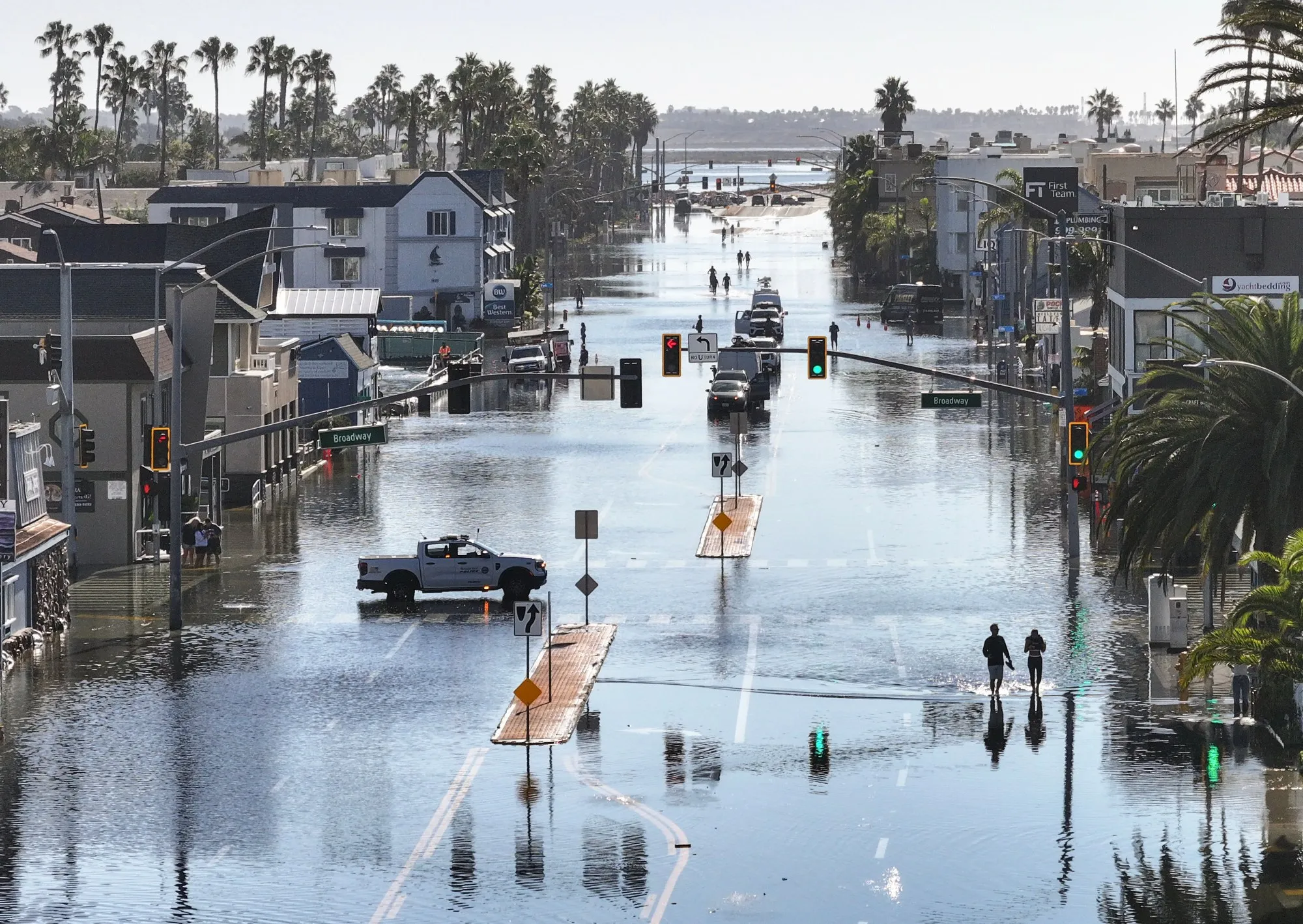
The water rises and falls every day, a predictable measure of the ocean’s tidal swing. But, especially in winter months, there are periods when tides become so high they are called “king tides.”
Read more Warming has gotten so out of hand, nations call for sucking carbon out of air somehow
And this year, those king tides are even higher with recent unusually warm water conditions from an El Niño and other factors that have raised sea levels even more. What was once a 7-foot high tide has reached upward 8.5 feet, even inching close to 9 feet — and that means trouble for low-lying areas along the coastline that are unprepared for that much seawater, which can spill over into roads and people’s homes.
Astronomical tides are based on the relative position of the Earth, moon, and sun, and can be predicted well in advance, happening every single day throughout the year.
Take a look at a beach at one time of day, you may see exposed tide pools and lots of sand space as the water levels retreat. Stroll along that same spot eight hours later, and the water is higher up on the sand, in some areas leaving no beach behind, the ocean covering up stretches exposed hours earlier.
King tides isn’t exactly a scientific term, but is used to describe very high tides when there’s alignment of the gravitational pull between the sun, moon, and Earth, and when the moon is closest to the Earth.
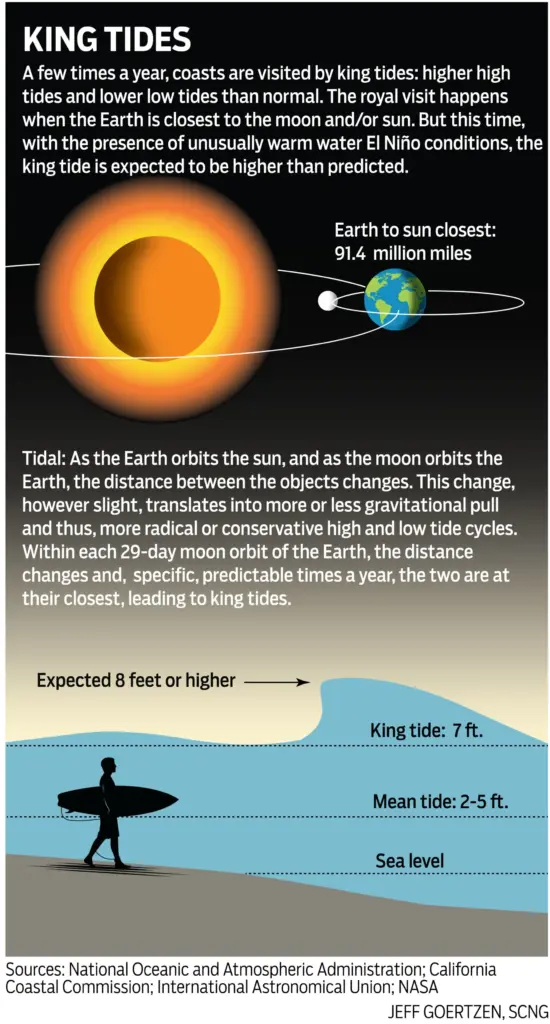
Around the new year, when the Earth is also closest to the sun, it further increases the gravitational pull on the ocean during California’s winter season, creating tides typically one or two feet higher than average, explains the California King Tide Project.
The king tides of today likely mimic the sea level rise of tomorrow, experts say, and the California King Tides Project is tasked by the California Coastal Commission with documenting and raising awareness to encourage communities to better prepare and take action.
Volunteers up and down the coast arm themselves with cameras each king tide cycle to document the sea changes, which can show where areas are vulnerable in order to plan for the future. Homes that saw seawater flowing over seawalls might want to have them raised sooner rather than later, and many cities are expediting permits.
“King tides themselves are not related to climate change, but they allow us to experience what higher sea level will be like,” the King Tides Project says on its website. “When you observe the king tides, imagine seeing these tides — and the associated flooded streets, beaches, and wetlands — every day. Understanding what a king tide looks like today will help us plan for future sea level rise.”
By 2050, the median sea level on our coast is expected to rise between 0.8 feet and 1.2 feet, and by 2100 to between 3.1 feet and 6.6 feet, experts predict.
Read more UN climate talks slammed by activists, leaders as fossil fuels go unmentioned in draft agreement
When king tides occur during swells or storms, water levels can rise even higher and have the potential to cause great damage to the coastline, according to the King Tides project, which launched in 2010.
Warm water also expands, causing water levels to rise even higher. This year’s “super El Niño” and Kelvin waves, which are bands of warm water that originate from the equator and slowly pulse out, have caused a temporary increase in sea level.
A few weeks ago, during a regular 6-foot tide, water levels hit a record-breaking 8.4-foot level in Newport Beach, catching neighborhoods off guard as water spilled into streets and into homes. The tide that week broke a 2005 record in San Pedro, measuring 8.19 feet.
King tides on Nov. 25 are expected to be about 7 feet along the Southern California coast around 8:30 a.m., but with current conditions, cities are preparing for another foot and a half or so, with tides potentially reaching 8.5 feet, or even higher.
On Christmas Eve, high tides hit around the same time even higher, at 7.17 feet in Newport Beach and even 7.25 feet at the Santa Monica Pier, putting them closer to 9 feet if water levels stay abnormally high.
And then, if it rains, that could spell even more trouble, with extra water from storms filling in harbors, bays and drainage systems. A big swell is another factor that also adds concern, with surges sending water crashing over seawalls and against oceanfront infrastructure and homes.
The California King Tides Project warns people to always check and follow local and statewide safety guidelines during and after storm and high surf events and heed any emergency closures and warnings.
If you document king tides during Nov. 24-26, Dec. 23-25 or Jan. 21-22, submit photos to coastal.ca.gov/kingtides/participate.html.
Read more At an Italian hedgehog hospital, tiny patients face the strain of a warming climate