
By GERALD IMRAY
CAPE TOWN, South Africa (AP) — U.S. President Donald Trump has expanded the number of refugee places available for white South Africans, saying there have been “recent increases in the incitement of racially motivated violence” against them by their Black-led government and other political parties.
Read more Efforts to understand the nation’s drugged driving problem stall under Trump
It’s not clear what incitement Trump was referring to when his administration made the announcement Tuesday of 10,000 additional places for white South Africans in the refugee program this year to raise it to 17,500.
It’s Trump’s latest contention that minority white Afrikaners are being persecuted, which the South African government denies.
Here’s a look at what Trump says is happening to white people in South Africa to justify their resettlement and why his position that they are being persecuted is condemned as baseless:
Attacks on farmers
Trump laid the foundation for the resettlement of Afrikaners in an executive order last year that said they were victims of racial violence fueled by government actions.
Afrikaners are white South Africans descended from mainly Dutch and French settlers who first came to South Africa in the 1600s.
The U.S. has cited a small number of home attacks on white farmers as evidence of racial persecution. The South African government and analysts say that’s a distortion of the facts, because Black farmers and farmworkers are also killed and injured in what are largely violent robberies and not racial attacks.
It’s true that South Africa has a violent crime problem that affects all races, including white farmers.
There were more than 23,000 homicides across South Africa from April 1, 2025, to March 31, 2026, according to official annual crime statistics, affecting all races but mostly the poor Black majority. In comparison, there were 29 homicides on farms in 2025, according to the Afrikaner lobby group, AfriForum. Farm killings represent about 0.1% of homicides.
South African police say Black people were also killed in those farm homicides, though they don’t typically break rural crimes down as a separate category or by the race of victims.
AfriForum, the Afrikaner group at the forefront of raising concerns over rural crimes, also doesn’t publish how many Black farmers and farmworkers were killed, saying it “does not racialize the issue.”
Anti-white rhetoric
The Trump administration said that a recent increase in incitement to racial violence by the South African government and other politicians led to “an unforeseen emergency refugee situation” and “grave humanitarian concerns” for Afrikaners.
It wasn’t clear what he was referring to, because there has been no public incitement to violence by the South African government, which is made up of a coalition of 10 political parties — some of which are led by white people. White people, including some with Afrikaner heritage, serve in South Africa’s Cabinet.
Afrikaners are part of South Africa’s white minority, which also includes white people with British and other heritage. There are around 4.5 million white people in South Africa’s population of 62 million, which is more than 80% Black, but also has other minorities with Indian and multiracial heritage.
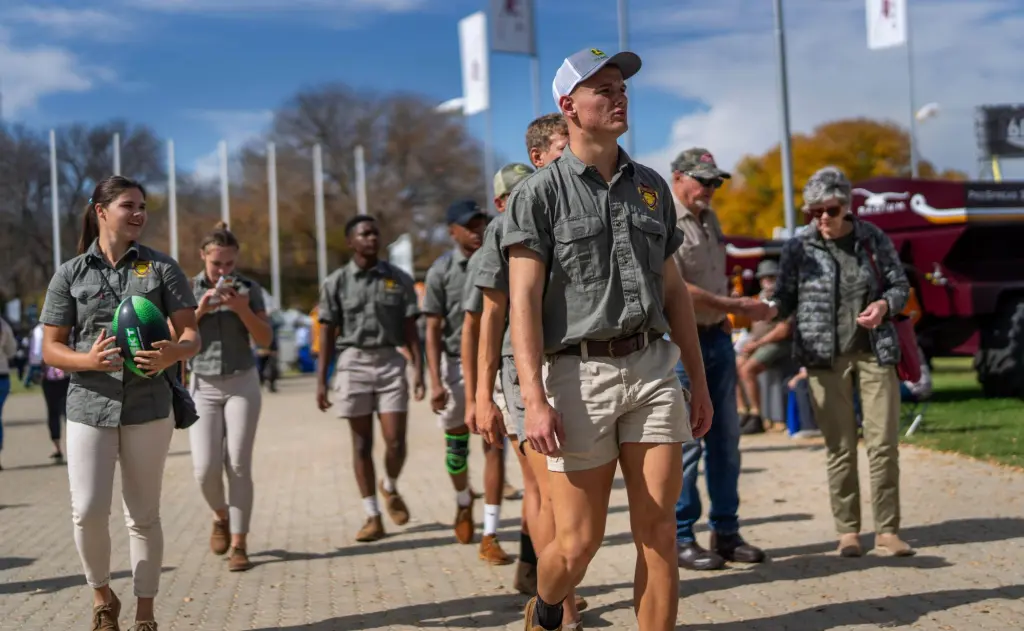
Allegations of an “emergency refugee situation” for Afrikaners aren’t reflected in everyday life in South Africa, where Afrikaners are prominent politicians, business leaders and sports stars.
Read more Millions of people have been placed in new voting districts. Here’s where the redistricting stands
Their language, Afrikaans, is widely spoken and taught in schools as one of the country’s 11 official languages, and Afrikaner monuments and churches stand and are maintained as part of the country’s multicultural makeup.
The Trump administration has previously focused on one far-left opposition party in South Africa, which has stoked racial tensions by sometimes using a decades-old chant from the era of resistance to the apartheid system of white minority rule, which ended in 1994. The chant has the lyrics “kill the Boer” — with Boer referring to white farmer — and it has been investigated for hate speech.
The South African government hasn’t condemned the chant, saying it has a historical place connected to the fight against apartheid and shouldn’t be taken literally. Some Afrikaner groups like AfriForum have criticized the government for that stance and called for the chant to be outlawed.
The far-left party isn’t part of the government and has no power on the national stage.
Affirmative action laws
South Africa’s affirmative action laws have also been cited by the Trump administration as evidence of anti-white policies. The laws are aimed at advancing opportunities for Black people and others who were oppressed under white minority rule. They also are meant to help women and people with disabilities, though how successful they’ve been is debated.
They have become a focus for Trump allies like South African-born billionaire Elon Musk, who has said he was prevented from getting a license for his Starlink satellite internet service in South Africa because he’s white.
The government says that’s a distortion. Starlink can operate in South Africa, though it needs to follow affirmative action regulations in that sector that require previously disadvantaged groups to have a minority stake in any local entities. The South African government says more than 600 American companies currently operate in South Africa and follow affirmative action regulations.
Afrikaners’ refugee status
The South African government has previously said that Afrikaners are free to leave for the U.S., just as other South Africans have emigrated in search of opportunities in other countries. However, the government says they shouldn’t be classified as refugees fleeing persecution.
“The assertion that white Afrikaners, in particular, endure systemic persecution is entirely without foundation,” South African foreign ministry spokesperson Chrispin Phiri said in a statement to The Associated Press on Wednesday.
Around 6,000 South Africans have moved to the U.S. since the Afrikaner program started last year, according to the U.S. government.
Other issues with South Africa
The Trump administration has a larger problem with South Africa’s government, especially its stance on the Israel-Palestinian issue. South Africa, a longtime supporter of the Palestinian cause, has accused close U.S. ally Israel of genocide in Gaza in a highly emotive case at the United Nations’ top court.
Israel, founded in the aftermath of the Holocaust, has vehemently denied the allegations, and countered that the Hamas-led attack on southern Israel on Oct. 7, 2023, was itself a genocidal act.
The U.S. has cited South Africa’s position on that issue, and the country’s diplomatic relations with Iran, as evidence of an anti-American foreign policy, which South Africa denies.
Read more Key Senators Cruz, Cantwell look to break college sports logjam in Congress with a bipartisan bill
Michelle Gumede contributed to this report from Johannesburg.