
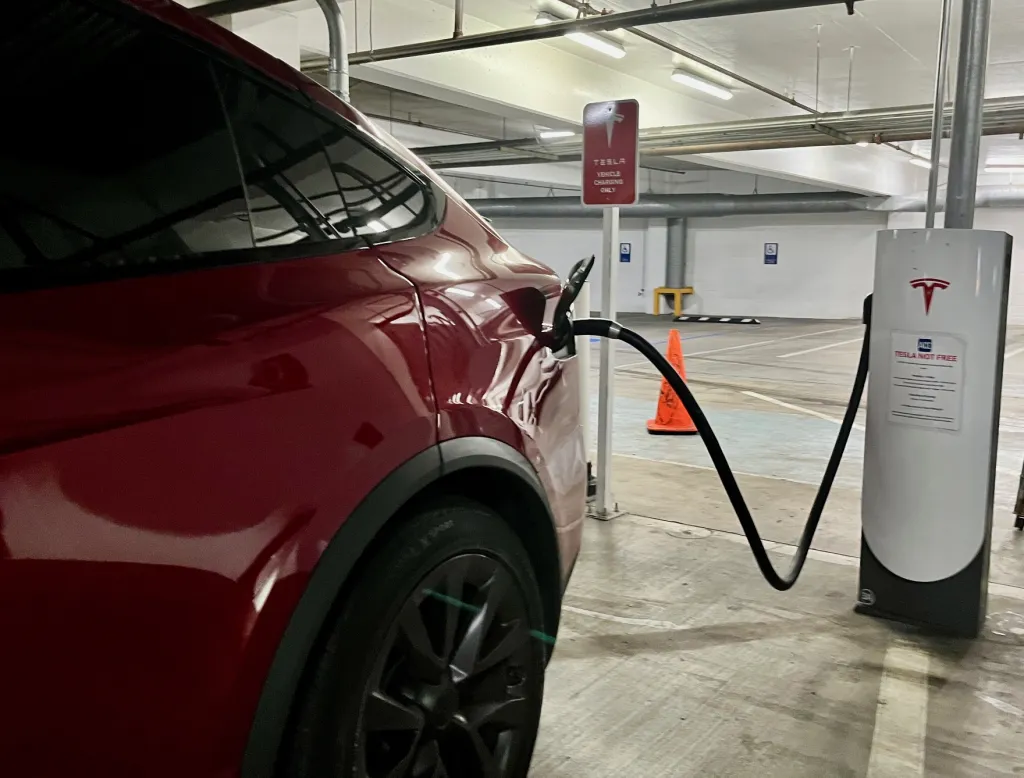
Thirteen automakers have agreed to participate in California’s new electric vehicle rebate program that will roll out later this summer, including Tesla, which manufactures the top-selling model in the Golden State.
Read more Appeals court reverses decision that freed pro-Palestinian Columbia activist Mohsen Mahdawi
Gov. Gavin Newsom last week announced the MyFirstEV program, which will offer $3,500 for first-time buyers of EVs that cost $50,000 or less. There’s also a rebate of $1,750 for first-time buyers who purchase a used electric vehicle with an MSRP of up to $25,000.
The initiative is a result of Newsom signing Senate Bill 168 into law. The legislation earmarks $135.5 million in state funding for the rebate program in fiscal year 2026-27, which can be matched on a dollar-for-dollar basis by automakers who choose to participate.
The carmakers who have agreed to join the program are: Ford, General Motors, Honda, Hyundai, Kia, Lucid, Mitsubishi, Nissan, Rivian, Subaru, Tesla, Toyota and Volvo. Their involvement effectively means the MyFirstEV program promises to deliver $270 million in total funding.
According to , the all-electric Tesla Model Y was the most popular-selling new car in California in the first quarter of this year — regardless of power train — after racking up 22,907 deliveries.
The California Air Resources Board will administer the MyFirstEV program. Officials at CARB say they will provide more details next month on how the program will work, including a launch date and how dealers will verify that customers are indeed first-time entrants in the EV market.
Officials say the rebates will be “instant” and no income limits will be applied on potential recipients.
A spokesperson for CARB told the Union-Tribune last week the dollars allocated to the MyFirstEV program will “be available until funds are exhausted.”
That would mean it would be wise for potential buyers to move quickly to take advantage of the rebates before the money for the program runs out.
“We expect strong demand,” the CARB spokesperson said in an email.
There’s also a notable provision within SB 168 that benefits Rivian and Lucid.
The legislation says “incentives under the (rebate) program shall be provided to California-headquartered zero-emission vehicle companies regardless of the vehicle manufacturer’s suggested retail price or sales price.”
That means all vehicles from Rivian and Lucid will qualify for the $3,500 rebates, even though Rivian’s least expensive model costs about $58,000 and Lucid’s cheapest offering runs around $71,000. Rivian is based in Irvine, and Lucid is headquartered in the Bay Area city of Newark.
MyFirstEV comes in the aftermath of last year’s federal budget legislation, dubbed the “One Big Beautiful Bill,” passed by Republicans on Capitol Hill and signed into law by President Donald Trump. It included provisions that eliminated the federal tax credit of up to $7,500 on the purchase or lease of a new EV and $4,000 for a used one.
In the announcement of the 13 automakers participating in MyFirstEV, Newsom said in a statement, “While Trump hands the keys to the clean car industry over to China, we are signaling to the world that California is open for business.”
The White House last week derided the California rebate initiative. Spokesperson Taylor Rogers called the governor “Newscum,” and said in an email to the Union-Tribune he “is carrying on with the Biden administration’s failed energy policies by wasting Californians’ hard-earned taxpayer dollars to subsidize electric vehicles.”
The dollars earmarked for MyFirstEV will come out of California’s general fund.
The program marks a revival of an earlier effort by the state.
For more than a decade, the Clean Vehicle Rebate Project offered thousands of dollars to buyers of EVs, plug-in hybrids and hydrogen fuel cell vehicles in California. But it was discontinued in late 2023 because of a lack of funding due to a combination of growing EV sales and a drop in gas tax revenue that threatened road repair funds.
California has more zero-emission vehicles on the road than any other state. As of May, registrations topped 2.6 million, according to the California Energy Commission. That number included 2.02 million battery-electric vehicles, almost 572,000 plug-in hybrids and 18,532 hydrogen fuel cell vehicles.
Read more Laguna Beach Unified faces new inquiries from ACLU, county education department