
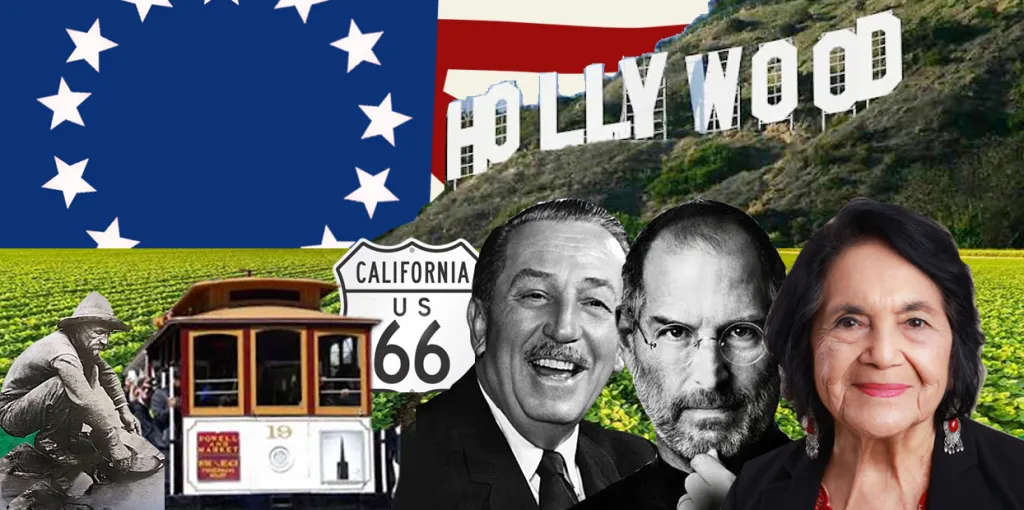
The first Californians came by sea. Later by covered wagon, by horse, by train, by plane, by automobile.
Read more What does ‘apportioned’ mean on a license plate?
Me? I came by Ford Escort with an iffy alternator, the seats crammed so tightly with my worldly possessions that the rear view out of the hatchback was only a memory.
I hit traffic on the 5 at around dusk. It was September 1989. I remember the sky was a weird shade of purple I hadn’t known existed in nature. As I tried to merge into the thick, unending snake of red taillights, I said the timeless prayer of all who drive freeways in a clunker: Lord, please don’t let my engine die.
I also had the distinct feeling that, finally, at the age of 23, I was in the right place to pursue my version of happiness, which included a boyfriend who wanted to make it in the music business and a career for me as a writer. I understood there were no guarantees. It didn’t matter. My real life was officially starting.
Eureka, to quote the state’s motto. I have found it.
“They who came to California were not the self-satisfied, happy and content people, but the adventurous, the restless, and the daring,” goes the often-quoted passage from “Where I Was From” by that iconic California scribe Joan Didion.
If you add in the nothing-left-to-lose, you pretty much have everyone I’ve ever known in California.
On this Fourth of July, as we celebrate 250 years of these United States, let us consider this home of ours, this place I honestly believe has best manifested American ingenuity, boldness and mightiness, and how it has been central to our nation’s success for the past 175 years of its statehood.
And it will be still, if we believe in it.
But before we talk about California as the American dream, we must admit that it can also be the nightmare.
It’s practically become a national sport – even among Californians – to bash our state, concentrating on what’s currently wrong with it.
“California is a disgrace to our country. It’s a shame…,” President Donald Trump once said at a campaign rally in 2019, a denunciation he still repeats often and with gusto to a chorus of agreement, not all of which comes from out-of-state. Only a third of voters now believe California is moving in the right direction, according to polling in May 2026 by the Public Policy Institute of California.
What this great shame boils down to is the thorny, pervasive problem we’re confronted with every day at the pump and the grocery store, and in paying our electric bills, our trash bills, our insurance premiums, our mortgages and our rents:
Affordability. Or the lack thereof.
California today has the highest cost of living of any state, so says a slew of data, including a report published in April by the Berkeley Economy & Society Initiative. Forget the cliché of southern poverty: California, not Louisiana or Mississippi, holds the nation’s highest poverty rate, if you factor in the cost of living.
Our affordability crisis is like the many-headed Hydra of Greek mythology, with the fearsome power to grow two more heads for every one that gets lopped off. Many say regulatory mazes and bureaucratic labyrinths make our hydra so hard to kill.
“A state with too many unaccountable boards, commissions, and special districts and too many local governments jealous of their prerogatives could learn the hard lesson that a better future will come from regional coordination…,” the cultural historian D.J. Waldie, who long served as Lakewood’s deputy city manager, noted in an essay published last year by Zócalo Public Square.
It can seem impossible to solve – so much so that, as Waldie has said, “Californians today see a future where their state isn’t exactly California anymore.”
But it doesn’t have to be that way.
When somebody has what feels like an unsolvable personal problem, any good therapist will advise that the road to a solution begins by validating that, yes, there is a problem, then reminding yourself of all you have accomplished before.
Or you can just try my mother’s approach. She used to tell me, “Buck up and remember who you are.”
This is who we are, Californians:
We invented the future. As our Gold Rush once fueled American expansion and turned the state into an economic powerhouse, our tech revolution is probably the single most consequential California innovation for American economic power and keeps transforming the world as we know it. Computers, the internet, that’s us.
California is the birthplace of Apple, Google, Cisco, Oracle, Adobe, of OpenAI, Anthropic and some 30 other of the top 50 artificial intelligence companies. We spawned Nvidia, the chip company that powers it all.
And speaking of the future, some of the greatest writers of science fiction, whose imaginations helped us conceive of both the possibilities and dangers ahead, called this place their home – writers like Pasadena’s Octavia Butler, Andy Weir from Davis, Phillip K. Dick, who lived in Santa Ana, Ray Bradbury, who spent most of his career in Los Angeles.
We are the linchpin of the aerospace industry, even now. Think Boeing, Lockheed, Northrop, Hughes, Douglas, JPL, Caltech — and while he might disavow us, remember that Elon Musk started SpaceX out of a warehouse in El Segundo. Add Edwards Air Force Base into the mix, and you have an entire ecosystem that’s foundational to U.S. military might and space exploration.
That would be enough for most states. For most countries. But there’s more.
While I was driving through the Central Valley last week on a getaway with my family – again on the 5, but in a much better car … how much my life has changed since 1989 – I couldn’t help but be reminded of what farmers we are.
We have the largest agricultural industry of any state in the union. We grow all of the almonds (pronounced “AYE-munds” in certain counties like Merced) for the nation. Dates, too. Pistachios. Walnuts. A hothouse for ag tech innovations, irrigation techniques? That’s us. And don’t forget wine. Napa is the nation’s premier wine region, producing vintages respected the world over, I don’t care what the French say.
It must be said that this agriculture was built on the backs of mostly migrant farmworkers. The fight for fair pay and safe working conditions gave rise to the United Farm Workers Union, now the nation’s longest-running farm union. “¡Sí, se puede!,” the rallying cry coined by legendary civil rights leader and labor activist Dolores Huerta, still resonates around the globe.
Read more Pechanga Studios’ new documentary series details ‘untold’ history of Native Americans in California
“Every moment is an organizing opportunity, every person a potential activist, every minute a chance to change the world,” the Stockton-raised Huerta is often quoted as saying.
And what is more Californian than starting a movement for equality? I’ve always thought Californians would have fit right in with the original American revolutionaries, the Abolitionists, and the Suffragettes. Consider the Black Panthers of Oakland, the Chicano Movement in L.A., the disability rights movement that sprang up in Berkeley in the ’70s. Without Mendez v. Westminster, the landmark case that ended school segregation for California’s Mexican American students, there would be no Brown v. Board of Education, which made racial segregation unconstitutional.
Next: What would the environmental movement and modern conservation be without us?
A pivotal but often overlooked moment in what is a long and complex story on this topic: Yellowstone was indeed the first national park, but eight years before that was the Yosemite Grant. That’s where the federal government gave the state stewardship over Yosemite Valley and the Mariposa Grove to keep it “for public use, resort, and recreation,” establishing the radical idea that spectacular landscapes should be preserved for the benefit of everyone.
And let’s not forget that it was Yorba Linda native son Richard M. Nixon who established the Environmental Protection Agency. He also saved the Mustang by signing into law the Wild and Free-Roaming Horses and Burros Act.
Another fun fact: Pacific Palisades resident Eddie Albert began speaking out against DDT pesticide in 1969 while starring on the sitcom “Green Acres.” Earth Day is observed on April 22 because it’s his birthdate. Well, that’s not a fact, exactly. I can’t find official confirmation of this, but that is what he always said. I was lucky enough to know him and his son. (Come to California, meet celebrities…)
Speaking of celebrities, long before RFK Jr., California was the original MAHA – we were Making America Healthy Again before it was a thing. Wheat grass, health food – old news to us. Venice’s Muscle Beach and Gold’s Gym were the epicenter of physical culture, and from Woodland Hills, Joe Weider ran a bodybuilding publishing and supplements empire. In the 1920s, Paramahansa Yogananda opened a center in Encinitas and wrote “Autobiography of a Yogi,” planting the seeds for yoga’s popularity that would be cultivated for generations here, launching superstar teachers like Power Yoga creator Bryan Kest in Santa Monica and Bikram Choudhury, the “hot yoga” mogul in L.A., to name only a couple.
I am not well-versed in sports that don’t involve horses, but I work in a place with journalists who are, and they assure me it would be a glaring omission if I did not point out a few things, namely that California is where some of the greatest coaches ever made their mark, including the “Wizard of Westwood” (UCLA’s John Wooden) and the “Genius” (Bill Walsh of the 49ers); that we had more than 120 athletes who competed in the 2024 Summer Olympics, and Californians regularly make up a contingent larger than most countries; that the state produces world-class athletes in everything you’d expect from a place with great beaches (swimming, volleyball) to things such as snowboarding, where Southern California’s Chloe Kim has been one of the ultimate innovators; and oh, Shohei Ohtani, Californian-by-way-of Japan, continues to redefine baseball greatness, first with the Angels and now with the Dodgers.
And then there are the sports that have transcended athletics and have become part of the California legend: Surf culture. Skate culture. Cue: Huntington Beach. Laguna. Malibu. Billion-dollar global industries, also now Olympic sports. You know this story. You’re a Southern Californian – you’ve likely lived some part of this story.
Speaking of stories, it is much too much to even begin to unravel the reach of Hollywood, and of Disney. But one thing I will say: The key to American “soft power” has been our ability to capture the world’s imagination.
I’ll tell you how I came to understand how profound was this “soft power,” all engineered in California.
In high school, I was a Rotary exchange student to Australia. During summer break (which was our winter), all of us foreign students were sent on a month-long bus tour from Sydney to Melbourne, up to Alice Springs, and then down the coast of Queensland to New South Wales.
If you can envision that continent, you can tell we experienced many stretches of remote, wild country. And at one point, we spent the night at a huge sheep station located in what I think was officially the middle of nowhere.
It was someone’s bright idea to put on a show for the workers and the owners of the station, as a form of thank you. The idea was that each country would sing its national anthem as a means of cultural exchange.
The Swedes knocked out what I can only describe as an opera. The French students proudly trilled “La Marseillaise.” The Germans sounded like they were mad at somebody, and the couple of kids from Toronto rendered an earnest “O Canada.”
Then it was our turn, the “Yanks” as they called us. Problem was, not one of us could carry a tune, let alone the notes required for “O’er the land of the free.”
In desperation, one of us warbled, “Here’s the story,” and the rest of us immediately joined in with, “of a lovely lady…”
Then, I swear to you, the entire room, from the Australians of the Outback to all the Europeans and the two Canadians, burst joyfully into the theme song for “The Brady Bunch.” Every. Single. One.
What had been created on a Paramount sound stage with a North Hollywood exterior worked as cultural currency, uniting everyone on that distant sheep station, half a world away.
You can argue that the world has changed. You can point out that the United States itself is much different from what it was even since the bicentennial celebration 50 years ago. You can point to how the conditions that once made “California Dreamin’” have now made “Hotel California,” the prison where you can check out any time you like, but can never leave.
I say that we the people of the Golden State have repeatedly created great things, pulled off amazing feats, found solutions that have perplexed others, and we retain the capacity to do so again, and again, and again.
My husband has a friend, the author Brad Taylor, who is also a retired lieutenant colonel and former Delta Force. Brad says that despite the prevailing wisdom in financial circles that past performance doesn’t equal future success, on the ground, when the going is tough and dangerous and scary, the best indicator of future performance is indeed past performance.
I’m betting the guy who has been in a real war is right.
“The future always looks good in the golden land because no one remembers the past.” Didion again. Another famous quote of hers. But this time I think she got it wrong. Our future looks good because of, and perhaps only if, we remember our past.
Read more Dodgers erase early 6-run deficit, roar past Padres in series opener
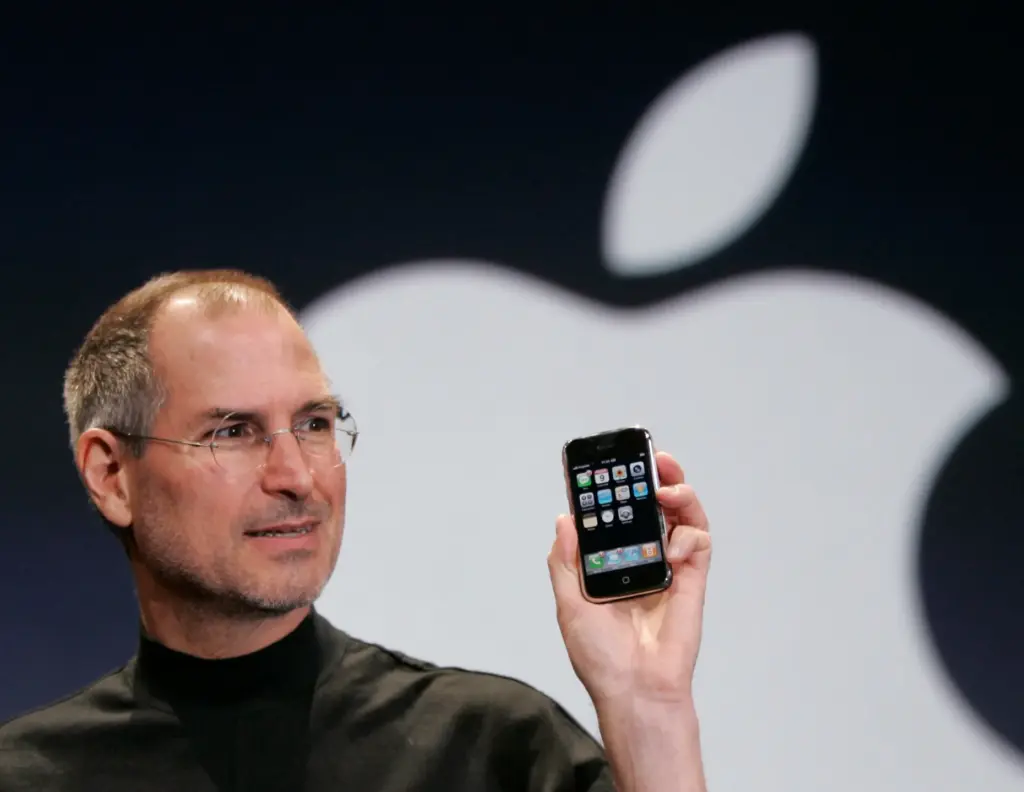 FILE – Apple CEO Steve Jobs holds up an Apple iPhone at the MacWorld Conference in San Francisco on Jan. 9, 2007. The iPhone introduced the convenience of touchscreens at the time that a physical keyboard was still all the rage on the top-selling smartphone – the BlackBerry – when Jobs first took out what was all-in-one computer, camera and music player out of his pocket in 2007. (AP Photo/Paul Sakuma, File)
 Dolores Huerta, 89, speaks to those gathered during the first Dolores Huerta Day at the Dolores Huerta International Academy in Fontana Monday, April 15, 2019. Huerta was a leader and civil rights activist, and along with Cesar Chavez, is a co-founder of the United Farm Workers. Huerta has also been awarded the Presidential Medal of Freedom, the highest award that can be given to a citizen. (Photo by Will Lester, Inland Valley Daily Bulletin/SCNG)
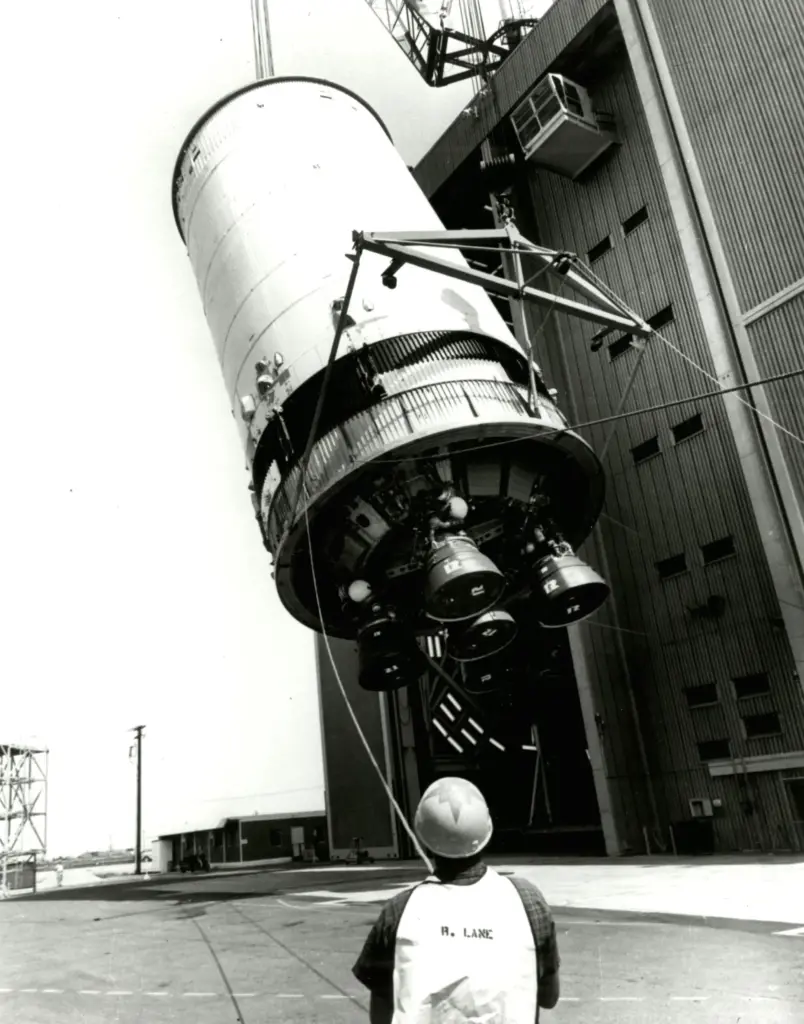 A S-II booster is lifted up at Boeing’s Seal Beach location. The booster was part of the rocket that carried the first men to the moon. (Courtesy of Boeing)
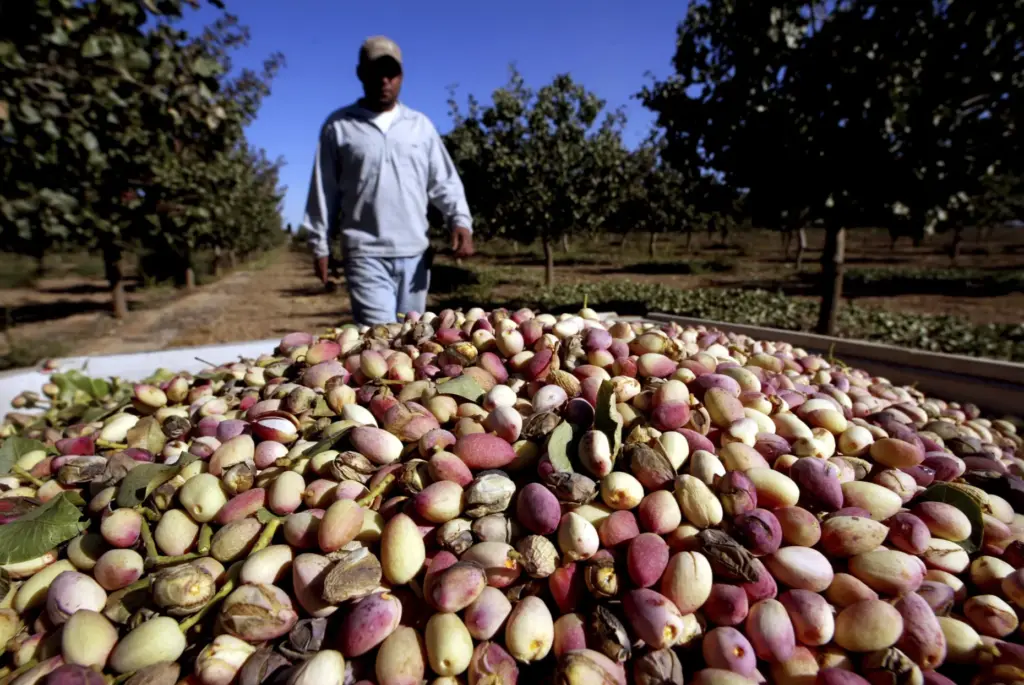 California is the pistachio capital of the United States, producing nearly 99% of the nation’s crop.(Photo by John Walker/Fresno Bee/Tribune News Service via Getty Images)