
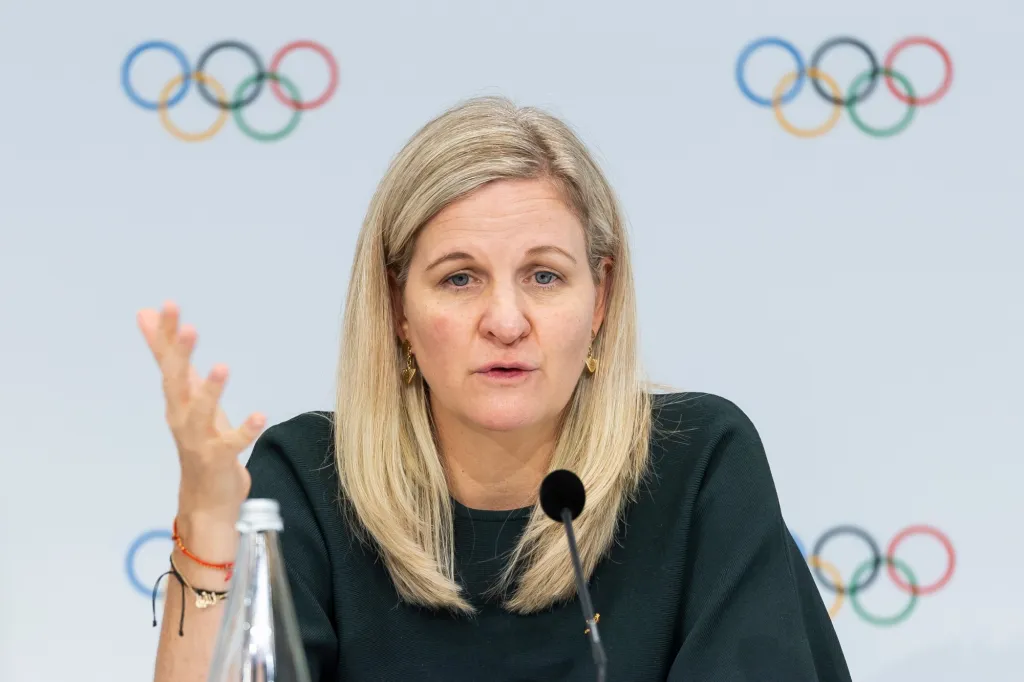
The International Olympic Committee on Tuesday provisionally lifted the suspension of the Russian Olympic Committee, clearing the way for Russian athletes to compete in the 2028 Olympic Games in Los Angeles.
Read more Rivian’s stock plunges on planned share sale
The ROC has been suspended by the IOC since October 12, 2023, nearly 20 months after Russia invaded neighboring Ukraine in February, a ban that prevented Russia athlets competing in the 2024 Summer Games in Paris and the 2026 Milano-Cortina Winter Olympics, although some Russian athletes were able to compete as “neutral” athletes.
The IOC lifted a similar ban on Belarus athletes in May.
“We made it clear that we wanted to ensure all athletes have the possibility to compete at the Olympic Games and not be held responsible for their government’s actions, and I believe that this is what this decision speaks to,” IOC president Kirsty Coventry said. “It allows for Russian athletes to take part in sport competitions, but we’ve also been very clear that we do not condone any violence and war around the world, and we will continue with that stance.”
But Russian athletes in some sports, most notably track and field, will still likely be prevented from competing because of international sports federations’ policies regarding the participation of Russian and Belarusian athletes. IOC officials on Tuesday acknowledged a “quite fractured landscape” of international sports federations’ policies on the participation of Russian and Belarusian athletes.
“No, we don’t foresee there being any patchwork,” Coventry said, “and again, I come back to we needed to take a decision based off of what the strategic framework put in place, and the strengthening of our neutrality, and part of that is also ensuring that the international federations remain autonomous, and that they are allowed and free to make their own decisions, so that will continue as is.”
Russian sports minister Mikhail Degtyarev characterized the IOC decision as “a green light for international federations to reinstate all our athletes.”
But that, at least for now, doesn’t seem likely in some of the Games’ flagship sports. The IOC’s decision to lift the Russia suspension comes just days after World Athletics, the global governing body for the Summer Games’ marquee sport, track and field, upheld its ban on Russian and Belarusian athletes in international events.
“We presented options for the Council to consider on this matter, however, the original decision remains on the sanctions that protect the integrity and fairness of our competitions, with no tangible movement towards peace negotiations having materialised,” said World Athletics president Sebastian Coe, an IOC member and two-time Olympic 1,500-meter champion.
But according to IOC sports director Pierre Ducrey, there are a number of issues to address in the wake of the IOC decision and a short period of time to resolve those issues.
“It’s a quite fractured landscape right now of federations with a lot of different situations when it comes to juniors, seniors, and we need now to work with all these federations, team sport, individual sport to try and come up with the best path forward for the athlete, and to normalize the situation,” Ducrey said. “We are already underway for the qualification for LA28, so for us it’s quite important that we try and make sure we can protect the integrity of this process for all the athletes that participate.”
The IOC’s ban on Russia organizing or hosting events or Russian government or state officials attending IOC events remains in place. The IOC also stressed that Russian athletes must meet certain anti-doping requirements prior to returning to international competition.
Read more Manhattan high-rise is still unstable after columns buckle, forcing evacuations
IOC officials said decisions on whether the Russian flag can be displayed and the national anthem will be played at the Los Angeles Olympics will be made at a later date.
The IOC said that the ROC must ensure that Russian athletes’ “selection [for the Olympic Games] shall be based not only on their sports performance, but also on their ability to serve as role models who respect, uphold and promote a peaceful society through sport as set forth in the Olympic Charter.”
The IOC banned Russia in October 2023, 20 months after the invasion, for violating the Olympic Charter by taking over sports councils in four regions in eastern Ukraine.
Ukraine’s prime minister, Volodymyr Zelenskyy, urged Coventry to take a strong stand against Russia in a September telephone conversation.
“Every sporting event that Russia manages to access, it always tries to twist for the benefit of its state propaganda: propaganda of hatred and war,” Zelenskyy said after the call. “Since the start of the full-scale war, more than 600 Ukrainian athletes and coaches have been killed as a result of Russian strikes, and hundreds of sports facilities have been destroyed,” Zelenskyy reminded the IOC president.
The IOC banned Russia in December 2017 from competing at the 2018 Games after an IOC investigation confirmed a “widespread culture of doping in Russia” in which national sports officials provided performance-enhancing drugs to Russian athletes in dozens of sports and covered up positive tests, most notably at the Sochi Games.
“This was an unprecedented attack on the integrity of the Olympic Games and sport,” IOC president Thomas Bach said at the time. “The IOC (executive board), after following due process, has issued proportional sanctions for this systemic manipulation while protecting the clean athletes. This should draw a line under this damaging episode and serve as a catalyst for a more effective anti-doping system led by WADA.”
But the IOC still offered individual athletes the opportunity to compete in the 2018 Winter Games in PyeongChang, South Korea, as “Olympic Athletes from Russia” under a neutral Olympic flag if they could prove they were not part of the doping scheme. Only 168 Russian athletes passed the vetting process.WADA banned Russia from all international sports for four years on December 9, 2019, after the organization found that data provided by the Russian Anti-Doping Agency (RADA) had been manipulated by Russian officials in an effort to protect athletes involved in the state-sponsored doping program. But in a ruling in December 2020 on a Russian appeal of the WADA ban, the Court of Arbitration for Sport ruled that Russian athletes should be allowed to compete in the Olympic Games and other international competitions. Under terms of the CAS ruling, Russian athletes for two years would compete in the Olympics as “Neutral” athletes or teams.
More than 200 Russian and Belarusian athletes competed in the 2022 Winter Olympics in Beijing.
Only 20 Russian or Belarusian athletes competed in the Milano Cortina as a result of the IOC’s ban against Russia and Belarus in response to the Putin regime’s February 2022 invasion of neighboring Ukraine and the launch of Europe’s deadliest war since World War II.
Read more Drivers shun premium gas in favor of regular as prices bite