
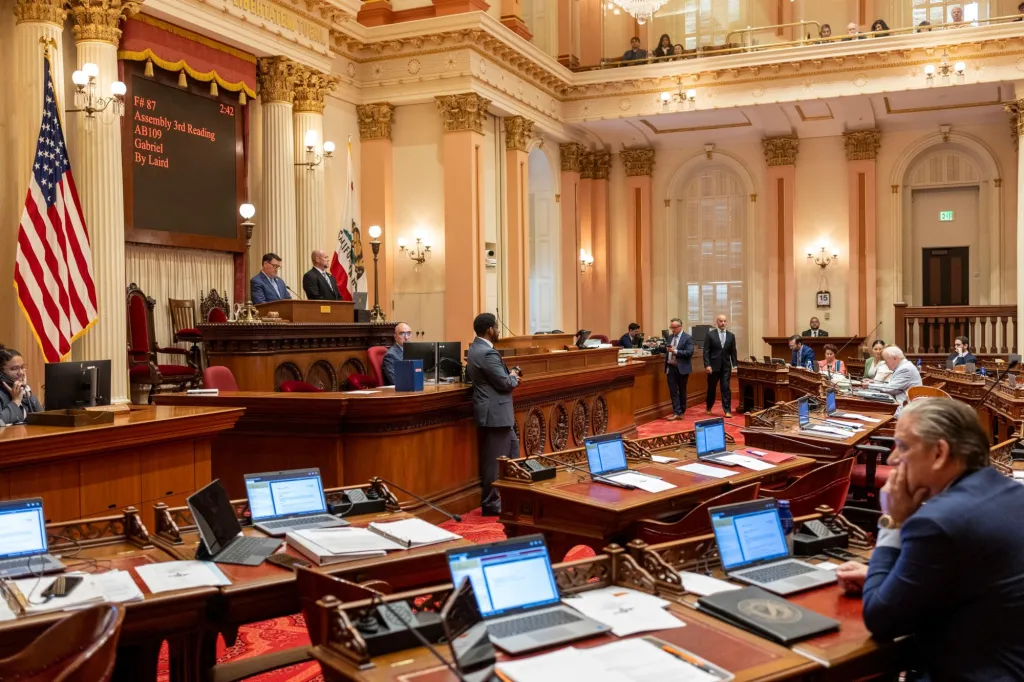
California lawmakers secured billions of dollars for public schools, community colleges, special education students and more in the 2026-2027 state budget.
Read more Dark threats from state Attorney General imperil O.C. cities’ sober laws
In all, the budget included $128 billion of the $350 billion budget package for a myriad of education priorities statewide.
Programs supporting newcomer students, English language learners and those seeking financial aid for postsecondary education all got boosts in the state budget.
But there are some controversial elements to just how much funding schools get that angered education leaders, teachers’ unions and even candidates running for office this year.
Here’s a closer look at what the budget means for California’s education system.
What the budget means for how the education department is structured
Starting in January, the California Department of Education will no longer be under the state superintendent’s management. And the state education board will expand from 11 to 13 members, giving the governor’s office and the legislature more control over it.
Executive and administrative functions of the department, powers that have been vested in the superintendent of public instruction, will be shifted to an “education commissioner” appointed by the governor, while the Senate and the Assembly will each pick a new member to the education board’s two new seats.
Gov. Gavin Newsom, who backed the change, said the state “can no longer postpone reforms that have been recommended regularly for a century.”
The nonpartisan research center Policy Analysis for California Education said in a December report that the reforms would create “clearer roles, stronger alignment and coherent leadership” in schools.
California Teachers Association president David Goldberg, however, said the move could risk subjecting students and educators to the “political whims” of the governor’s office in the future.
This means that the next superintendent — voters will decide between Richard Barrera and Sonja Shaw — will now hold an office largely rooted in advocacy, being a “nonpartisan voice for the public interest,” according to the bill.
Both Barerra and Shaw have been critical of the change.
In a statement, Barerra, a senior policy advisor in the Department of Education, called the change a “rushed, behind-closed-doors” process. And Shaw, president of the Chino Valley Unified School District, said the power shift was a “direct assault on California’s constitution and the will of the voters,” during a recent Fox News interview.
What the budget means for how schools are funded
The final budget included a plan to withhold about $3.9 billion in funding for schools, angering some education leaders.
The move was billed as a precaution in case revenues come in lower than projected. The funds will be held back from schools until early next year, when California’s new governor can reassess the financial landscape with a clearer picture of revenues.
The ballot measure approved by voters in 1988 established an annual minimum funding guarantee for public K-12 schools and community colleges. Each year’s Proposition 98 funding is calculated on a percentage of general fund revenues, usually about 40%, or the prior year’s funding adjusted for attendance and inflation.
Over $125 billion went toward Proposition 98 last fiscal year, and about $128 billion made it into the budget this year. The budget reserves $9.8 billion for a rainy day fund.
Goldberg said lawmakers should have stood up for students instead of ignoring the constitutional requirement.
“State leadership must prioritize efforts to increase revenue, especially when California boasts the fourth-largest economy in the world, yet educators are forced to regularly fight back against layoffs and cuts to their health benefits. This creates classroom instability and hurts students,” he said in a press release.
Also in the budget: A change to how preschool programs are funded. In years past, privately operated preschool programs were supported through general fund revenues. But now, the costs will shift to be covered by the money allocated under the Proposition 98 umbrella.
What the budget means for paid leave and afterschool programs
Broadly, California schools will receive a 4.31% cost-of-living adjustment, above the 2.87% that is constitutionally required through the Local Control Funding Formula, the state’s primary method for allocating funding to public school districts. That allows employees of community colleges and K-12 schools to take up to 14 weeks of paid pregnancy disability leave starting this upcoming school year.
And public schools will get even more discretionary funding through $5 billion earmarked for the Professional Development Discretionary Block Grant, more than $2 billion more than what was allocated last year.
Read more ‘Ferytale’ continues at Wimbledon as Arthur Fery reaches semifinals
After-school and summer programs for K-6 students will see a $64 million boost through the state’s Expanded Learning Opportunities Program. E-LOP programs in Orange County are run by Orange Unified’s Centers for Afterschool, Recreation, Enrichment & Safety, the YMCA and the Boys & Girls Club, to name a few.
What the budget means for newcomer students, English language teachers
The budget earmarks $100 million for a program that supports students and families who are new to the U.S.
The California New Americans in Schools program will fund English language development, instructional programs and courses for newcomer students and their families through grants awarded to school districts.
This program essentially replaces the work the California Newcomer Education and Well-Being program has handled since it began in 2017.
Lawmakers had pushed for the budget to include $350 million but got $100 million for the new program, which will be administered by the California Department of Education.
The old program had received $6.9 million annually to divvy up amongst school districts in years past and was administered statewide by 20 school districts, including Santa Ana Unified and Garden Grove Unified, as well as the Los Angeles County Office of Education.
$10 million was also earmarked for a grant program that will encourage high school students to become certified in teaching English.
Those grants, up to $600,000 and awarded on a competitive basis, will be doled out through what a budget trailer bill calls the Pathways to Bilingual Teaching Program. It will allow schools to help their students obtain the qualifications to begin teaching English learners by partnering with colleges and universities.
The grant program aligns with the education department’s , which launched in 2018 and aims to have half of all K-12 students proficient in two or more languages by the end of the decade.
What the budget means for student loan borrowers
A program providing free financial education and case management to help people navigate their student loans has sunset after two years.
The Student Loan Empowerment Network began in the 2024-2025 fiscal year and helped more than 3,000 borrowers over two years, according to the state’s finance department. The program was allocated $10 million in the 2024-2025 fiscal year.
Other higher education programs and initiatives, however, did get more support through this year’s budget.
The Middle Class Scholarship program, which offers students up to $250,000 in scholarships to attend state universities and community colleges, is receiving nearly $167 million in additional funding.
California community colleges are receiving a $63.8 million boost to grow enrollment by 2.5%, while $70 million will support Dream Resource Centers in colleges and universities, a financial aid program for undocumented students in the state.
What the budget means for special education
Special education systems statewide are receiving a $2.4 billion bump in funding this fiscal year, a 43% increase compared to last fiscal year and the largest investment in special education in California’s history, according to Newsom’s office.
Meanwhile, the legislature is also considering a bill that would create California’s first special education network “to ensure families have access to training and tools to advocate for students with disabilities.”
From Assemblymember Stephanie Nguyen, D-Elk Grove, the bill would send $2.4 million over three years to the State Council on Development Disabilities to create the network
“This is an important step in supporting parents as they learn to navigate the special education system. This critical funding ensures that parents come together in a coordinated manner to uphold the rights promised to students with disabilities,” Nguyen said.
There are more than 800,000 disabled students statewide, according to Nguyen’s office.
Read more Global markets are mixed and oil prices rise as Iran and US launch new attacks