
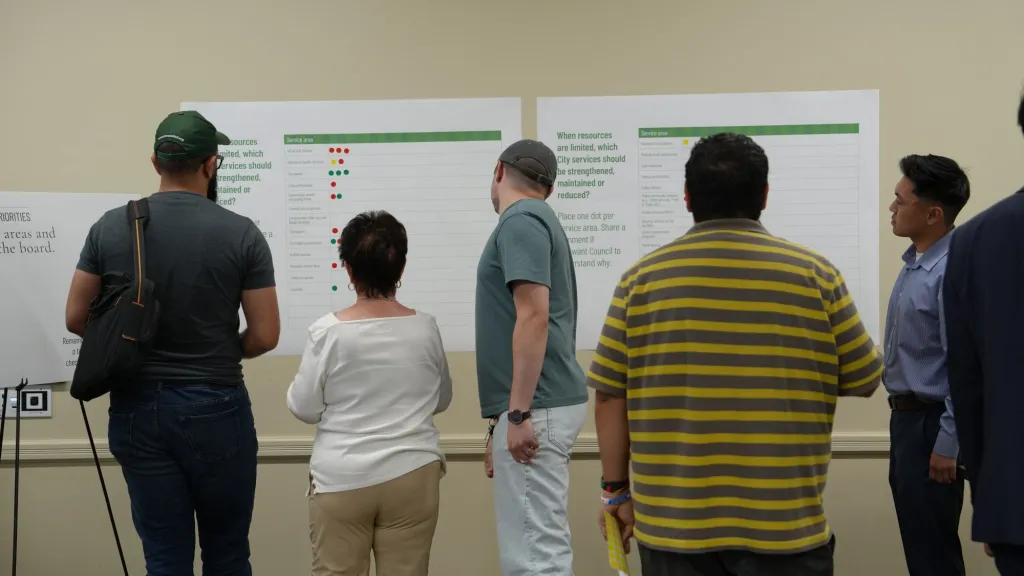
Fullerton leadership gathered public input last week as the City Council faces budget decisions on a potential $3.6 million deficit — councilmembers are having their study session on the budget Tuesday, July 14.
Read more Santa Ana’s Newhope Library reopens following year-long renovation
The 2026–27 fiscal year began July 1, but the council has yet to discuss the new fiscal year’s budget — a delay prompted by an independent financial audit that City Manager Eddie Manfro told the council he wanted to wait on before proceeding. Auditors reported to councilmembers in mid-June that their review of the city’s budgeting process revealed no signs of fraud or intentional misconduct, and the city promptly scheduled the community input sessions and meetings for the council to consider and approve the fiscal year budget.
Two community meetings last week included a presentation by city officials proposing three different budget scenarios: the first would rely on reserves to maintain baseline services, resulting in a roughly $3.6 million deficit. The second option would balance the budget through service cuts and deferrals, and reduce staffing and service levels across multiple departments, while the third centers on structural reductions aimed at maintaining a balanced budget longer term.
“Imagine your household expenses gradually increase each year while your paycheck stays the same. That’s similar to the challenge facing Fullerton’s budget,” one slide told the community members in attendance.
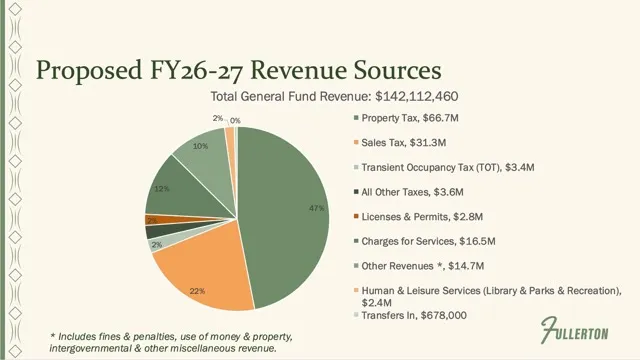 A slide from Fullerton’s proposed FY 2026–27 General Fund budget presentation shows projected city revenues broken down by category. (City of Fullerton)
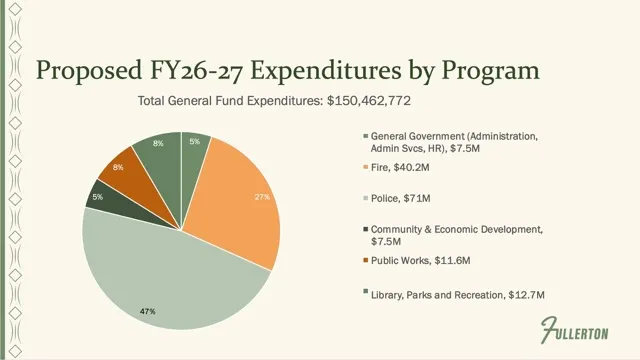 A slide from Fullerton’s proposed FY 2026–27 General Fund budget presentation shows projected city expenditures broken down by program. (City of Fullerton)
The city is projecting general fund revenue this fiscal year at $142 million, generated in part by $66.7 million in property taxes, $31.3 million in sales taxes, and $3.4 million in transient occupancy taxes.
Of the $150.4 million in forecasted expenditures, police and fire would account for approximately 74% of general fund spending — with $71 million allocated to the Fullerton Police Department and $40.2 million to the Fullerton Fire Department. Another $7.5 million would go toward city administration and services, including Human Resources, with an equal amount directed toward Community and Economic Development. Another $12.7 million would be earmarked for library services and parks and recreation and public works would receive $11.6 million in funding.
Elijah Manassero, a 26-year-old Fullerton resident and regular at council meetings who attended the community discussion, said he found the presentation on the proposed budget an improvement over last year’s presentation, which he said was “a little bit confusing,” and he believed other residents shared a similar sentiment. He said the city also had a different city manager and finance department head at the time.
“This year, I think because of this big budget error that came up, they have been trying to be more actively engaging with the community,” he said following the community meeting. “They’re trying to really just be transparent and really engage with residents throughout this process to try and rebuild trust.”
Read more No relief from the heat as many US cities will see record overnight temperatures
Those who were unable to attend had the option to answer a digital survey addressing potential new revenue for the city, with options ranging from legalizing cannabis and selling city-owned properties to privatizing water utilities or creating a local sales tax to exclusively fund street infrastructure or public safety.
The survey also asked participants to rank which services should be strengthened, maintained, or reduced, and which ones they would be open to replacing with alternatives. Those services included events such as Coffee with a Cop, library programs, park maintenance, and the behavioral health clinicians that work with the Police Department.
Manassero said the city should invest in an economic development plan, pointing to “good assets” such as Cal State Fullerton, the Fullerton Train Station, and Fullerton College that should be a draw.
“I don’t think we really have a plan for how to develop the economy around them,” he said. “That’s a big reason why we’re in this situation.”
As for potential revenue sources, he said legalizing cannabis “makes a lot of sense,” especially given the city’s poor financial situation. While it won’t close the budget gap on its own, he said previous projections showed those funds could bring in a couple million dollars a year.
“It’s already legal in Fullerton to have it delivered to you,” Manassero said, “so it doesn’t make sense to me why we’re keeping shops from opening here, especially when we need the revenue.”
The 2026–27 budget is set to be adopted by the City Council in a public hearing scheduled for July 21. Residents and those interested in learning more or contributing to conversations around the budget can attend the upcoming council meeting’s budget study session at 5:30 p.m. on Tuesday.
Read more EU rallies $1 billion in pledges for Gaza’s recovery