
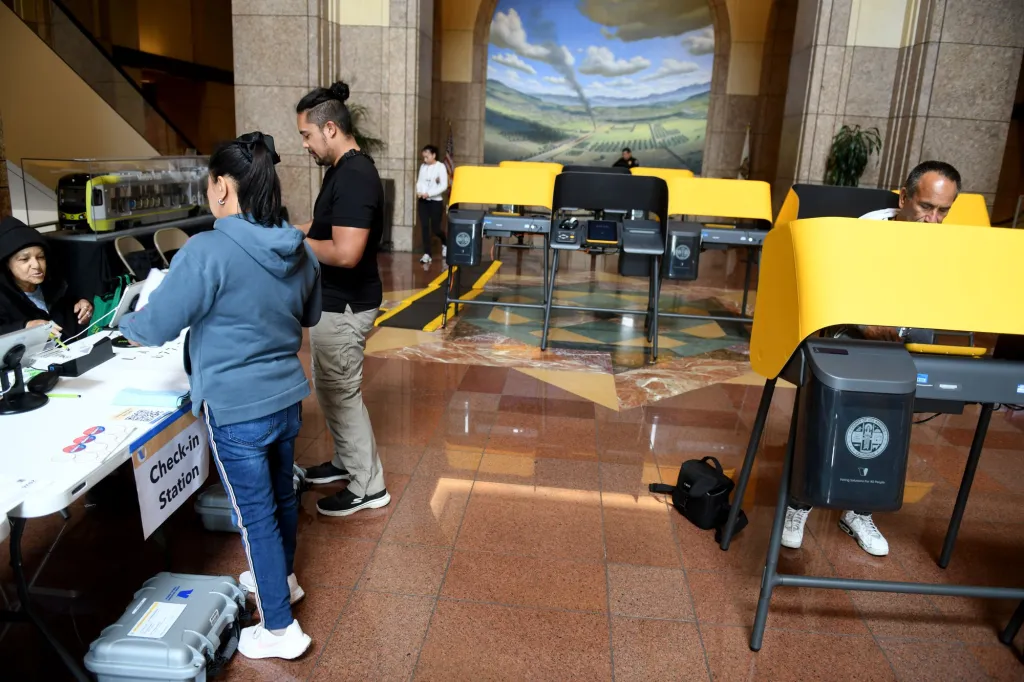
Primary elections, particularly during non-presidential years, don’t generally drive oodles of folks to vote.
Read more Election 2026: Orange County voters now have more options to cast their ballots in person
This year is no exception. And even with a competitive race for governor, California is seeing lower turnout than would generally be expected heading into the week of June 2 Election Day.
That’s in part because of the Republicans’ tendency to vote in person, on Election Day, particularly in the Trump era of GOP politics. Other voters may also be holding onto their ballots, deciding to put them in a drop box or cast them at a vote center because of uncertainty about when the U.S. Postal Service would postmark them.
There’s yet another factor driving down this year’s early turnout — a tactical move on the part of some Democrats, said Louis DeSipio, an expert in electoral politics who teaches at UC Irvine.
Among Democrats, the 2026 race for governor has been fluid. And, overall, the race has lacked a clear frontrunner; recent polling shows former Biden Cabinet official Xavier Becerra, a Democrat, with a slight lead, and two other candidates, Republican Steve Hilton and billionaire Democrat environmentalist Tom Steyer, battling it out for the No. 2 spot. But earlier, there was widespread belief that the two Republican candidates might lock the entire crowded field of Democrats out of the runoff in the fall.
Couple that with the downfall of Eric Swalwell’s campaign — he was viewed as a strong candidate until April, when he was accused of sexual assault (allegations he denies), dropped out of the race and resigned from Congress — and Democrats may be waiting to see which candidate has the best chance to be in the race come Election Day.
“That said, I think other voters may have sort of just slowed their decision to vote generally because they were underwhelmed with the field,” DeSipio said. “Certainly some people have had some interesting ideas, but there wasn’t a clear frontrunner who was an easy person to get behind.”
Diving into the data
Out of the more than 23.3 million 2026 primary ballots sent to California’s registered voters, only 3 million had been cast as of Friday afternoon, an early turnout rate of nearly 13%, according to the latest available .
Locally, the early turnout numbers were mixed: about 9% (530,000) in Los Angeles County; about 16% (307,000) in Orange County; about 15% (217,000) in Riverside County, and about 11.5% (138,000) in San Bernardino County.
“Statewide, in a primary, turnout is going to be really important,” said Christian Grose, an expert on electoral behavior who teaches at USC. “And what’s interesting to me about this one is turnout is relatively low so far, based on the votes that have already been tabulated.”
And aside from the political reasons why voters may be clutching their ballots longer, Grose pointed to the sheer length of the ballots in this primary. Orange County printed its longest ballot ever, at 17 inches. The county’s Registrar of Voters, Bob Page, said it was needed in order to get all 61 gubernatorial candidates on one page.
But it’s not just the number of people running for that job. There are open seats for a slate of other statewide executive offices, including lieutenant governor, insurance commissioner and state superintendent of public instruction, to name a few, and the lack of incumbents has driven up the number of candidates.
“There’s a ton of down ballot elections that people just don’t know who the candidates are,” Grose said.
“And then the congressional districts, too, having been redrawn, some voters probably have new people they’re thinking about.”
Grose added that, in some elections, when people don’t have what they view as enough information, “they don’t end up showing up.”
A jungle’s future
Aside from choosing candidates, this primary might be paving the way for voters to decide if California’s way of, well, voting, should stay.
Read more Temecula’s ‘smart freeway’ project launches to attack 15 Freeway traffic
This month, a bipartisan pair of political strategists launched an effort to reform California’s “jungle primary” system, in which the top two vote-getters in the primary advance to the November general election, regardless of party affiliation. The move came in the wake of Democrats’ concerns that the system might shut out their side — which has had as many as eight seemingly well-financed candidates versus the GOP’s big two, Hilton and Riverside County Sheriff Chad Bianco — in November.
California’s way of determining which two candidates move from a primary to a general election — the result of Proposition 14 in 2010 — is uncommon. Voters approved the jungle primary, which was pushed by then-Gov. Arnold Schwarzenegger, after it was billed as a way to give moderate candidates in each party a greater chance of advancing.
But backers of the new initiative say the jungle primary concept has not panned out as intended, and instead often creates political situations they describe as “unfair.”
“Over the years, I’ve seen the consequences of it (the top-two primary system), legislative districts with two Democrats running in a district that’s overwhelmingly Republican, and vice versa,” said veteran Sacramento-based Democratic strategist Steven Maviglio.
Grose, at USC, doesn’t expect the effort to succeed, particularly if a Republican and a Democrat advance out of the gubernatorial primary. In that case, he suggested, the issue of fairness “won’t have the same resonance.”
“And even if it’s a Democrat and a Democrat,” he added. “It would lead to Republicans not liking the system, but I’m not sure how Democratic voters might respond. Voters might like two Democrats on the ballot.”
Focusing on the issues
The lack of a frontrunner for governor has led to at least one net positive for voters, experts say: A lot of ideas.
A seeming marathon of debates among the leading contenders for governor was held right around the time that ballots were hitting mailboxes. Candidates talked about a wide range of political issues in California — ranging from affordability and homelessness to immigration, taxes and more.
“That’s a good thing,” DeSipio said.
“Some of the debates sort of descended into personal attacks. But at the beginning, there was some effort to talk about things that were actually bothering people in the state.”
Still, DeSipio isn’t optimistic that the trend will continue in the fall should a Republican and Democrat advance.
“They’ll go back to the traditional Democrat versus Republican kind of conversation,” he predicted.
“But that’s too bad because the debates did expose you to different ideas.”
A look at history
In the 2022 primary — another non-presidential election year — .
Fast forward to March 2024, a presidential election year, and the primary turnout only increased slightly, to just under 35%.
But in June 2016, amid a tense battle for the Democratic presidential nomination between Hillary Clinton and Bernie Sanders, 47.7% of California’s registered voters participated in the primary election.
The highest participation among registered voters came in the June 1976 presidential primary, when 72.6% of registered voters in the state cast a ballot.
That was, of course, an election where California primary voters chose two of their governors to lead the top of the ticket: Ronald Reagan on the Republican side, and Jerry Brown for the Democrats. Neither wound up winning their party’s nomination that year. Republicans eventually went with incumbent President Gerald Ford, and Democrats chose Jimmy Carter, who would win.
Read more Tough advice for property owners is key to being a successful adviser