
A surge of fear and anxiety over mold in the early 2000s, and the insurance claims and costly litigation that followed, sent home insurers into a panic, leading most to drop or severely limit mold coverage.
Read more Lawsuit alleges 136 were sexually abused in San Bernardino County juvenile detention
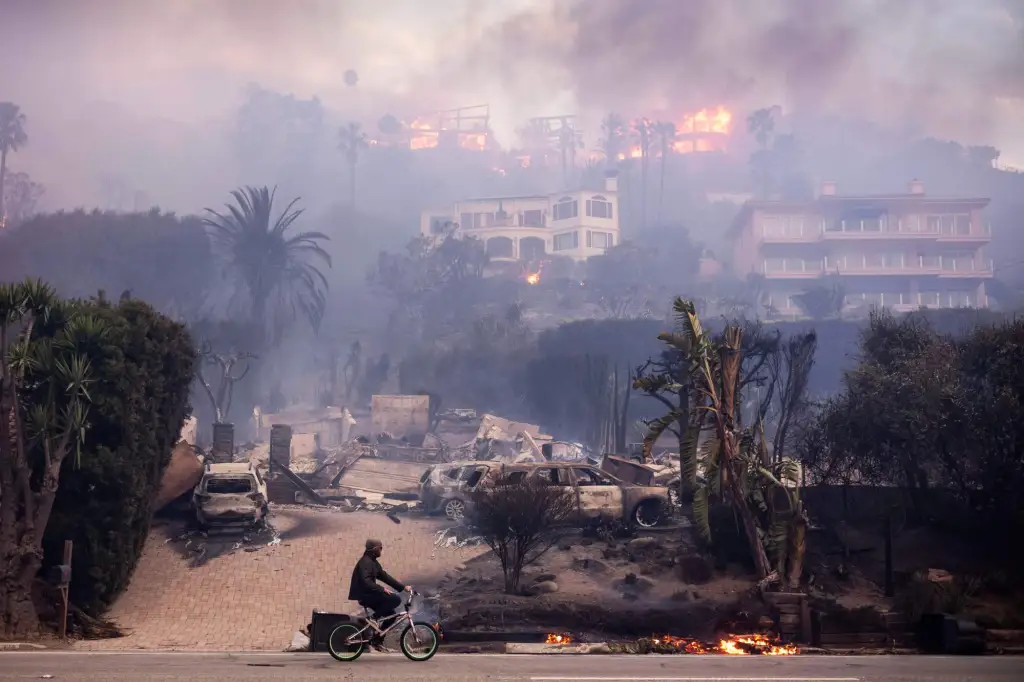
Now, smoke damage is creating a similar stampede in California in the aftermath of the devastating 2025 wildfires in Los Angeles County.
The outcome, however, is far less certain, and will involve much more of a fight.
Insurance providers and policyholders are waging war in the Legislature and in courtrooms to settle fierce disputes over how smoke damage should be covered. The outcome could have ramifications nationwide and open the door to billions in additional claims or slam it shut for homeowners who argue the toxic chemicals left behind by smoke can be as devastating as damage caused by flames.
“The insurers are quaking in their boots here and, to be honest, I don’t blame them,” said Amy Bach, executive director of United Policyholders, a nonprofit consumer advocate for the insured. “That doesn’t mean it is not their responsibility.”
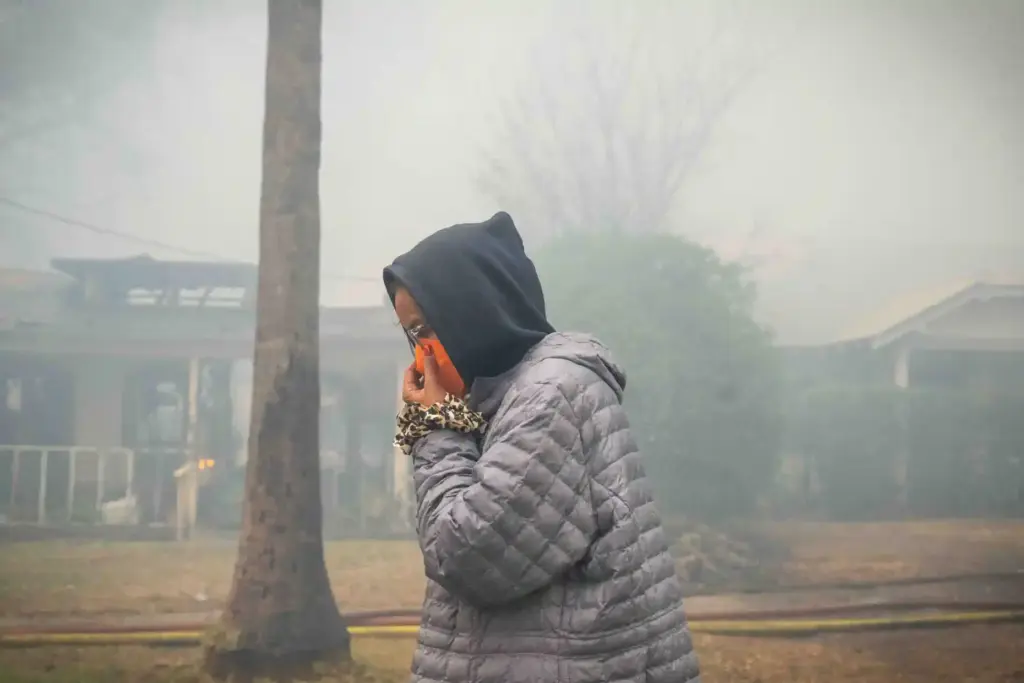 Dana Albright leaves Walworth Avenue in Pasadena on Wednesday, January 8, 2025 after checking on her mother’s home which was still standing during the wind-driven Eaton fire. (Photo by Sarah Reingewirtz, Los Angeles Daily News/SCNG)
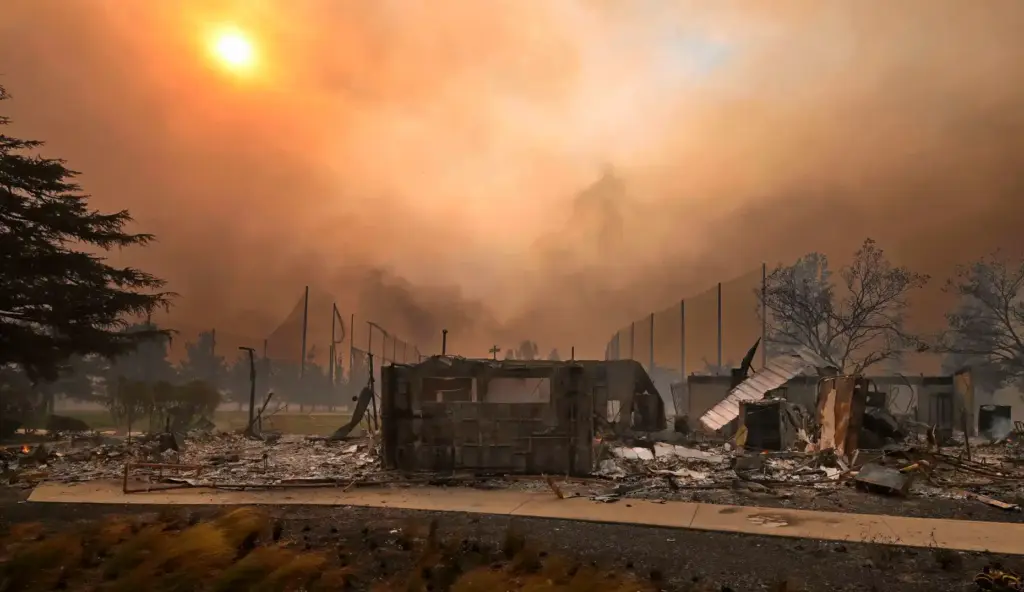 Smoke shrouds the sun as it rises above the Altadena Town and Country Club which was destroyed by the Eaton fire in Altadena Wednesday morning Jan. 8, 2025. (Photo by Will Lester, Inland Valley Daily Bulletin/SCNG)
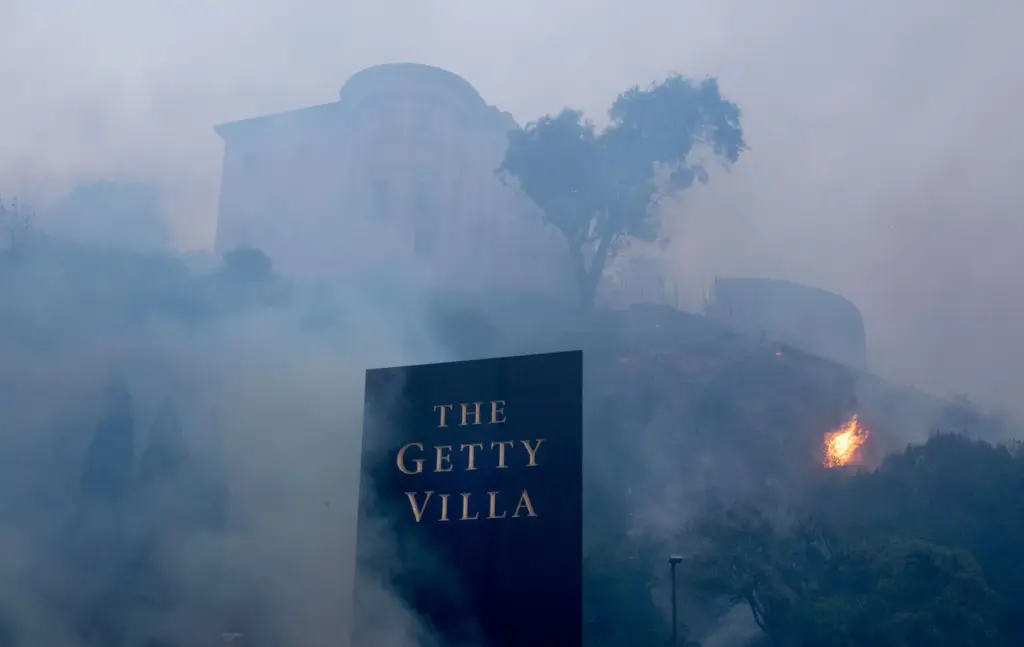 Smoke and flames surround the Villa de Leon along Pacific Coast Highway in the Palisades Fire on Tuesday, January 7, 2025 The mansion offers views of the Pacific Coast Highway and the Pacific Ocean, located near the Getty Villa. (Photo by David Crane, Los Angeles Daily News/SCNG)
Nearly $24 billion in claims related to the Palisades and Eaton fires already have been paid out as of March 2026. More than 13,000 smoke-damage claims have been filed, though many of those have yet to be resolved as homeowners and insurers brawl over what is and isn’t covered.
Hundreds of homeowners have filed formal complaints with the state alleging insurance companies are stalling and downplaying dangers to try to save money and pushing families — who are rapidly running out of funds — back into potentially contaminated homes. The companies, meanwhile, say opportunistic lawyers and public adjusters are playing to fears and driving up costs for everyone by exaggerating the risks and damage.
The average cost of a smoke-related claim already has tripled since 2020, according to Allison Adey, a legislative analyst for the Personal Insurance Federation of California. The industry is seeing more and more smoke-damage claims that ask for the full policy limit, she said.
“This is going to mean massive increases in people’s premiums if we don’t find some way to mitigate that,” Adey said.
Consumer advocates say insurance companies are posting record profits and that policyholders simply know more about the types of byproducts generated by urban conflagrations. Research shows that vacuuming and wiping down surfaces isn’t enough.
Last year, a Los Angeles judge gave credence to that argument when he ruled that the California FAIR Plan, the state’s insurer of last resort, had violated state law by rejecting claims involving smoke that did not leave behind visible damage or smells. Policies must cover “loss by fire” under the law, and “direct physical damage” can include smoke damage at a microscopic level, the courts ruled.
That language makes it more difficult to carve out smoke damage in the same way that insurers once did with mold.
Both sides, however, agree that the root cause is a lack of clear standards for testing and remediation. Two bills moving through the state Legislature aim to change that, while a deluge of lawsuits could establish precedent in the interim.
In 2001, a $32 million verdict in a lawsuit over mold sent shock waves through the industry and started what some would later call the “mold stampede.” Businesswoman Melinda Ballard and her family began coughing up blood and suffering memory loss after a water leak led to the hidden growth of mold in their massive 22-bedroom home in Texas. The family sued Farmers Insurance in 1999, alleging the company’s delayed handling of their water-damage claim allowed black mold to spread, according to the Austin Chronicle.
The verdict was later quietly reduced to $4 million on appeal, but news of the battle and the spotlight it cast on the risks of mold opened a Pandora’s box of lawsuits and policy claims that scared the industry into limiting mold coverage out of fear it would become the next asbestos.
In Pacific Palisades, a lawsuit demanding an even larger, eye-popping dollar figure could serve as a similar catalyst for smoke damage.
A total loss to smoke
John and Callene Momtazee paid nearly $100,000 in annual premiums for a high-end insurance policy promising to get the family back to their lives “without hassles, headaches or delays” in the event of catastrophe.
Though their multimillion-dollar home still stands after the 2025 fires, the Momtazees have not returned to it. Instead, they have spent the last year-and-a-half fighting their insurance provider over whether the structure that remains is truly as unscathed as it might look on the surface.
The family argues in a federal lawsuit that their home is a “constructive total loss,” unable to be safely remediated, due to severe contamination left behind by the toxic fallout of the Palisades fire. They allege their insurer did not sufficiently test their home and attempted to discredit the results of a more thorough, independently commissioned test that found “many hazardous substances above safety levels established by government agencies.”
The litigation demands that Federal Insurance, a subsidiary of Chubb, cut a check for the entire $45 million policy, plus damages. All told, if their attorneys can prove Chubb and Federal acted in bad faith, that payout could stretch to $100 million or more.
“This will be a test case for Chubb’s widespread practice of refusing to test for and remediate highly toxic chemicals found behind the walls and ceilings of smoke-damaged homes,” Brian Timmons, an attorney from Quinn Emanuel Urquhart & Sullivan, said in a written statement. “Chubb’s current approach expects policyholders and their children to return to these dangerously contaminated homes — in spite of the warnings from toxicologists and public health officials.”
Chubb previously estimated losses of $1.5 billion from the wildfires.
“The exposure from this precedent could run into the billions — much more than it has likely reserved on its balance sheet for expected payouts to Palisades and Eaton fire victims,” Timmons said.
A spokesperson for Chubb did not respond to requests for comment. Attorneys for the company broadly denied the lawsuit’s allegations in court filings.
More lawsuits filed
Several insurance companies face similar litigation.
Attorney Michelle Meyers and her firm, Singleton Schreiber, represent fire victims in several of the pending cases stemming from the Eaton fire, including two possible class-actions lawsuits.
“You’re almost better off if your house burns down,” Meyers said. “It eliminates much of the subjective nature of what you can fight about.”
The firm’s most recent wildfire lawsuit, filed on behalf of Altadena residents Shawn and Eileen Johnson, accuses State Farm of using a noncertified industrial hygienist to conduct “sham testing” to discredit an assessment that concludes the Johnsons’ property required full remediation, potentially including a full tear-down, due to the presence of cyanide, lithium, lead, chromium and other carcinogens.
“Insurance companies are cutting corners and pinching pennies, prioritizing their own financial interests over policyholder rights and personal safety, and disregarding the statutory mandate to provide coverage for ‘all loss by fire,’ ” the lawsuit states.
Toxic contaminants continue to be found
The two urban wildfires in the Pacific Palisades and Altadena in January 2025 torched cars and buildings, melted plastics, electronics and household appliances, and spread plumes of heavy metals, cyanide, asbestos and other toxic contaminants. Together, the Palisades and Eaton fires killed at least 31 people, burned roughly 37,000 acres and destroyed 16,000 structures.
The toxic smoke released from these intense and increasingly more common “wildland-urban interface fires” can seep into walls, floors, furniture and duct systems, leaving homes with hidden dangers that, if not addressed properly, could turn into health conditions decades later. Long-term exposure to some of the chemicals found after the fires are linked to increased risks of cancer, heart attacks and respiratory issues.
Studies from Rutgers University and Caltech have found unsafe levels of lead and heavy metals in homes miles from the Eaton fire’s burn zone.
Residents are much more organized than in the past, too. In Altadena, Eaton Fire Residents United collected tests from hundreds of homes and tracked the results before and after remediation. Roughly 96% of the homes tested positive for lead, according to the group.
The Centers for Disease Control and Prevention indicates there are “no safe levels of lead” in the blood for children and even low levels are associated with “developmental delays, difficulty learning and behavioral issues.”
A third of the homes covered by the tests remained uninhabitable even post-cleanup, the organization said.
Read more Orange County scores and player stats for Saturday, May 30
‘Toxic relationship’ with insurer
The New York Times worked with a family in Altadena to test their environment and hair after their home’s remediation. Six of the 11 samples from the home still showed unsafe levels of contaminants, including one sample that was 27 times the federal hazard limit for lead. Hair samples from the family members showed “measurable spikes in heavy metals after they returned home.”
There are no uniform state or federal standards when it comes to assessing and remediating contaminants inside smoke-damaged homes. One test might only look for certain contaminants and exclude others, or collect samples from different locations and end up with drastically different results.
Homeowners and insurers, though they strongly disagree on the specifics, say there should be clear guidelines for when testing is required, how thorough it must be and what thresholds need to be met before homeowners move back in.
Nicole Maccalla, a member of Eaton Fire Residents United, spent five months fighting with her insurer after the Eaton fire scorched the roof of her home. She compared it to a “toxic relationship” in which her adjuster would make promises over the phone and then deny it in writing.
For her, every part of the process became one exhausting battle after another. Her insurance company covered a roof replacement but decided after the work was done that it wouldn’t cover the full amount. Cleaners took weeks to finish the home, then the adjuster fought her for months about the tests needed to determine if it was safe enough for her and her children to return, she said.
She eventually moved back without getting that testing done because she was driving three hours every day, living in an unfurnished home without air conditioning in the middle of summer, and taking on more and more debt.
“I gutted my retirement just to move things along,” she said. “They basically just waited me out and washed their hands of it.”
She and her two children threw out most of their belongings during the cleanup. Little remains from her children’s childhoods, she said.
“They didn’t get to go back to their stuffed animals and Barbies and toy cash registers,” she said. “They went forward.”
While she believes the cleaning crew did a good job, Maccalla never got the peace of mind that a final test of the home would have provided. Now, her family follows strict daily and weekly cleaning routines.
“I just hope that it is sufficient and worry that, if it’s not, what have I done to my kids?” she said.
Legislation addresses ambiguities
Two bills, Assembly Bill 1642 and Assembly Bill 1795, are attempting to address the existing ambiguity. Both made it out of the Assembly Appropriations Committee’s notorious suspense file May 14 and are working their way through the Legislature.
The Wildfire Environmental Safety and Testing Act, or AB 1642, written by Assemblymember John Harabedian, D-Pasadena, would require the Department of Toxic Substances Control to develop standards for testing and removal of lead and asbestos inside and outside of homes affected by wildfires by July 2027 and for other chemicals, including heavy metals, cyanide, lithium, manganese, polycyclic aromatic hydrocarbons and volatile organic compounds, by July 2028.
It also spells out specifically where samples should be collected from inside a home and requires both pre- and post-remediation testing. Any hazardous contamination found in a home with fire-related debris is presumed to be a result of the fire.
Insurers and policyholders continue to fight because there are no rules in place, Harabedian said in an interview.
“We can solve that by establishing a very simple, binary set of standards that say whether it is safe or not,” he said.
While AB 1642 has found support from such groups as Eaton Fire Residents United and United Policyholders, the insurance industry opposes it over the strict testing and remediation requirements. Every fire produces different contaminants, they said, and testing for each one, regardless of the circumstances, could unnecessarily drive up costs.
“We’re looking at two fires that are incredibly unique from the ones we have seen before,” said Adey, of the Personal Insurance Federation of California. “There are definitely homes in this situation that require a higher level of remediation and replacement than we’ve seen in other fires, and nobody is disputing that.”
They also oppose the presumption that any contaminant found is from a fire, saying it would require insurers to remediate homes to higher level than their pre-loss condition.
“We don’t want to create standards that are impossible to meet, because you’re going to end up in a lot of litigation,” said Mark Sektnan, vice president for state government affairs at the American Property Casualty Insurance Association.
The Smoke Damage Recovery Act, or AB 1795, written by Assemblymember Mike Gipson, D- Carson, and backed by California Insurance Commissioner Ricardo Lara, would more broadly require CalEPA to develop standards for sampling, testing and chemical screening of smoke-damaged homes within “impact zones,” either inside the fire perimeter or in an adjacent ZIP code by June 2027.
Insurers would need to inspect homes within 30 days of receiving a claim, pay for the testing and cover the homeowners’ living expenses until the home is deemed safe again. Certification would be required for anyone who performs the tests and inspections.
Last year, Lara formed a task force to develop long overdue standards as complaints surged from fire survivors over the handling of smoke claims. The task force in March.
Bach, who represented policyholders on the task force, said the report had some “good stuff” in it, but by the time it was released, “the anger and frustration and pain that a lot of households had been going through down there” had dragged the fight to the Legislature and into courtrooms.
AB 1642 was introduced in January and AB 1795 in February. Neither the insurance industry nor policyholders are willing to support AB 1795 yet.
Policyholders believe the bill, as it stands, leaves too many loopholes for insurers. Insurance companies, meanwhile, are pushing for sub-limits that would set caps on smoke-damage payouts.
Unlike with mold, cutting back coverage isn’t an option, not without the Legislature’s support, as coverage for “loss by fire” is ingrained in state law, Bach said. She doesn’t believe lawmakers are likely to concede such a big change to the industry, not without proof of widespread fraud or significant rate increases attributable to smoke claims.
Any attempt to add that smoke coverage limits to these bills would trigger significant pushback, she said.
Neither Gipson nor Lara would say where they stand on such limits. In a statement, the Department of Insurance responded that it is “putting survivors first” but is working to see that “stability in the market is maintained.”
Bach is still hopeful the two bills will find the right balance, but the message to insurance companies should be clear:
“Whether it is the courts that tell them it is not going to fly anymore or the Legislature, it is going to be clear that they cannot continue business as usual,” Bach said.
Read more Victor Wembanyama, Spurs dethrone Thunder to reach NBA Finals