
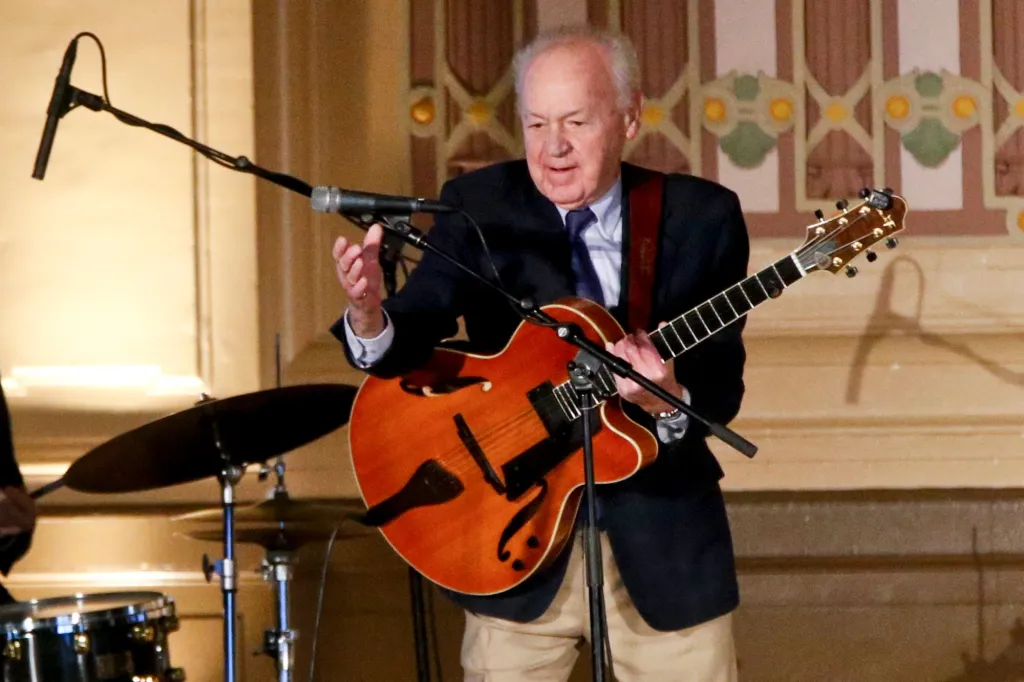
By Kevin Kirkland, Pittsburgh Post-Gazette
Joe Negri couldn’t hammer a nail straight, but the guitarist known as Handyman Negri on “Mister Rogers’ Neighborhood” spent nearly a century building a musical and personal legacy like no other.
Read more Judge to decide if a key hearing for the man accused of killing Charlie Kirk will be public
“He is literally world class, even if nobody knows him outside of Pittsburgh,” said Noah Todd of Chicago, who enrolled at Duquesne University in 2017 mainly to learn guitar from Negri, who worked at the university for more than 45 years.
“The world doesn’t need more musicians. It needs more good people.”
Negri, 99, died Saturday of natural causes, his daughter Lisa Negri told the Post-Gazette, less than two weeks before his 100th birthday. He lived in Scott and spent nearly his entire life performing in Pittsburgh.
In August 2017, Negri was honored in a tribute concert as part of quarterly jazz series at St. Barnabas Health System’s Kean Theatre in Richland. Longtime admirer and friend Brooks Bartlett organized the concert.
“He has not lost any of his chops,” Bartlett said then. “I thought he deserved something like this. He is such a nice guy — no pretense at all. Pittsburgh is lucky to have him.”
His family, in a statement shared with the Post-Gazette on Sunday night, said Negri “has always loved Pittsburgh, and Pittsburgh has loved him back.”
“His career may have reached national audiences, but his heart has always been here, with the people, the musicians, and the family he loved,” the family said. “We are endlessly proud of the joy he has brought to so many people.”
Negri was born June 10, 1926, on Mount Washington. He said his father, Michael, was the real handyman. The union bricklayer emigrated from the Calabria region of Italy at age 16 to escape induction into the Italian army.
“He wanted to escape war, but he ended up in the U.S. Army,” said his eldest son.
When Michael Negri returned home from service, he took up his mason’s trowel and his fascination with Dixieland music. Though he played the banjo, he bought his 3-year-old son a ukulele.
“I was a singer. Dad gave me the uke so I wouldn’t need anyone else to rehearse,” Negri said in a 2017 interview.
At age 4, he performed on KDKA-AM’s “Uncle Henry’s Radio Rascals” radio program. At 5, he drew the attention of local dancers Fred and Gene Kelly — yes, that Gene Kelly. They asked little Joe to perform at several shows. He was a regular at Sons of Italy lodges and other ethnic clubs.
His mother and his aunt — the former Rose and Rene Viggiano of Italy’s Basilicata region — taught him the words of “Pardon Me Pretty Baby,” “My Ideal” and other songs they heard on the radio. His father helped with the music and gave him a small Epiphone guitar when he was 6.
He and his younger brother, Bobby, took dance classes Downtown at the Lou Bolton Studio. Their father bartered labor for dance lessons, then drove his sons, then known as the Rhythm Boys, to compete in talent contests at the Enright and other Pittsburgh theaters. With their cousin Harold “Mutsy” Amato, they sometimes won first prize: $25.
As a teenager, Negri took guitar lessons for five years with Vic Lawrence at Volkwein’s on Liberty Avenue, Downtown. A family friend gave him records by Charlie Christian, Les Paul and George Barnes. Christian’s electric guitar was a major influence, Negri said. “He gave guitar a voice.”
At Volkwein’s, Lawrence challenged the teenager with “fancy stuff.”
“At 14, 15 years old, I’m playing ‘Flight of the Bumble Bee.’ It blew people’s heads off!” he said, laughing.
At Prospect Junior High, the guitar prodigy performed for his fellow students in the 250-seat auditorium. Many years later, after the old school had been turned into the Lofts of Mount Washington, it was renamed the Joe Negri Auditorium.
He was a junior at South Hills High School when bandleader Shep Fields persuaded Negri’s parents to let him take the 16-year-old guitarist on the road with his 15-piece swing orchestra in 1943. They performed in Chicago and at The Strand in New York City, returning to Pittsburgh to play the Stanley Theater in March 1944.
The Pittsburgh Press called him a “virtuoso on the steel guitar,” and the Pittsburgh Post-Gazette said: “Young Joe Negri, a Pittsburgh lad, easily demonstrates why he is right up there with the wizards of the electric guitar.”
Negri turned 18 in the summer of 1944 and was drafted into the Army. He did 18 weeks of basic training in Macon, Ga., where a foot injury idled him. “I got a 10-day furlough while my unit went to Europe,” he said. “I never did catch up with them. I missed the Battle of the Bulge.”
He ended up in Dusseldorf, Germany, whose rivers, mills and smokestacks reminded him of Pittsburgh. He and another soldier were given a three-day pass to Eupen, Belgium, and went to a nightclub one night.
“Everyone there was a Django Reinhardt fan. A guy was playing acoustic guitar, and I sat in.”
An American lieutenant heard him play and approached him afterward. “He said, ‘How would you like to join the Special Services?’ I said, ‘Would I!’”
Negri joined the 13th Special Services in January 1945. A few months later, he learned his unit was heading stateside; most of the musicians had already served two years in Europe.
“By May I’m coming home,” Negri said. “I think someone is praying for Joe.”
He spent several months stationed near Newark, N.J., playing for homecoming soldiers during the day and dancers in the canteen at night. He returned to Pittsburgh in 1946 and formed the Joe Negri Trio with his brother on piano and John Vance on bass.
The trio became the de facto house band at two clubs: the Carnival Lounge on Sixth Street and the Midway on Penn Avenue. They also backed up national headliners who came through town, including saxophonist Ben Webster and trumpeters Charlie Shavers and Roy Eldridge, a North Side native.
In 1950, Negri met Johnny Costa, who suggested Negri join him studying music composition at Carnegie Tech, now Carnegie Mellon University. Negri got a night school diploma at Allderdice High School and enrolled under the GI Bill. His composition teacher at Carnegie Tech was Nikolai Lopatnikoff, a Russian-born composer.
“He told me to write something for piano and violin. I did, and he said, ‘You have a wonderful way with melody,’” Negri recalled.
Majoring in composition and minoring in bass, he studied harmony, counterpoint, music history, even solfeggio, the sight reading method his father taught him as a child.
Read more NASA’s moon plans take hit with Blue Origin explosion
In the summer of 1953, while playing with his brother in a trio at Conneaut Lake, Negri tripped over a pretty girl on the beach, Joni Serafini of Squirrel Hill. “He literally fell on me,” she said in 2017.
They were married in 1954, and he began to search for a steady gig. He found one in a new medium — television. He became the leader of a jazz trio that played live five days a week on KDKA’s “Buzz ’n’ Bill Show” with song and dance men Buzz Aston and Bill Hinds.
The Negris moved to Brookline and had three daughters.
In 1959, guitarist Tony Mottola persuaded him to move his young family to New York City.
“He said, ‘You can sub with some bands.’ It was all very iffy,” Negri said. “After a few months, Joni and I said, ‘Let’s go back to Pittsburgh.’ ”
In addition to writing commercial jingles, he teamed up with writer Sy Bloom on the song “Beat ’Em Bucs,” which played the Pirates all the way to a 1960 World Series victory over the New York Yankees.
He worked on another KDKA-TV program, “The John Reed King Show,” and moved over to WTAE-TV in 1968. His 20-year stint as the station’s music director included the “Hank Stohl Show” with Nick Perry and two children’s shows, “Ricki and Copper” and “Adventure Time” with Paul Shannon.
In the mid-’60s, Negri worked on a short-lived children’s show with Fred Rogers. When the Latrobe native created “Mister Rogers’ Neighborhood” for WQED several years later, he remembered Negri.
“Fred said, ‘Joe, how would you like to be Handyman Negri?’” the musician recalled.
“I said, ‘You gotta be kidding. I can’t hammer a nail straight!’
“He said, ‘That’s OK. It’s all pretend.’”
For 35 years, Negri was Handyman Negri on “Mister Rogers’ Neighborhood.” Just as Rogers had said, his lack of repair skills never hampered him in the Neighborhood of Make-Believe. But his jazzy guitar licks came in handy when he played with guests Wynton Marsalis, Mabel Mercer, Tony Bennett and Yo-Yo Ma and with the rest of the TV show’s quartet — musical director Johnny Costa on piano, Carl McVicker Jr. on bass and Bobby Rawsthorne on drums.
Rogers, a music composition major at Rollins College in Winter Park, Fla., wrote many of the songs he sang on the show. He loved that his jazz quartet tucked swinging riffs into every episode. Thanks to them, generations of children unconsciously absorbed a little soul with their public television.
While doing the show, Negri continued to play local clubs and accompany headliners who came through town. Bob Hope, Peggy Lee and Michael Feinstein all became Joe Negri fans.
“Joe’s fluid and spontaneous ability to perfectly accompany and enhance every song I was singing made me feel as happy as I’ve ever been on a concert stage,” Feinstein said after performing with Negri and the Pittsburgh Symphony Orchestra. The singer and guitarist later made an album together.
Negri said the end of “Mister Rogers’ Neighborhood” began with the deaths of three neighbors — Don Brockett in 1995, Johnny Costa in 1996 and Bob Trow in 1998.
“Fred said, ‘Before we lose anyone else, I’m going to end the show.’”
The show’s last episode aired in August 2001. Rogers died of stomach cancer in February 2003, at age 74. Seven years later, Bobby Negri died at age 81.
In the 1970s, Negri began teaching jazz guitar at Duquesne University, then expanded to the University of Pittsburgh and Carnegie Mellon.
He was presented with the Presidential Award for Extraordinary Service to Duquesne University and the Community in 2022. As the award was presented, university officials showed photos of Negri on the “Mister Rogers’ Neighborhood” set and also a video of him playing the song “You Are Special” on the guitar.
“I’m overwhelmed, honored and humbled, and I’m really very happy to be here today,” Mr. Negri said during the ceremony.
In 1999, Matt Hudson came from his hometown in Erie to study guitar at Pitt. He found a mentor in Negri.
When Hudson became a teacher himself at Lane Technical High School in Chicago, he turned on his students to Negri’s arrangements of jazz standards. He encouraged Noah Todd to email a video of himself playing a Negri solo to Negri.
“The morning after, he responded with the most encouraging words and ideas,” Todd recalled.
After one lesson with Negri, Todd auditioned for Duquesne’s School of Music. He was accepted and spent one year here before transferring to another college.
In 2017, Negri cut back on his teaching and performing, but he still practiced every day on his custom-made Benedetto guitar. It kept him sharp, he said, and allowed him to continue to play at a high level.
“Jazz is not as simple as people think. It has a very complex structure,” he said then.
He lamented how this quintessentially American music form had fallen from favor.
“Sometimes you play, and nobody’s listening. They’re talking at the bar, checking their phone,” he said, shaking his head.
But he played on, making it look easy.
“Joe can play something flashy, but it always takes a back seat to melody and phrasing,” Hudson, his former student, said in 2017. “There’s not a wasted note.”
In addition to his wife of 72 years, Negri is survived by his three daughters, Lisa Negri of Detroit; Laurie Bentz of Naples, Fla.; and Gia Leven of Pittsburgh; and three granddaughters. He was preceded in death by a brother, Bobby Negri, and sister, Eleanor Barneck.
Those wishing to honor Negri can make donations to St. Jude Children’s Research Hospital, a charity he loved, his family said. Funeral services were held privately.
© 2026 the Pittsburgh Post-Gazette. Visit www.post-gazette.com. Distributed by Tribune Content Agency, LLC.
Read more Macron says French Navy, backed by the UK, intercepted a sanctioned tanker from Russia