
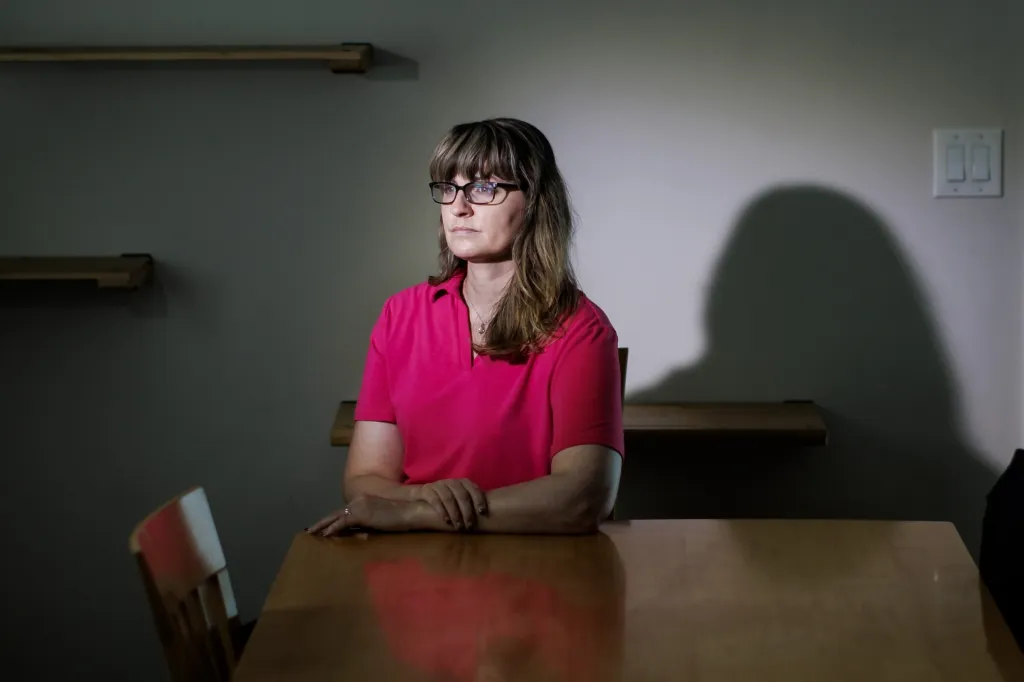
In June 2022, a week after Dev Davis was eliminated from San Jose, California’s mayoral contest, the then-city council member noticed six police cars outside her home. She called her designated police captain – her point person for any safety concerns — who told her he would find out what was going on.
Read more How AI could help save lives this hurricane season
“You and your family need to evacuate your house,” she recalled him saying when he called back five minutes later. “We’re calling in the bomb squad.”
RELATED: The ways women in elected office protect themselves from abuse
Davis’s neighbor had found a suspicious package less than 50 feet away from her house: a small, cylindrical object, wrapped in duct tape, with a partially-burnt fuse, according to police records.
“You don’t feel safe in your own home,” Davis said. “You don’t feel safe for a long time.”
These threats and abuse take a mental toll on the elected officials they target. More broadly, the culture can dissuade diverse candidates from running for office or working on divisive issues, experts and elected officials said.
“We’re seeing people being reluctant to run for office when their families are put in harm’s way,” said Maya Kornberg, a senior research fellow and manager for the Brennan Center for Justice’s Elections and Government Program. “Almost half of women in local office that we surveyed expressed some level of reluctance to run for reelection or remain in office because of abuse.”
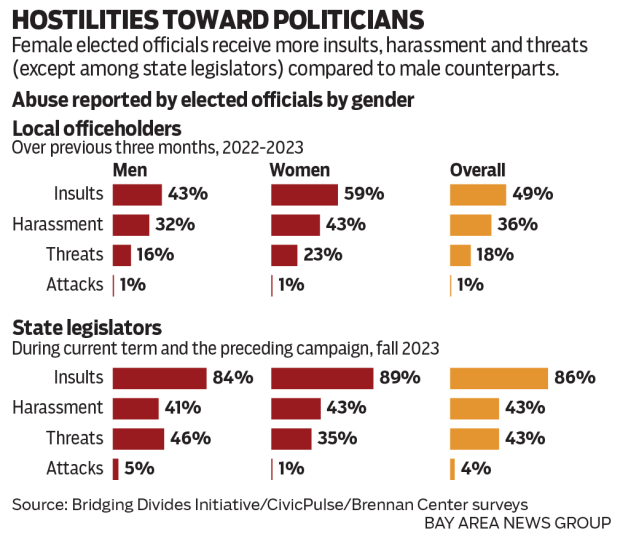
Women are targeted more frequently and with different types of abuse than men, according to a 2024 research report conducted by the Brennan Center, a nonpartisan policy organization housed at New York University’s School of Law.
“Politics continues to be a man’s world,” said Santa Clara County Supervisor Sylvia Arenas. “When you take a look at the crimes that are committed in this world, the majority of them are committed against women, and I think this is a microcosm of the world. It’s no different.”
Some women who spoke to the Bay Area News Group attributed the rise in vitriol over the last decade to a change in political rhetoric led by President Donald Trump, whose verbal attacks on women often rely on comments about them being “low IQ” or criticism of their looks.
“The world shifted under Trump 1.0 in terms of the level of political hate and vitriol that people seem to be willing to engage in,” said California State Assemblymember Mia Bonta. “There’s been more broadly a fundamental attack on women and somehow a kind of normalizing of saying violent things and abusive things towards women.”
“Women as well as people of color experience more abuse, and this is true in terms of total numbers of threats, but they also experience different kinds of abuse,” said Kornberg, a co-author of the 2024 study. “It’s not just more abuse, it’s also different kinds of abuse that target these particular parts of their identity.”
Among local officeholders, 23% of women reported receiving threats — defined in the study as expressions with an intent to imminently harm someone — compared with 16% of men, researchers found. One-quarter of elected officials of color reported threats, while 18% of white officeholders reported threats. In state offices, though men reported higher levels of threats and attacks, more women than men experienced harassment and insults.
“The tone and tenor of emails we receive can be very aggressive,” said Alameda County Supervisor Nikki Fortunato Bas.
•••••
Most of these threats are reported through official channels, such as law enforcement or through a government agency where the elected official works where they can be monitored and investigated. But some menacing messages – such as death threats – can demand the attention of the courts.
Noelia Corzo, president of the San Mateo County Board of Supervisors, was used to receiving contentious messages at public meetings, such as being told to “shut the f— up” or “repent,” she said. Those incidents happen frequently enough that they were “just noise,” she added.
But while working on local issues related to the removal of the former San Mateo County Sheriff — Christina Corpus, whose ouster was a contentious fight in the county — Corzo received a death threat, she said, that led her to obtain a restraining order.
“I grew up in a lower income neighborhood. I have thick skin,” Corzo said. “What made it most difficult was thinking that it could impact my son and my loved ones.”
Shara Watkins, a former member of the San Mateo Foster City School Board, noted that publicly available information can be used against elected officials: “Everyone knows where you live. Everyone can find you,” she said. “There’s a level of vulnerability and visibility.”During California State Assemblymember Liz Ortega’s campaign leading up to the 2022 election, an independent expenditure sent out a mailer to millions of voters in her district featuring her address alongside messaging she worried could galvanize someone to show up to her house.
“The fear wasn’t really as much for me as it was for my family,” Ortega said. “As a candidate, I felt, ‘Okay, fair game, you’re going to attack me.’ But putting my home address, directing people to my home when a lot of times it was my elderly mother or my daughter who was home alone – that really scared me.”
“There’s a legal question, and then there’s the political climate that we’re in today,” she added. “There’s the moral question of taking our safety into consideration.”
The threats received in the Bay Area primarily target contentious issues that legislators are working on, but they also target elements of the recipients’ identities, such as their race or gender. Women of color in local elected office are more likely than white women, men of color and white men to experience threats, Kornberg said.
As an immigrant, Ortega said, she has been targeted with comments such as, “Are you even a citizen?” and “You’re not a real American.’
Read more Jurupa Valley transgender athlete AB Hernandez wins 2 girls’ titles at state track meet
“It’s a representation of where we are in politics today with our current administration,” Ortega said. “When you have the highest person in office, the most powerful person in the world, making derogatory comments about immigrants, about women, about LGBTQ, anything that he doesn’t deem to be worthy of his standards, (they) become the target.”
Watkins was advocating to remove school resource officers from school campuses during the Black Lives Matter movement, she said, when a man started to leave “ranting voice messages” on her personal cell phone.
“Those are the moments that make you question why you’re doing this,” she added. “Is it worth it for my children (to be) in harm’s way potentially and expose them to this for no fault of their own?”
Watkins said she was the only person targeted — though she was not the only board member to vote in support of the resolution, she was the only Black woman on the board.
“You draw those lines, even if somebody isn’t saying, ‘This is why I’m doing this,’ ” Watkins said. “There are many, many things people said to me or ways that they interacted with me that would have never happened if I had been a white man, but you can’t prove that.”
•••••
For many lawmakers interviewed, the majority of threats they have received have targeted specific issues or policies they were working on.
Assemblymember Buffy Wicks was working on two bills on vaccine mandates and abortion in 2022 when a brigade of truckers caravaned to her family’s home in Oakland. Working on abortion bills has been a “lightning rod” for threats because it hits on both a controversial issue and her identity as a woman, she said.
When the truckers pulled into Wicks’s sleepy neighborhood — about ten minutes before law enforcement arrived on scene — they began blasting their horns and yelling into megaphones, she said.“They’re really in your face, and you’re looking at these people and you’re like, ‘Are they armed?’ ” Wicks said. “Should I go outside? Should I stay here?”
The brigade left the neighborhood after a contingent of middle school students started egging the trucks, Wicks said.
Threats against family members are more common among women serving in elected positions than men, with the study finding that 12% of women reported threats against their family members compared to 8% of men.
Before she rose to prominence as a state assemblymember, Bonta was already in the public spotlight as the spouse of an elected official, state Attorney General Rob Bonta, who had served on the Alameda City Council and in the state Assembly. Mia Bonta had to deal with receiving threatening texts to her personal phone, menacing social media posts and threats against the lives of her children, she said.
“It takes it to another level as a mother, and as a human being – a parent – when my children, whose only connection to a particular threat is somebody being unhappy about a policy stance or my very existence, (are threatened),” Bonta said. “It’s beyond the pale, for sure.”
In June 2023, a man downloaded a photo of San Jose Vice Mayor Pam Foley’s family from her campaign website and cropped it to focus on her adult daughter, sending it alongside “really threatening” language, Foley said. Police investigated, but no one was arrested.
“You don’t do this work because you think your life is (going to be) threatened, but people are very passionate about their issues and don’t set boundaries,” Foley said. “It’s scary.”
Watkins, who moved to Southern California after her term on the school board was over, decided to take “quite a break” from her involvement in local politics, she said.
“It’s hard enough to be an elected official, and then you add on all of the lead layers of prejudice, bias and people feeling like they have the right to make you feel unsafe and uncomfortable,” Watkins said. “You have to take care of yourself first.”
For others, the threats can have the opposite effect, encouraging them to focus more on their policy work.
“I would be lying if I said that I have the same sense of safety that I had before beginning my role as supervisor,” Corzo said. “But nothing that will ever prevent me from doing the work that I feel is really important.”
Authorities eventually determined that the mysterious package left outside Davis’s house was an improvised explosive device capable of causing “great bodily injury or death if detonated,” according to police records. The bomb was transported to SJPD’s bomb disposal range, where it was rendered safe.
Detectives did not make an arrest in the case until January 2024.
“That was really disconcerting, especially because I was still a public official,” she said. “That person knew where I lived.”
For Davis and other women in elected office, that’s an “occupational hazard,” she said — one she thinks about when weighing if she wants to return to elected office.
“That’s just something you have to deal with if you’re a woman running for office,” Davis said. “I’m never going to forget that there was a bomb outside my house.”
Read more A robot is helping an ailing couple stay in their home. Are more to come for an aging population?