
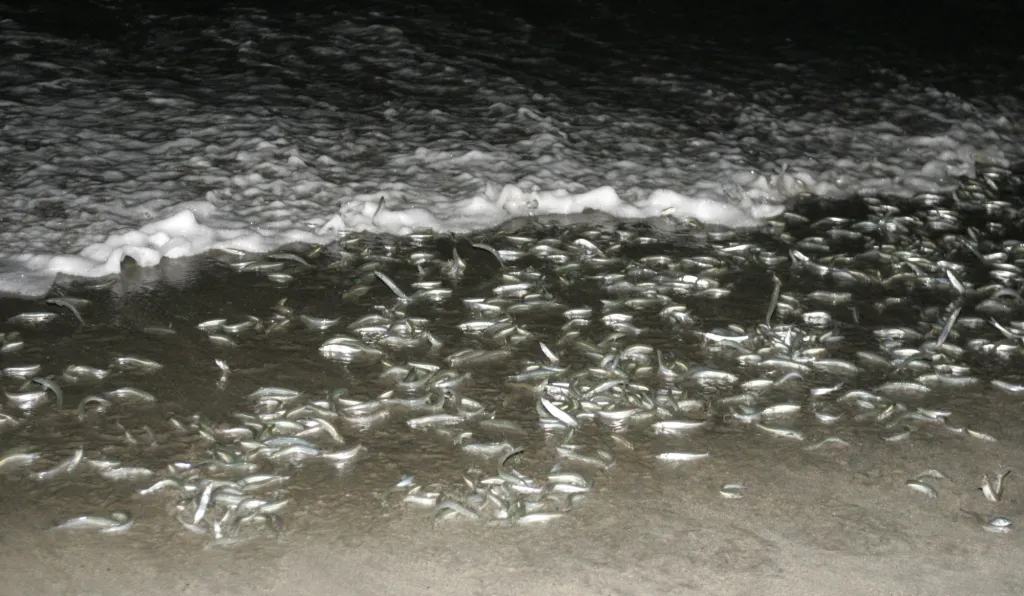
It’s a sight on the sand: fish wiggling themselves up the shore, creating a blanket of silver along the beach.
Read more Pride Month 2026 has begun. Here’s what to expect for the LGBTQ+ celebrations
State Parks is hosting its annual grunion run event on June 2 at Doheny State Beach in Dana Point, one of the the beaches the small fish like to frequent. It will hopefully be a chance to watch the unusual spawning ritual happen — if the fish are in the mood.
The event starts at 8:30 p.m., with experts who will talk about the fish and what makes the species unique, and will give a live demonstration of egg hatching.
For the generations who have sought out the late-night sight, it’s an up-close marine biology lesson on the sand.
Karen Martin, a professor of biology at Pepperdine University and foremost expert on the creatures, will be in attendance, as will retired State Parks ranger Jim Serpa, who ran the program for three decades and helped resurrect it a few years ago.
Serpa, also a science teacher at the time, and fellow ranger Brad Keitzman would work nights in the early 1990s and see the silver creatures on the sand, marveling at the process.
“We’d see thousands of grunion on the beach and we kept saying we need to show other people this, so we came up with the program,” Serpa said, noting the first official Grunion Run Night was in 1992.
It’s a process unlike any other sea creature and unique to California. The female grunion burrows her body into the sand and lays her eggs. Then, the male is washed up and fertilizes the eggs.
The eggs stay buried under dry sand for a few weeks until the next full moon cycle brings higher tides again, the wave action moving the eggs around to help the babies hatch.
Some advice Serpa gives people heading out to see the creatures: Don’t give up, sometimes they are late, and don’t flash bright lights or make a lot of noise.
Read more US World Cup roster: Pepi, father share emotional celebration four years after being left out
The run is expected to happen during a two-hour window, around 10:30 to 12:30 p.m., though the fish can run late or be a no-show.
The event is happening during the “closed” season, as set by the state Department of Fish and Wildlife, meaning it is only for observation and taking the fish is not allowed.
The closures are important to help preserve the species. Data collected over the years showed their numbers dwindling.
Open season begins again in July.
***About the grunion
• Their average length is between 5 and 6 inches.
• Early Spanish settlers called this fish grunion, which means grunter. Grunion are known to make a faint squeaking noise while spawning.
• The spawning season extends from late February or early March to August or early September, varying slightly in length from year to year.
• Larger females are capable of producing up to 3,000 eggs every two weeks. As the mature eggs are deposited in the sand, another group of eggs is developing that will be spawned during the next series of runs. This cycle continues throughout the season.
• Grunion may be taken by hand only — no appliances of any kind may be used, and no holes may be dug in the beach to entrap them. During the open season, the daily bag and possession limit is 30 grunion per person.
• Some of the area beaches known to have runs are Malibu, Santa Monica, Venice, Hermosa Beach, Cabrillo Beach, Long Beach, Belmont Shore, Seal Beach, Huntington Beach, Newport Beach, Corona del Mar, Doheny Beach, Del Mar, La Jolla, Mission Beach and the Coronado Strand.
Read more Orange County Baseball All-Star Game is Wednesday at Great Park
Source: CDFW