
Kymberly Jones had lost hope.
Forty years had passed since her 18-year-old sister, Pomona resident Michelle “Missy” Jones, was found dead and sexually assaulted in a Fontana grapefruit grove the day after a family Fourth of July barbecue in 1980, and no one had been arrested.
Read more OC founder of green financial firm sentenced after defrauding investors of more than $248 million
“I didn’t think this case would ever get solved after so long and you don’t hear anything from the Police Department,” Jones, now 57, told an audience at Sunrise Church in Rialto during a memorial service for National Crime Victims’ Rights Week in April. “The silence was deafening. We heard absolutely nothing.”
But Jones also said that her family is, in fact, a testament as to why one should never give up — and to the value of a clever and tenacious detective such as Fontana Cpl. Kathryn Clark, who was listening to Jones from a pew and once had her own doubts.
“It seems impossible to solve a case that is that old, right?” Clark, who was assigned to the San Bernardino County cold-case unit in 2020 and began investigating the killing that March, would say.
“Looking at it from the outside contours, it was formidable,” Lloyd Masson, the deputy district attorney on the murder’s task force, would recall.
But on Sept. 8, 2020, Leonard Nash was arrested on suspicion of murder after the county crime lab matched his DNA to a sample collected from Missy Jones four decades earlier. He was convicted of second-degree murder last year and sentenced in January to 15 years to life in state prison, where he spends his life now, at age 72.
It was the oldest cold case successfully prosecuted in county history.
That day at the church, after the ceremony, Kymberly Jones said she was not shocked to learn that it was Nash who committed the crime.
“Not at all,” she said. “I was surprised about how they got the DNA.”
Missy Jones
Missy was one of eight siblings in a home “that was always filled with birthdays, gatherings and laughter, and in the middle of it, Missy was always there,” said Kymberly, a younger sister. “She didn’t have to try to be special; she just was.
“She was feisty, strong-headed and very protective of her family. Missy had a maturity about herself that made her seem older than 18.”
She helped start a yearbook club at Park West Continuation School before graduating and getting a job as a dispatcher on the switchboard at the Claremont Police Department.
At that time, in 1980, Nash was 26 and dating 19-year-old Phyllis Jones but also interested in her sister Missy.
“He wouldn’t leave her alone,” said Clark, the Fontana corporal who oversaw the case. “He sees her dating other men, but she wants nothing to do with him. He can’t have her. That, to me, kind of gives a little bit of a motive.”
On the Fourth of July, the Jones family gathered at a Rancho Cucamonga home where Phyllis lived with Nash for a barbecue. After those who lived in Pomona returned home, Kymberly said, Missy headed out with a man she was dating.
“I’ll be right back,” Missy said.
Not long before 5 p.m. on July 5, Missy’s body was found in the Fontana grove by a passerby who called police. There were indications that she had been strangled.
The man she left with, Clark said, told detectives that he picked her up about 10 p.m., they went to a park to party and have sex. The man, who Clark called the “obvious suspect,” was briefly arrested.
He said he dropped Missy off at home around 4 a.m., and three lie-detector tests backed him.
Cpl. Clark
Clark, 46, was born the same year Missy Jones was killed. She attended Fontana High, Riverside City College and San Diego State. She ran the aquatics program for the city of Fontana but wanted something more.
Her older brother, now a lieutenant with the Riverside County Sheriff’s Department, encouraged her to go into law enforcement. Clark has been an officer for 19 years.
She sometimes get called “Red” for the color of her close-cropped hair. She has worked patrol and with the bicycle team, been a field-training officer, worked with the major-accidents investigations unit, was the cold-case unit and now is with the Multiple Enforcement Team, a special patrol division.
Clark said she closed eight cold cases before she left that unit. Some investigations resulted in arrests, and some led her to dead suspects.
“Your job as the detective,” Clark said, “is to address each and every open door, and to close those doors as much as you can.”
First, with the help of a secretary in investigations, Clark assembles the digital and hard copies of a case. She views and listens to recordings that could be on cassette tapes, VHS tapes. She reads the files.
The Missy Jones folder, the case’s “murder book,” would grow to several inches thick.
Fewer murder cases go cold, or even freezing cold, anymore.
“Back in 1980, there were no cellphones,” the detective said. “There were no cameras. There were no cellphone towers. No license-plate readers.
“It was much easier to find a dark place and dump a body, and no witnesses if it’s late in the middle of the night.”
Kymberly Jones and sister Melisa Jones felt a surge of hope after meeting Clark when she took over the case.
“I said, ‘That is a bulldog and she is going to get this case done,’ ” Kymberly recalled. “I saw that, and I sensed that in her. Detective Clark, man, that is a TV cop! She’s a real go-getter.”
Read more Voluntary departures spike as immigrants face squalid detention, pressure to leave
Clark told the family that the DNA from Missy had been preserved.
“I liked her from the get-go,” said Melisa, now 63. “I had faith in her then when she told me it was going to be OK.”
A clue
Phyllis Jones was cleaning the house the day after the July 4th barbecue when she pulled back the shower curtain and was surprised to see Nash’s sport coat hanging up, Clark said. Inside a sleeve was a foxtail, matching those found on Missy’s clothing and in her hair. His shoes were in the closet, Clark said, covered in mud, similar to the mud in the grove that covered Missy’s face.
It would be 40 years before those clues took hold. A few weeks before Clark was officially on the case, she said, Kymberly Jones told a detective about the find.
(Kymberly told the Southern California News Group that Phyllis told her in 1991 about the clues, and over the years Kymberly would call Fontana police with that information, but apparently it didn’t make the murder book.)
Clark traveled to Arizona, where she asked Phyllis why she didn’t tell detectives about her discovery in 1980.
“I was 19 years old,” Clark recounted Phyllis saying. “My sister had just been murdered. I told my stepfather at the time, and I just assumed that he told the police.”
Clark then rounded up the swabs and slide created when DNA samples were taken from Missy’s vaginal cavity at her autopsy. In 1980, there was no means to test the samples for a DNA match. And when detectives sent the samples to a lab in 2008, the slide, which had semen on it, was not tested for some reason, Clark said.
Now degraded, the swabs could not be tested. But the slide …
In 2019, the Police Department’s forensic technician resubmitted the slide to the lab, which assigned a profile to the DNA. It did not match anyone in the database, including the former prime suspect and another man who Missy had dated.
Nash’s DNA — he hadn’t been convicted of a crime that would required him to provide a sample — was not in the database. But the discovery of the foxtails in Nash’s clothing made Clark determined to talk to him.
A plan
In June 2020, Clark, along with San Bernardino County sheriff’s investigators Walt Peraza and Arturo Alvarado, went to Las Vegas, where Nash was last known to live, and eventually tracked him down through his girlfriend. Clark and Nash spoke on the phone.
“Do you remember Missy?” the corporal asked him.
He said he thought so and that he would call back and did while the three cops dined at a Thai restaurant.
“I hadn’t figured out if I was just gonna ask him to voluntarily submit to give me his DNA or what I was gonna do,” Clark said. “I was gonna kind of play it by ear to see if there was a chance for me to get something discarded, and if not, then I had no choice but to ask him, right?”
She invited Nash to dine with them, and he agreed as long as they picked him up.
At the Thai restaurant, officers laid out a straw, a plastic cup, a fork and a napkin for Nash in hopes he would use and discard or leave them behind.
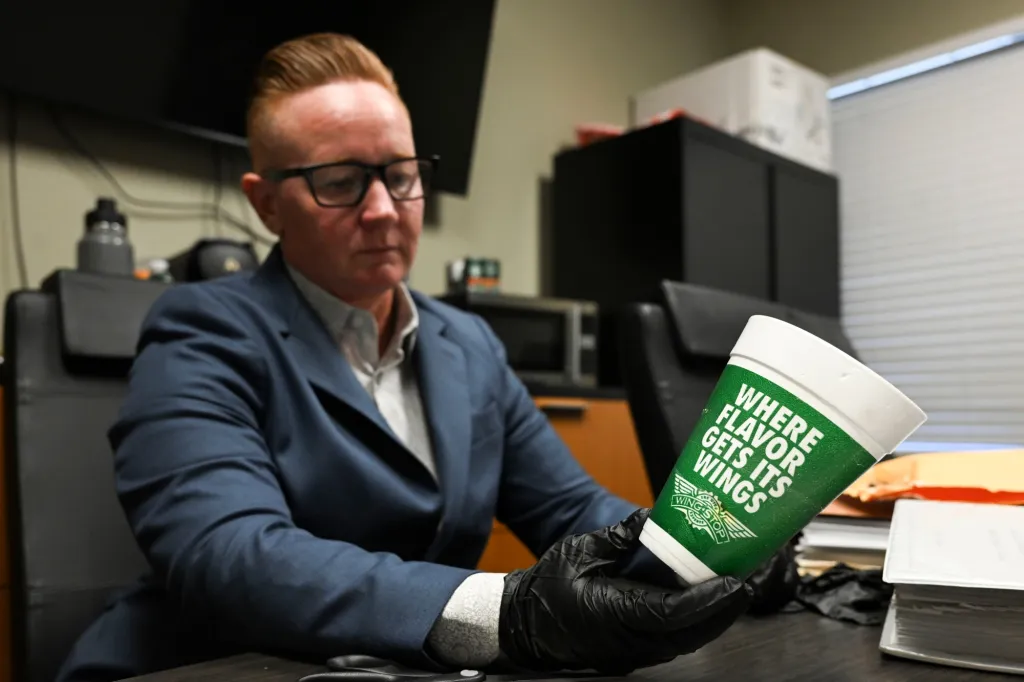
She and Peraza picked Nash up outside a convenience store. He was holding a Styrofoam cup from Wingstop. During the ride, Clark offered Nash water in hopes he would drink from the bottle and leave his DNA on it. Instead, he poured water into his cup and drank from it.
“I’m bummed, right?” Clark said.
They arrived at the restaurant, and Nash makes it easy on the detectives.
“He throws the cup away in the trash can right outside the restaurant,” she said. “And so, he walks in, and I turn and I look at Walt Peraza, my partner, and he looks at me. And when you work with people, and you know what the plan is, you don’t have to say anything. …
“So I knew that Walt knew he needed to get that cup. And, we go in. I tell Nash, ‘Mr. Nash, have a seat, relax, drink some water.’ And Peraza says, ‘Oh, I need to use the restroom.’
“So he goes back outside, he gets the cup from the trash can,” Clark continued. “He goes to his car, and he stores it in his car in a manila envelope.”
Nash orders pineapple fried rice and, asked what he remembered about the July 4 barbecue, is suddenly reticent but does say he never had sex with Missy.
Nash went out to Clark’s car and identified people in photographs from the case file. They returned to the restaurant, where Peraza and Alvarado had packed up Nash’s leftovers for him and collected the fork, straw and napkin.
They drive him back to his apartment.
‘That’s a lot of zeros’
Several items were sent to the lab. The county crime-lab analyst compared the DNA on the Wingstop cup to that of the DNA on the slide containing the semen taken from Missy’s body.
“They give you a statistic, and they say it’s this many times more likely that it’s this person than it is some unknown individual,” Clark said. “It came back with a statistic that, I think, is the largest statistic I’ve ever seen. So it was 130 septillion. That’s a lot of zeros.”
After the DNA hit, Clark secured a warrant for Nash’s arrest, and the Las Vegas Metropolitan police placed him in handcuffs. The detectives returned to Nevada to pick him up.
Nash denied guilt then and, Clark said, denies guilt today.
At the end of a trial in 2023, a Superior Court jury in Rancho Cucamonga hung 10-2 in favor of a conviction. Two years later, a jury deliberated for four days and found Nash guilty.
At that April memorial service in Rialto, Kymberly Jones took the lectern in front of that crowd that included victims, family members of victims and Clark. Kymberly Jones had said her thanks before, but she wanted to do it again.
“Thank you,” Kymberly Jones said.
“Detective Katie Clark, and Lloyd Masson, deputy district attorney. You didn’t just work this case. You carried it. You lived it.
“You didn’t just fight for justice,” Jones said. “You fought for her. You fought for us. And you became our family.”
Read more Man, 81, who killed stepdaughter, 11, and attacked wife in Garden Grove gets life sentence