
If.
If is little, as words go, but often powerful. And in any honest account of the recent chemical scare in Garden Grove, “if” is huge.
Read more Wall Street poised to open lower even as AI and data center companies soar on still-hot demand
If Orange County Fire Agency responders had been less brave and nimble; if their bosses made different decisions; if thousands of families hadn’t actually listened (not a given) when told to spend an unknown amount of time in unknown places away from their homes; if the company at the center of it all hadn’t told authorities what it was seeing (legally required but also not always a given); if the tank holding a dangerous chemical hadn’t fissured in precisely the way that it did; if…
You get the idea. The incident at a 500-employee aerospace manufacturing plant in Garden Grove was many things: a mixed bag of communication wins and stumbles, an expensive and frustrating disruption for thousands of local families, a vivid example of why old-school industrial plants maybe shouldn’t be located in densely populated cities.
But it wasn’t a disaster. Nobody died. Nobody got hurt.
The system held.
And the loudest questions raised since the incident fizzled out: Are the rules regulating dangerous chemicals designed to protect people or businesses? Is the county’s emergency response system up to the task of, say, a major earthquake? Do working-class people get treated the same as wealthier people during an emergency?
They sound like air kisses when compared with the two versions of catastrophe that experts believed to be most likely: a deadly fireball spewing a toxic cloud over a county of 3.1 million people, or a flood of poison flowing out of the plant and into storm drains and, eventually, the ocean.
That said, for 120-plus hours, from mid-afternoon May 21 through the evening of May 26, the bullet-dodged outcome wasn’t known. In fact, the opposite was loudly predicted.
And as it played out in public — with images of hoses shooting water at aging industrial tanks, scary updates about a slow boil inside a vat of flammable chemicals and public evacuation orders that touched as many as 50,000 people — the incident in Garden Grove took on the feel of an action movie come to life, complete with a ticking bomb and rising odds of chaos and potential for mass casualties.
Close calls, it turns out, can be scary.
Here’s how different people saw key moments of a disaster averted:
May 21: 3:22 p.m.
The Orange County Fire Authority answers an emergency call from workers at the Garden Grove manufacturing plant owned by GKN Aerospace, a company that makes windows and canopies for commercial and military aircraft and spacecraft.
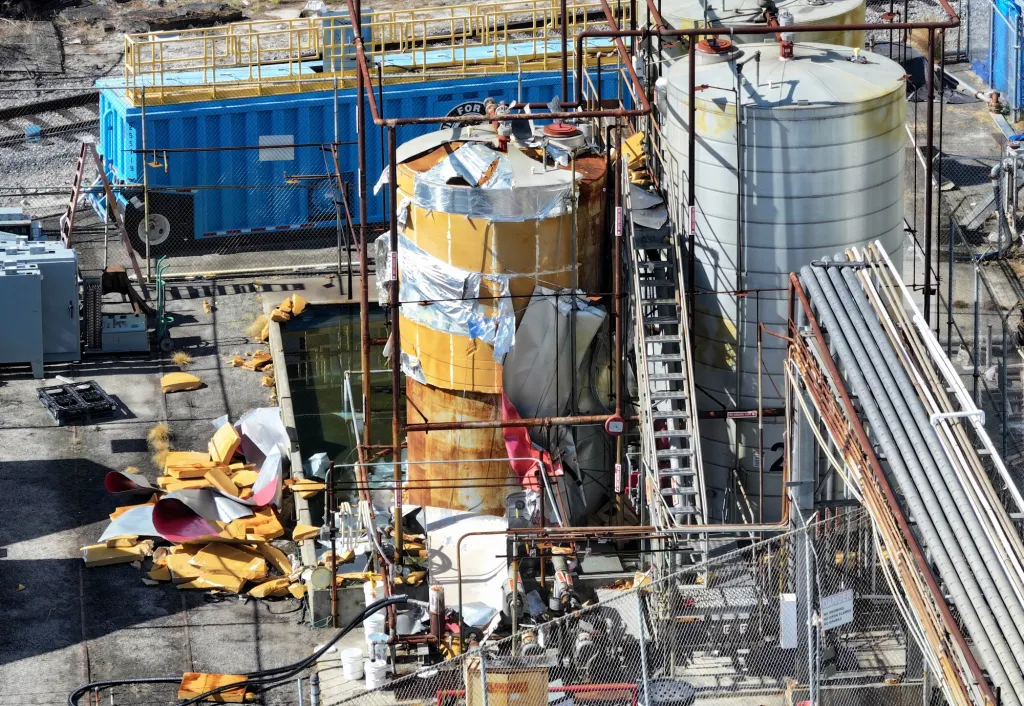
The report is about an “active leak.” And, soon, the OCFA crew learns that one of three storage tanks at the plant — one that contains the chemical methyl methacrylate, or MMA — is bulging. They also learn the tank in question is “off-gassing,” which is jargon for “no longer holding all the stuff that’s supposed to be inside, inside.”
Because MMA is bad if you inhale it (in low doses, it can cause everything from respiratory distress to nerve damage; in bigger doses, it can kill you), and because bulging and off-gassing are signs that all is not normal inside the tank, OCFA leadership starts to assess how much risk the conditions pose to the public.
They also know this: The roughly 7,000 gallons of MMA stored inside the bulging, belching tank is highly flammable. What’s more, they know it’s a type of chemical that can drive a thermal event known as a “boiling liquid expanding vapor explosion,” or BLEVE, which is the kind of combustion that happens when a gas heats beyond its normal boiling point while still under pressure.
So even as they work to cool the tank, inside and out, OCFA leaders begin to assess whether nearby residents should be evacuated. And, if so, how near is “nearby?”
The downsides to an evacuation order are clear: There’s not a lot of warning and there are relatively few places to go; lives will be disrupted.
And the reason those downsides sound semi-lame, even after the fact?
“That tank was imminently ready to blow,” said OCFA Division Chief Craig Covey, who led the agency’s response in Garden Grove, during a May 26 post-mortem meeting with residents and city leaders.
So Covey recommends evacuating the neighborhoods within a half-mile of the GKN plant, which is on Western Avenue, just south of Chapman Avenue.
Then, as police begin urging people to leave, Covey and others begin working on ways to stave off a chain of chemical reactions that could end in a fireball. Water hoses are part of their plan. So is fixing the valve so the tank will stop overheating.
For a time, the moves seem to be working.
“Those (initial) cooling measures were successful,” Covey explained during the meeting. “Confidence levels were high that we could put in a neutralizer into the tank. … We believed we could reduce the explosion potential. Things continued to trend in the right direction.”
Soon, Covey makes another key move; he recommends calling off the evacuation.
“We made the determination to repopulate,” Covey said.
 Orange County Fire Authority Division Chief Craig Covey speaks during a news conference at the Los Alamitos racetrack in Cypress, Calif., Friday, May 22, 2026, about hazmat situation in Garden Grove. (Photo by Jeff Gritchen, Orange County Register)
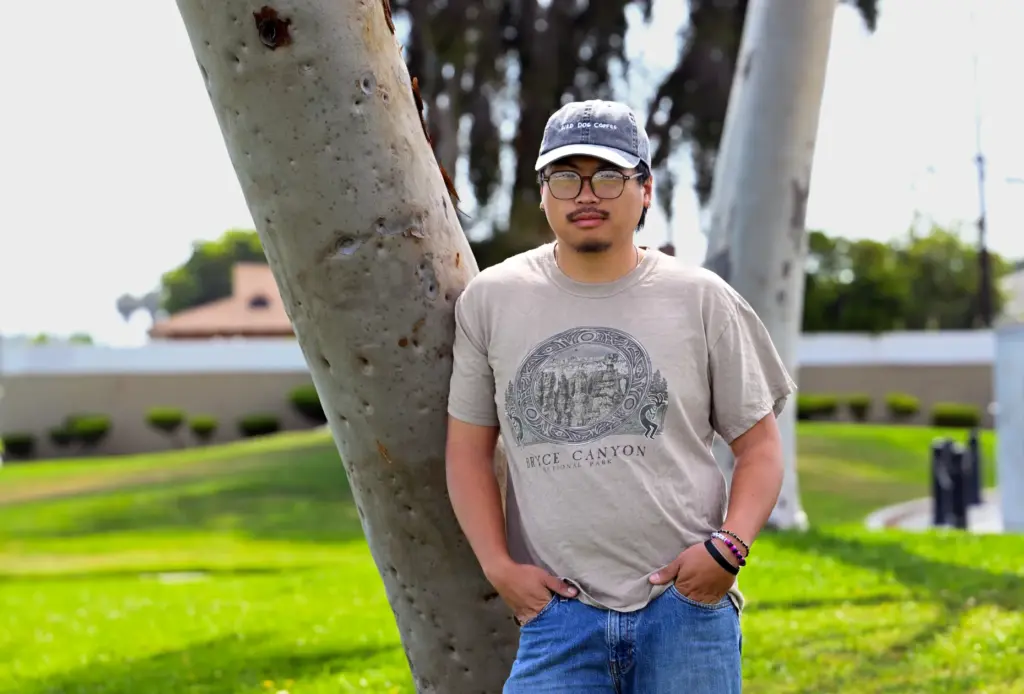 Nathan Tran, a 26-year-old substitute teacher from Garden Grove, CA, lived outside the evacuation area but had relatives stay with him who were evacuated. Tran, whose father works on the assembly line at GKN Aerospace, said he went to various shelters looking to help on Monday, June 1, 2026. (Photo by Jeff Gritchen, Orange County Register/SCNG)
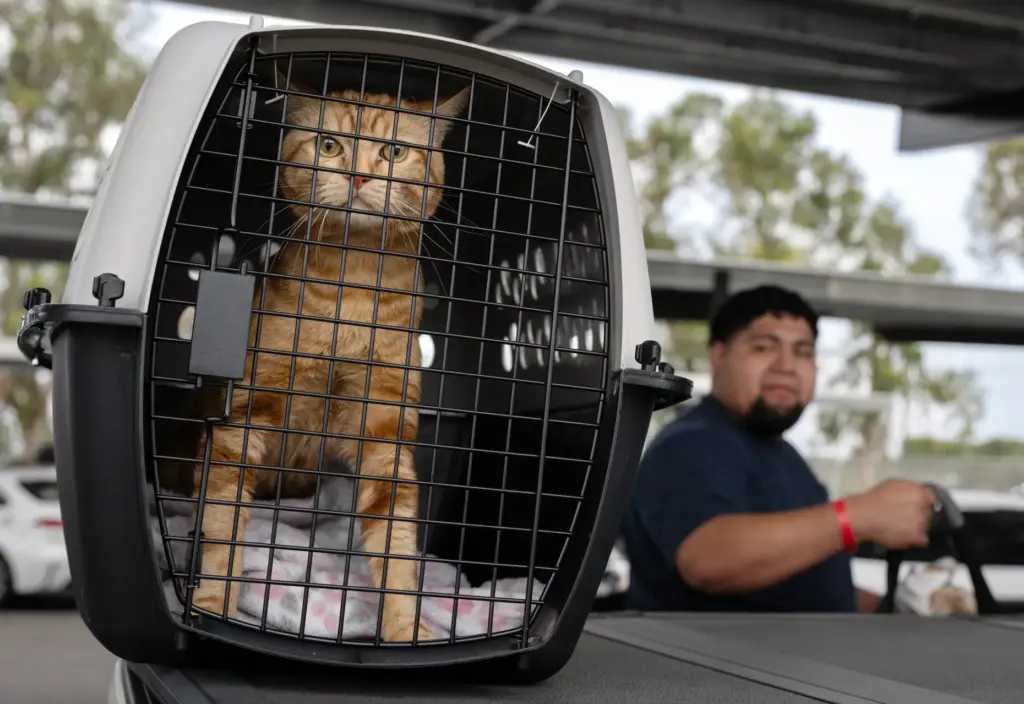 Gallo, an emotional support cat for a Marine veteran who asked not to be identified, is taken to his car to be fed in Anaheim on Saturday, May 23, 2026. They were part of dozens who stayed at Savanna High School after being displaced from their homes during a Hazmat evacuation. A tank containing a flammable, volatile chemical malfunctioned at an aerospace plant in Garden Grove and surrounding communities were evacuated as officials figure out what to do. (Photo by Mindy Schauer, Orange County Register/SCNG)
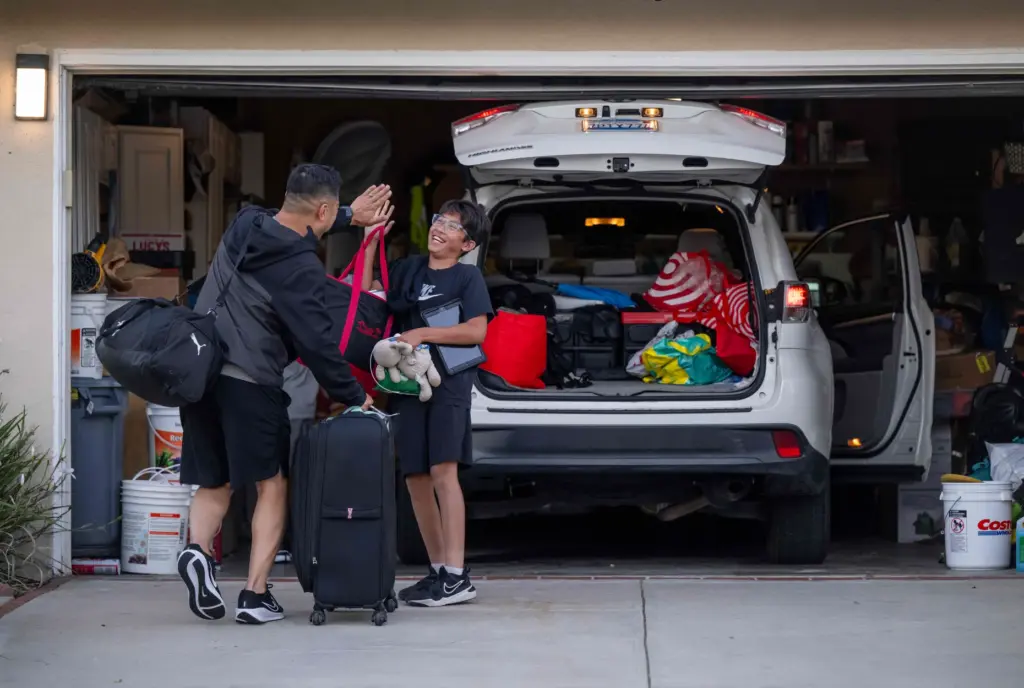 Ton Tran gives a high five to one of his two sons as they carry bags into their home after days of being evacuated from their neighborhood in Cypress due to a hazmat incident in nearby Garden Grove on Monday evening, May 25, 2026. The Trans were able to stay with family in Huntington Beach as they, and tens of thousands of residents in several nearby cities, awaited the chance to return home. (Photo by Jeff Antenore, Orange County Register/SCNG)
May 22: 3:30-ish a.m.
Until they didn’t.
Sometime between 3:30 and 4 a.m. Covey gets a call from the commander he’s left in charge at the incident he’d just left. The update isn’t good. Much of what the responders thought they could do is turning out to be less-than-doable. The valve deemed key to lowering the temperature of the tank is gummed up.
Covey quickly returns to the scene.
Soon, Covey and others at OCFA decide that an evacuation is, in fact, necessary. And after estimating the size of the potential explosion, the new evacuation zone is bigger than before, extending a full mile away from the plant. Some 50,000 people living in a 9-square-mile area that touches Garden Grove, Stanton, Anaheim, Buena Park, Cypress and Westminster are urged to sleep with non-neighborhood family, in hotels or in evacuation center cots — anywhere but home.
The county and Red Cross start setting up emergency shelters. They eventually choose nine public buildings — area high schools, a community college, a community center at Mile Square Park — that have indoor gyms or conference rooms or other spaces that can hold a couple hundred cots.
As the day unfolds, OCFA crews and others take up a routine that they’ll replay over the next three days.
When the sun is out, warming the tank and boosting the overall risk of explosion, the responders monitor the situation from a distance. Instead, they take steps to offset a potential environmental disaster that could unfold if the tank implodes and spills its contents in liquid form. They build temporary dams in nearby flood control channels to capture any migrating MMA before it can float into the ocean.
But at night, they focus on the tank. Specifically, they take its temperature. This requires responders to get close enough to a potential bomb to visually read the temperature gauge.
By Friday evening, the tank is 77 degrees. That’s well above the normal 50 degrees, but well under the 113 degrees that experts say could trigger chemical changes that might end in a fireball.
By Saturday night, the reading is up to 90 degrees.
6:30 a.m.
Nathan Tran, a 26-year-old grad student and substitute teacher, calls off his fishing trip.
He was planning to drive with some friends to a spot near Malibu, where he hoped to catch a halibut big enough (22 inches or longer) to be taken legally from the ocean. Halibut is tasty.
But he’s just learned some news, good and bad, that takes that plan off the table. Bad? The evacuation order that freaked out his family the night before is back on. Good? The new evac zone stops just short of the house he shares with his parents and younger siblings. Instead of scrambling for shelter, Tran’s family will play host, housing an aunt and uncle who live across the street from the GKN plant.
Tran hears much of this from his father, who has a strong interest in the unfolding event. He works for GKN, on the assembly line that builds airplane windows and related products. What happens with the tank, he notes, affects his paycheck.
11:40 a.m.
Vy Phan, a 24-year-old business student at Cal State Long Beach, wakes to a buzzing cell phone. She’s slept at a friend’s apartment in Long Beach, where she attended a party the night before. The call is from her great-aunt.
Phan, originally from Texas, has lived with her grandmother’s sister and her husband in Garden Grove for most of the past three years. The couple, who arrived in Orange County from Vietnam in the early 1990s, supported Phan while she established California residency and worked (in coffee shops, a restaurant, answering phones at a law firm) to save money for school.
Now, they tell her, there’s a cop in the street telling everybody on the block they have to go.
Read more Election 2026: What to expect on Election Day in Orange County
“They’re smart people, but I think the whole emergency thing freaked them out a little,” Phan said later. “I think the police gave them a list of shelters or something, but they didn’t know what to do with that. They were kind of frozen.”
Phan soon books them a room at a motel near Hawaiian Gardens. But her call to inform them of that goes to voicemail. By mid-afternoon, she learns the couple is planning to sleep at a shelter in Garden Grove, but they tell her this from their car, saying they’re still waiting to check in.
Phan explains they have a place to sleep, if they want it.
“They’ll just rip us off,” her great-aunt says.
“I checked. They’re not. It’s the usual rate.”
“I don’t believe that. That can’t be.”
Phan admits later that she rolls her eyes at this.
Soon, Phan is driving to the park to make sure her relatives get some cots.
11 p.m.
Over the previous few hours, Tran has grown frustrated, watching evacuees getting re-evacuated from evacuation shelters.
The process, he quickly notes, has been chaotic, not unkind. Restaurants and local businesses and organizations have stepped up, he said, offering a variety of hot meals for free. Tran himself downs a food truck taco al pastor and he sees others eating plates of chicken and rice.
But the Garden Grove rec center shelter didn’t fully open. Instead, around 8 p.m., evacuees were sent to a different location, at Freedom Hall in Fountain Valley, about 15 minutes away by car. Tran believes about 400 people were hoping to sleep at the Garden Grove shelter, but Freedom Hall is offering only about half as many cots.
At the new location, Tran is helping people settle. But he’s also seeing many who are, again, left without a place to sleep.
Now, he’s helping a woman with a young son, about 8 years old, as they trudge through a parking lot to their car.
The boy is dwarfed by what he’s trying to carry, a giant backpack and sleeping bag. As Tran helps the boy, the mother says they’ve been told to go to a shelter at Kennedy High in La Palma. But that’s a 20-minute drive, at night, and she’s not a great night driver. Also, she says, she and her son are exhausted.
It’s warm enough, she tells Tran. They’ll sleep in the car.
Walking back to his own car, Tran starts crying. The woman he couldn’t help is Vietnamese, like his family, and she reminded him of his mother.
How would his mother and father fare in a similar situation?
“I just got very emotional.”
May 23, 6:20 a.m.
Phan and her great-aunt and great-uncle all wake in the same instant.
They’ve slept in the older couple’s aging minivan, parked outside the shelter where the couple said they couldn’t get cots. A dog, just outside the van, is barking.
The older woman says that the tiny dog sounds like a big dog. She also says she doesn’t like dogs. This prompts Phan’s great-uncle to nod and smile. “He doesn’t laugh,” Phan says later. “A smile is big.”
Soon, he’s off to get them all coffee. And Phan is back on her phone, trying to get a cheaper room.
9:45-ish p.m.
Covey warns the public, via video, of deteriorating conditions in and out of the tank.
The tank’s gauge reads 90 degrees and rising. Though responders initially believed the tank was cooling, they learned, instead, that it’s heating, probably at a rate of about 1 degree an hour. It’ll be hard to know if the tank is hotter than 100 degrees because the gauge doesn’t register numbers any higher than that.
Covey believes an explosion or a spill is more likely than not.
But, critically, an unexpected turn is giving Covey hope.
Though responders and chemical experts were recently driven away when an alarm went off, suggesting the tank might soon explode, they didn’t leave before noting a crack in the tank’s shell. That crack, Covey and others later said, might be a sign of imminent explosion, or a sign that the tank is relieving pressure from within.
“It was a watershed moment,” Covey says, later, during the post-mortem. “Before that, there were only two options.”
May 24: 6:30 a.m.
Tran wakes to the sounds of his mother and aunt arguing. It’s not an intense, high-anger argument, but the family does communicate, at times, via dispute. This is one of those times.
Tran’s mother insists that, yes, President Donald Trump will agree to declare an emergency, following the state’s lead. Tran’s aunt says he won’t. Eventually, Tran’s mother is proven right.
Better, they all learn, is the idea that all emergency orders soon might be moot. The emergency itself seems to be ebbing.
Tran learns that the worst outcome at the GKN plant might be off the table. Though OCFA responders have watched the tank’s temperature rise to 100 degrees (or higher), they also have come to believe that the crack is relieving pressure inside the tank and, with it, the chance of a BLEVE explosion is going down.
“I’m extremely skeptical at that point,” Tran says later. “But, yeah, that’s good to hear.”
May 25, 6 p.m.-ish
The county reduces the evacuation zone, letting about 34,000 people return home. A BLEVE isn’t likely, Covey and others now say, but a small explosion or a spill are still possible. So part of the evacuation zone remains in place.
7:45 p.m.
The Phans are home.
Vy Phan says her great-aunt and great-uncle got word that the evacuation was lifted as they were driving to a motel she’d found for them in Long Beach. Now, she says, they’ve made it back to their house.
The first thing her great-aunt does upon getting home is to inspect her small backyard herb garden.
“Everybody else worried about their families or probably their pets or whatever. My great-aunt was afraid for her mint.”
May 26, 7-ish p.m.
Tran is at the Garden Grove meeting, one of many who speak to city officials to express frustration with how evacuations — and evacuees — were handled. Some, including Tran, raise questions about the wisdom of having a business with a chemical like MMA near schools and houses.
Then Covey and others announce that the GKN incident is officially over and everyone can go home. Many in the room cheer.
Tran says he’s happy, too, but he doesn’t cheer. He sees a text on his cell phone. His father sees his son on television and has a question: “Are you for GKN or not?”
Tran answers diplomatically, telling his father he just wants him to have a safe place to work.
Read more Republican senators want more answers on $1.8 billion settlement fund as Trump considers its future
His father doesn’t respond.