
By Maya Averbuch, Bloomberg
The iconic sticker book of soccer stars playing in the upcoming World Cup has taken on a dark meaning in parts of Mexico, where families of disappeared crime victims are filling in a symbolic virtual album to draw attention to their fight to find them.
Read more Some Republican governors are rebranding June with conservative alternatives to Pride
That’s not the image that tourism operators and businesses in the Mexican state of Jalisco want to convey as millions of fans flock in for the premier sports event that kicks off this month. After the military fatally shot a notorious drug-trafficker outside the state capital of Guadalajara in February, tourists have started to return to the historic city. The World Cup now offers a chance to leave behind the episode and its brutal aftermath. But many residents worry that the festive mood and infrastructure works risk papering over the security crisis that still affects their daily lives.
ALSO SEE: Amtrak Pacific Surfliner adds trains, urges early reservations for LA World Cup
Mexico is hosting the games alongside Canada and the US in the first-ever tri-national World Cup. In 13 matches to be held in three Mexican tournament cities, nearly $2 billion in public and private money is pouring in to prepare for one of the world’s biggest sports events. That includes Jalisco, the birthplace of tequila, home to Mexico’s Silicon Valley and a major beach destination for US and Canadian tourists.
Giant screens are going up in the renovated city center and picturesque nearby towns. At Akron Stadium in Zapopan just outside Guadalajara, new grass has been rolled out to meet FIFA standards. It now has new VIP areas too. The stadium has been renamed after Guadalajara for the duration of the games. In late May, one pitch-side lounge seat was going for more than $5,000, 10 times Mexico’s minimum monthly salary.
For local businesses, the World Cup is an opportunity for renewal after organized crime affiliates torched businesses and vehicles across more than 20 states in response to the killing of Nemesio “El Mencho” Oseguera Cervantes, the powerful boss of the Jalisco Nueva Generación cartel. For weeks afterward, foreign visits to the resort town of Puerto Vallarta on Jalisco’s coast fell by more than 30% compared to 2025, while hotel occupancy and restaurant sales plummeted.
In a government survey published in April, nine out of 10 Guadalajara residents said they felt unsafe.
Ernesto Sánchez Proal, president of the American Chamber of Commerce in Guadalajara, said his tour company had to cancel a trip in March to photograph wildlife near Puerto Vallarta. “People were very afraid,” he said.
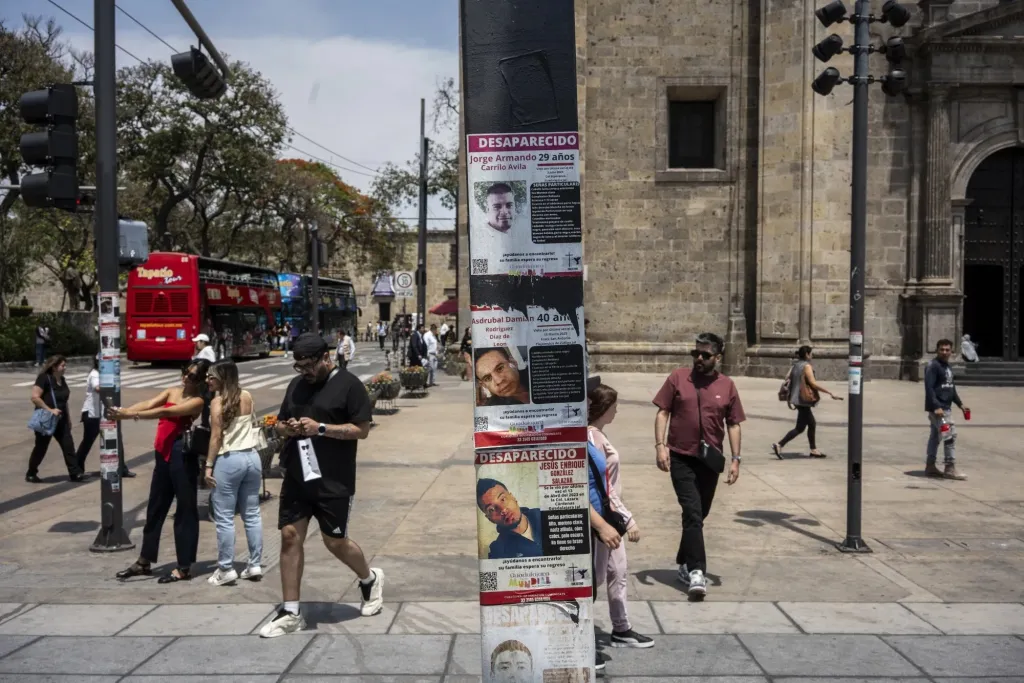
Many Mexicans still are. Given the heightened security, soccer fans will likely feel safe, but locals caught up in the violence are still disappearing. With buckets of glue in hand, families and friends have taken to pasting images of the victims across the city to make sure they’re not forgotten.
“They’re giving so much attention to the World Cup,” said Hilda Villalobos Tinoco, 49, whose son never came home after a dawn motorcycle ride in March. “How long does it take for them to pay attention to us?”
Anti-World Cup protesters say the security crisis is afflicting working-class Mexicans who won’t be in the stands. Instead of repairing stadiums, remodeling airports and adorning public squares with decorative soccer balls, they say the government should channel scarce resources into addressing the country’s social plight.
The World Cup is no stranger to protests. In Brazil in 2014, residents turned out ahead of the games demanding an end to corruption after what they saw as lavish spending on stadiums. South Africa’s 2010 tournament was preceded by the police’s use of rubber bullets and tear gas to put down labor strikes after a similar public outcry.
Asked at a recent press conference whether police would block protests outside stadiums during the tournament, Interior Minister Rosa Icela Rodríguez said, “In Mexico, there’s freedom of expression.”
Beefed-Up Security
Mexico’s President Claudia Sheinbaum, whose administration has made security a government priority, assured tourists in February there’s “no risk.”
The federal government has designated some 99,000 security forces for Guadalajara, Mexico City and Monterrey, where the games will be played. Jalisco has upgraded its camera systems to better track players and fans. A one-mile perimeter around the stadium is designed to keep out anyone without a ticket. Expanded private security will patrol inside to quell any stadium brawls.
“We know there are fans coming from all over Mexico. We also know there are Spaniards, Colombians, Americans. There are also Uruguayans,” said Alfonso Briseño Torres, a Jalisco official on a 2026 World Cup security committee that has sought to reassure foreign diplomats. “We met with consuls and ambassadors, and they left convinced that, in Jalisco, we’re doing the right things to guarantee security.”
That confident assertion will be tested in Guadalajara, a bustling metropolitan area that hosts Michelin-starred restaurants, famous stained-glass churches and affluent gated communities. Zapopan alone includes some of the wealthiest zip codes in Mexico. It’s also a landscape dotted with unmarked graves — and the people looking for them.
Read more Local product Wade Meckler injects life into Angels’ lineup
Villalobos realized something was wrong when her 31-year-old son, Giovanni Luna Villalobos, didn’t show up to eat pozole corn soup at her birthday party. Security cameras showed him wheeling his motorbike to a fuel station. Cellphone records later located his phone a few blocks from an upscale mall in Zapopan.
With the help of other parents and Jalisco’s official search commission, Villalobos has glued posters near the mall and along an avenue closer to home – noting her son’s 5’ 10” athletic build, the freckles on his nose and the ‘only God can judge me’ tattoo inked in green on his neck. But she hasn’t received any news and blames authorities for neglecting the case.
“I called him again and again, and it just went to voicemail,” she said. “The days pass, the hours pass, but I don’t believe that my son is dead.”
Grassroots associations have made sure the posters of the disappeared are visible even at tourist sites, including outside a 17th century cathedral and on bollards at a central roundabout featuring a Roman goddess statue where Mexican soccer fans often celebrate. A call by local lawmakers to take down the posters has gone unheeded.
In Mexico, the last large-scale security mobilization occurred in 2025, after the murder of a mayor in another state. That year, the association to which Villalobos now belongs, Guerreros Buscadores de Jalisco, ignited a national scandal after they found backpacks, shoes and bone fragments at a ranch outside the city, signs of forced recruitment and assassinations.
Since then, the group has found more mass grave sites, including some they say are only around 15 kilometers (9.3 miles) from the stadium.
Awaiting the Windfall
Zapopan Mayor Juan José Frangie Saade, a businessman and former head of the beloved Chivas soccer team that usually plays in the local stadium, believes the games will bring the state a windfall of some 30 billion pesos ($1.7 billion).
Infrastructure works have accelerated, he said. Airport operator Grupo Aeroportuario del Pacífico, for example, has pledged to invest 26 billion pesos in the Guadalajara and Puerto Vallarta airports through 2029. Throngs of fans are expected to turn out at festivals that include pop-rock band Maná and Mexican crooner Alejandro Fernández, allowing money to trickle through to small businesses.
“Soccer is a sport that brings us together,” Frangie said. “We say Jalisco is the most Mexican location because, what are we known for in the world? Tequila, mariachi, folklore, charrería horse riding and gastronomy.”
But the games are likely to profit criminal organizations too. Jalisco Nueva Generación has an economic incentive to serve tourists, said Victor Manuel Sánchez Valdés, a researcher at the Autonomous University of Coahuila.
“There’s a fear that there could be violent actions at the World Cup, and while we can’t completely ignore such a scenario, the economic incentive is greater than the desire to generate violence,” Sánchez said. “Organized crime wants a chunk of the economic benefit that’s going to come to the legal economy. Tourist areas have the big-ticket spenders.”
Fernando García de Llano Valenzuela, a developer who opened a nine-story hotel with panoramic views in the Guadalajara area in December, had a single guest for days after the killing of the cartel boss earlier this year. His high-end boutique hotel in Puerto Vallarta also stood empty in March. By April, he finally saw signs of a comeback.
“There’s a perception that there might be danger, but nothing’s going to happen in this city,” he said in April, sitting at his hotel’s rooftop bar in Zapopan. “It’s like anywhere else in the world. There are parts of the city that are dangerous, but you’d have to go to them – and a tourist doesn’t have any reason to.”
If the World Cup goes smoothly, García de Llano envisions Guadalajara emerging as one of the world’s top tourist destinations, similar to Barcelona’s transformation after the 1992 Summer Olympics.
“People’s passion for soccer is huge. I’d like to think that whoever was afraid in February or March, wasn’t by April,” he said, adding that as the games approach, they were looking for a way to get to the city.
Read more Hezbollah rejects latest ceasefire agreement as Israeli strikes kill 4 in Lebanon
More stories like this are available on bloomberg.com
©2026 Bloomberg L.P.