
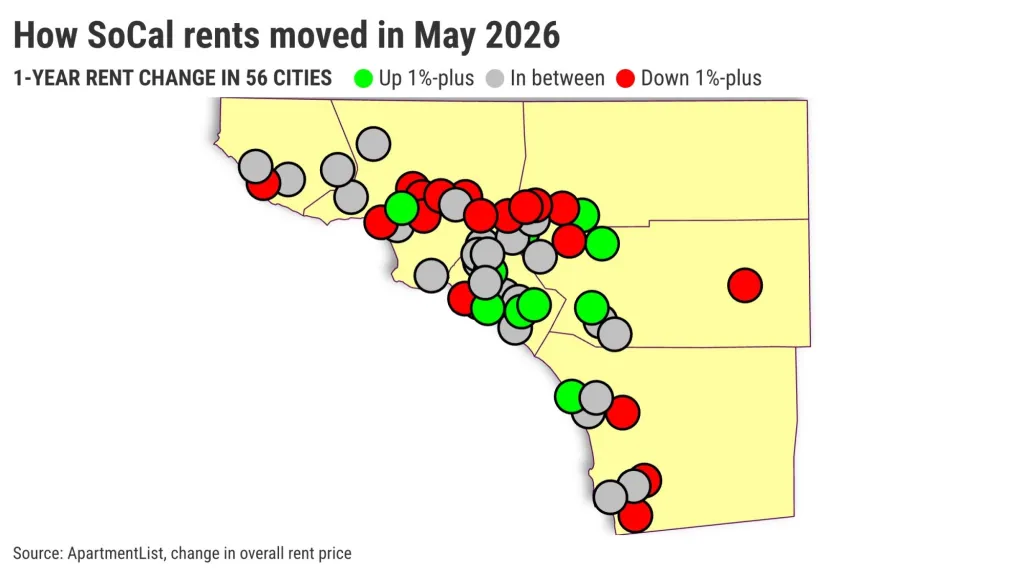
Rents are dropping in about two-thirds of Southern California cities, and the biggest breaks are showing up where prices were already on the lower side.
Read more Security planners brace for unprecedented threats as millions head to 11 US World Cup cities
My trusty spreadsheet reviewed May’s rent report from ApartmentList, which tracks what landlords charge in 56 cities across the region. These price estimates, a combination of government statistics and ApartmentList’s listing data for apartments and houses, tracked the overall one-year change in rents for one- and two-bedroom units.
In the past year, rents dropped in 35 cities, climbed in 30, and held steady in just one. That equals 63% of all cities down in a region where typical rents slipped by 1 percent. Monthly costs run $1,934 for a one-bedroom unit and $2,365 for a two-bedroom.
When the 56 cities were ranked by how much rents changed and then split into three groups, it was clear where renters were most likely to see landlords trim what they charge.
In the cities with the steepest rent cuts, a typical one-bedroom went for $1,734. In the places with the biggest hikes, that same apartment costs $2,253. That’s a 23 percent gap.
For two-bedrooms, the median was $2,173 in the cities with the biggest drops, while it hit $2,673 where rents jumped the most. That’s 19 percent cheaper.
This price gap hints that higher-income areas are still flexing more economic muscle.
Landlords across the region are finding it tougher to hike rents. The job market feels shaky, and all those new homes mean more empty rentals to fill.
These stats show the challenge gets even harder in places where both rents and paychecks are on the smaller side.
Market moves
You can see this economic divide in the past year’s rent swings. Only Orange County – Southern California’s priciest rental market – saw typical rents go up.
Here is how rents moved, geographically speaking, ranked by share of cities wth declining prices:
– San Diego County: 88% cities with declines, 7 of 8, to a 1% median decline with median pricing of $1,864 for one-bedroom units and $2,247 for two.
Read more Philly-style dessert shop coming to Downtown Disney
– Los Angeles County: 86% declines, 12 of 14 cities to a 2% median decline with $1,846 one-bedroom units and $2,365 for two.
– Ventura County: 80% declines, 4 of 5 cities to a 1% median decline with $2,158 one-bedroom units and $2,597 for two.
– Inland Empire: 62% declines, 8 of 13 cities to a 1% median decline with $1,707 one-bedroom units and $1,951 for two.
– Orange County: 25% declines, 4 of 16 cities to a 1% median increase with $2,270 one-bedroom units and $2,698 for two.
Counting cities
Look at where prices swung the most, by city.
Three of the five largest rent drops occurred near the areas where the January 2025 Los Angeles wildfires hit. It looks like the rush for rentals from displaced families has faded.
– Pomona: 6.7% median decline with $1,489 one-bedroom units and $1,879 for two.
– Santa Monica: 6.7% median decline with $2,212 one-bedroom units and $2,651 for two.
– Pasadena: 5.3% median decline with $2,100 one-bedroom units and $2,702 for two.
– Chula Vista: 4.2% median decline with $1,712 one-bedroom units and $2,240 for two.
– Glendale: 3.4% median decline with $1,841 one-bedroom units and $2,369 for two.
On the flip side, three of the five biggest rent hikes this year showed up in Orange County.
– Aliso Viejo: 7% increase with $2,797 one-bedroom units and $3,303 for two.
– Newport Beach: 4% increase with $2,846 one-bedroom units and $3,535 for two.
– Colton: 4% increase with $1,411 one-bedroom units and $1,742 for two.
– Mission Viejo: 3% increase with $2,410 one-bedroom units and $2,898 for two.
– Chino: 2% increase with $1,707 for one-bedroom units and $2,187 for two.
Jonathan Lansner is the business columnist for the Southern California News Group. He can be reached at [email protected]
Read more What it’s like to go inside New York City’s dank, dangerous, bug-filled sewers
- Try Jonathan Lansner’s Substack collection of economic trends. CLICK HERE!