
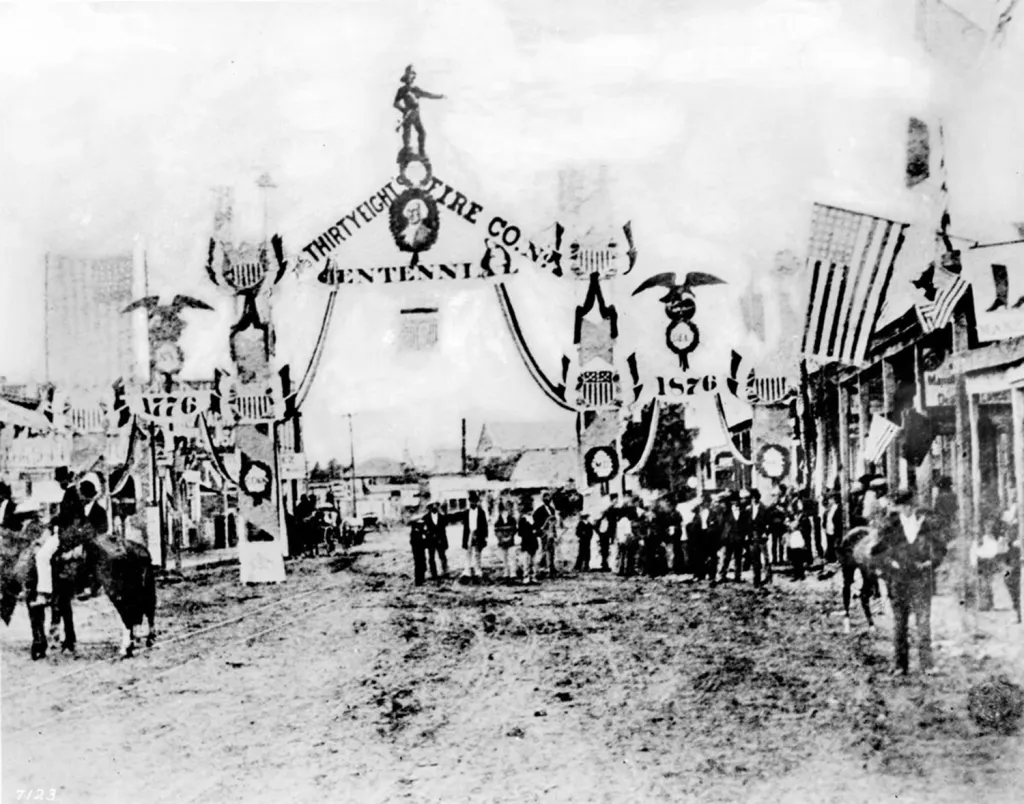
Americans love to celebrate the birth of their country, and the first centennial celebration in 1876 was the biggest party in the nation’s 100-year history.
Read more Why the Toyota RAV4 is suddenly the most coveted used car in America
From isolated prairie gatherings to enormous parades in big cities, Americans made Fourth of July that year into a multi-day or even a months-long party draped in patriotism.
It was a pivotal year in which the United States announced its emergence as an industrial, technological, and cultural global power. It was a year filled with inventions, major projects, and a growing population.
The Union grew as well, welcoming Colorado as the 38th state on Aug. 1, 1876.
Californians were feeling especially patriotic in 1876 because the Transcontinental Railroad had reached the Golden State only seven years prior, and they had a strong desire to prove their patriotism and strengthen their connection to the rest of the country.
Southern Californians celebrated a major milestone on Sept. 5, 1876, when the Southern Pacific Railroad completed its line from Los Angeles to the San Joaquin Valley.
Charles Crocker, president of the Southern Pacific drove a golden spike at the completion ceremony at Lang Station in Soledad Canyon, near today’s Santa Clarita. Thousands were there to witness the long-awaited connection of Southern California to the rest of the country
Most cities across the country held some special Fourth of July celebration during the centennial, and many newspapers placed their town in an unofficial local competition for the title of the best, most extravagant, or most patriotic event.
Los Angeles threw a centennial sized July Fourth party highlighted by a parade that started near what is now the intersection of Fourth Street and Broadway. The enormous parade was divided into four sections, arranged to showcase different aspects of the city and country. Those four were:
Division 1: Citizens and civil societies consisting of local civic and cultural organizations.
Division 2: The Los Angeles fire brigade featuring the city’s firefighters decked out in colorful uniforms, and firefighting equipment covered with flowers and horses in festive trimmings.
Division 3: Dignitaries and military personnel including the mayor, city council, and military groups.
Division 4: Citizens and participants included members of the public and businesses in the area. Interestingly, many businesses had large wagons with moving displays. The Page and Gravel Company provided a wagon with more than a dozen artisans demonstrating their skills in the wagon-making and blacksmithing trade.
The parade culminated at the Round House Gardens where citizens and dignitaries performed patriotic readings.
San Bernardino was the largest town in the inland region in 1876, and the city held a centennial celebration that included a parade, fireworks, and other festivities.
Read more Car owners shocked by $200 fill-ups are embracing used EVs
The June 26 edition of the San Bernardino Daily Times Index described excitement in the city.
A colonel was on a test run on a steam-powered wagon included in the July Fourth parade as a “novelty item.” Amused by the spectacle, the article says “Those who had never seen a steam wagon were under the impression that it was either a locomotive out on a general rampage, or the much desired railroad coming over land on its own hook.”
A description of the centennial Fourth of July celebration in the Daily Times included a parade with marching bands, a volunteer portraying “The Goddess of Liberty,” San Bernardino County Supervisors, baseball clubs, and artillery, followed by a picnic and fireworks.
The artillery mentioned was presumably the town’s 1818 cannon that was fired in previous Independence Day celebrations. The cannon had a storied past, but in more recent years, it had been relegated to celebratory firings. The old iron relic is now on display at the San Bernardino Historical Society’s facility at the corner of 8th and D streets in San Bernardino.
The Centennial International Exhibition in Philadelphia was the country’s largest and most extravagant celebration.
The six-month exhibition ran from May 10 to Nov. 10, 1876, and it was the first World’s Fair held in the United States.
Nearly 10 million tickets were sold — an extraordinary number considering the population of the U.S. at the time was only about 46 million.
President Ulysses S. Grant formally opened the exhibition on May 10, by delivering a welcome speech to a crowd of more than 100,000. Grant then went to the Machinery Hall where he and Dom Pedro II, emperor of Brazil, activated the massive 1,400 horsepower Corliss Steam Engine that powered the fair’s exhibits.
The Centennial Exhibition was built on a sprawling 285-acre fairground, and featured more than 250 new structures, anchored by five huge architectural showpiece buildings. New inventions like Alexander Graham Bell’s prototype telephone receiver, the Remington Model 1 typewriter, and an early version of the electric arc lamp were there.
The completed torch arm of the under-construction Statue of Liberty was also unveiled and on display at the exhibition.
Events at the U.S. Centennial Exhibition’s Independence Day celebration in Philadelphia provided some key moments that drew the country together on that special Fourth of July.
Just 11 years after the end of the Civil War, the U.S. Centennial Exhibition held a huge ceremony at Independence Square where officials rang a newly cast Liberty Bell forged from melted-down Union and Confederacy artifacts. The reforged bell literally transformed instruments of a divided nation into a symbol of American unity.
Mark Landis is a freelance writer for the Sun. He can be reached at: [email protected]
Read more War in the Middle East is flaring again. Here’s how each side sees the stakes